Battery Recycling and Second-Life BESS in India: 2026 Market, Policy and Economics
By Sudarshan Karweer · sudarshan@growthifye.com · +91 84510 99371 (Call / WhatsApp) · 2026-08-25
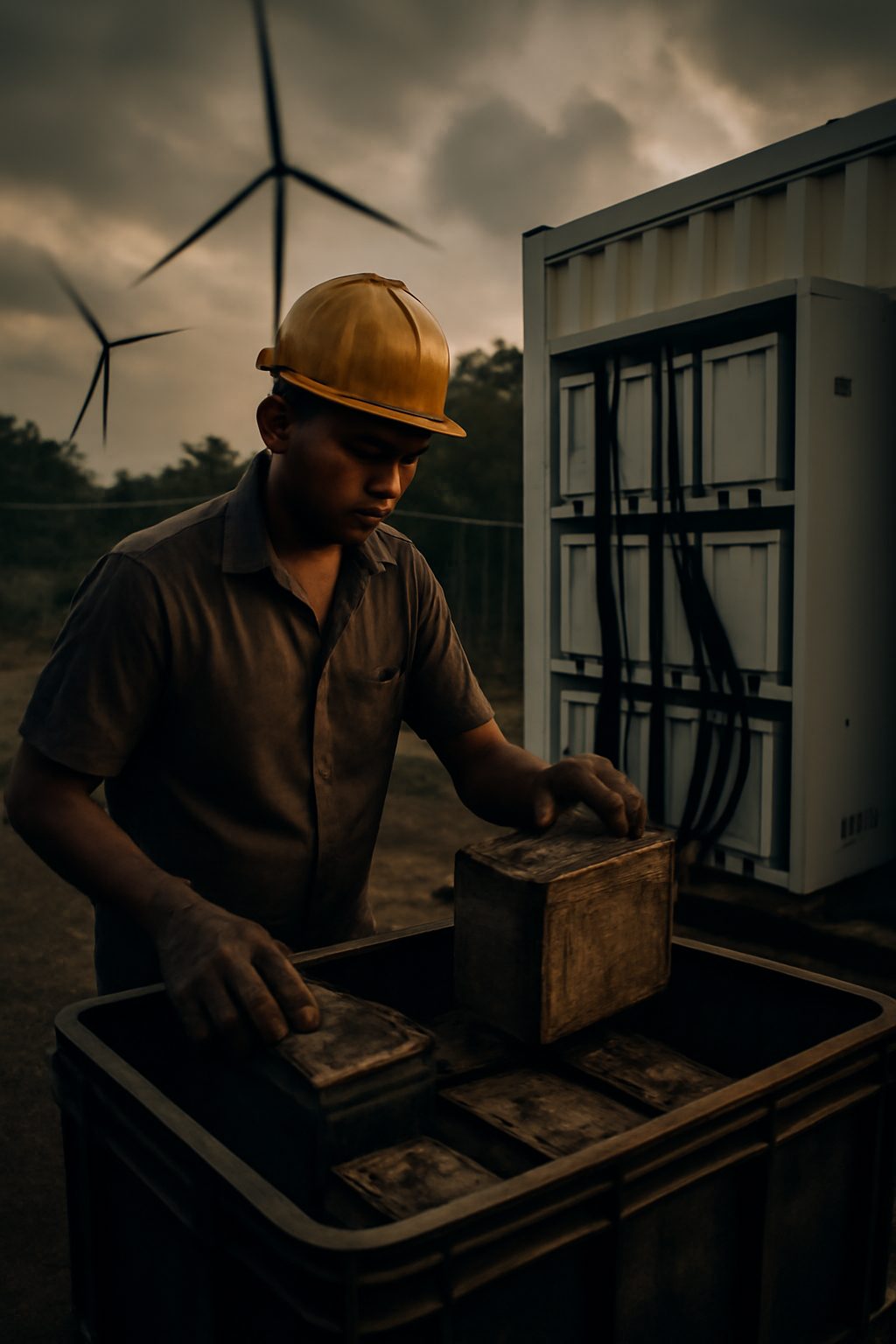
India’s battery economy is moving from a future theme to an operating reality. For commercial and industrial power users, renewable-energy developers, lenders, discoms and policymakers, 2026 is the year when battery circularity stops being a compliance side note and becomes a bankability issue. The core reason is simple: battery volumes are rising fast across electric mobility, behind-the-meter storage, utility-scale BESS and telecom backup systems, while raw-material imports remain strategically sensitive and expensive.
In this context, battery recycling and second-life battery energy storage systems, or second-life BESS, are no longer niche topics. They sit at the intersection of energy security, project economics, ESG performance, extended producer responsibility, domestic manufacturing and power-system flexibility. India now has enough policy structure, enough early project data and enough corporate pressure on supply chains to move from pilot thinking to portfolio thinking.
This article looks at the 2026 Indian market through a practitioner lens: where the battery waste will come from, how recycling economics work, when second-life BESS is technically and commercially viable, what lenders need to diligence, and how project sponsors should structure procurement and offtake decisions.
Why battery circularity matters in India in 2026
India’s battery demand is being shaped by three parallel trends.
- EV adoption is increasing across two-wheelers, three-wheelers, buses and fleet applications.
- Grid-scale and C&I storage procurements are rising as solar and wind penetration increases and time-of-day tariffs become more relevant.
- Domestic cell and pack assembly are expanding under industrial policy support, but raw-material dependence remains high.
For the power sector, this creates a practical challenge. Batteries are not one-time capex assets in a linear supply chain. They generate end-of-life liabilities, residual value opportunities and performance risks that affect project IRRs, debt sizing and O&M assumptions.
By 2026, many lithium-ion batteries deployed in early e-mobility and stationary applications are beginning to reach repurposing or recycling decision points. At the same time, battery chemistry choices are widening. LFP remains strong in mobility and stationary applications because of safety and cycle-life advantages, while NMC and related chemistries continue to matter where energy density is critical. This chemistry mix directly affects circularity economics because recoverable material value differs significantly between cobalt-rich and iron-phosphate systems.
For India, the strategic value of circularity is not only environmental. It is also about reducing exposure to imported lithium salts, nickel, cobalt and graphite value chains, improving domestic material recovery, and creating a reliable stream of secondary feedstock for future battery manufacturing.
Policy and regulatory landscape: what market participants should track
The policy backbone in India is now clearer than it was even two years ago. The Battery Waste Management Rules, 2022, continue to anchor producer obligations, collection, tracking and environmentally sound recycling, and their implementation architecture has become much more consequential in 2026 as compliance scrutiny tightens. Producers, importers and brand owners are under growing pressure to demonstrate traceability, authorised recycler tie-ups and target fulfilment.
For market participants, five policy points matter most.
- Extended Producer Responsibility, or EPR, is no longer theoretical. Producers need audited collection and recycling pathways, and downstream counterparties increasingly ask for digital traceability.
- CPCB and state pollution control compliance is central to recycler selection. Informal or weakly documented channels create legal, insurance and reputational risk.
- Hazardous waste handling norms and transport documentation affect logistics costs and turnaround times, especially for damaged or low state-of-health batteries.
- Domestic manufacturing policies, including ACC-linked incentives and related industrial measures, indirectly improve the business case for secondary material recovery by creating future local demand.
- Power-sector procurements increasingly ask for lifecycle disclosures, making circularity relevant to utilities and C&I buyers even before end-of-life occurs.
There is also a financing implication. Lenders are beginning to request clearer assumptions on end-of-life value, decommissioning reserves, reverse logistics and recycler agreements. This is especially true where BESS projects are built on aggressive residual-value assumptions or where imported equipment dominates total capex.
From a policymaker perspective, the next frontier is standardisation. India still needs stronger and more widely accepted protocols for battery testing, grading, second-life certification, transport of used batteries, fire-safety rules for repurposed packs, and material accounting standards. Without these, second-life adoption can be slowed by uncertainty even where the economics are attractive.
Recycling economics: where the value really sits
Battery recycling economics in India are often oversimplified. The real equation depends on chemistry, collection quality, logistics distance, discharge and dismantling requirements, process yield, recovered material purity, commodity prices and plant scale.
A practical way to understand this is to separate three value pools.
- Collection and aggregation value: who controls access to battery waste volumes.
- Processing value: who can safely discharge, dismantle, shred and refine material at high recovery rates.
- Product value: who can monetise black mass, recovered lithium compounds, nickel, cobalt, manganese, copper, aluminium and graphite.
For chemistries such as NMC, recoverable metal value can support stronger recycler margins, especially when commodity prices are favourable and hydrometallurgical recovery is efficient. For LFP, the absence of cobalt and lower nickel content mean the economics are tighter and rely more on scale, process efficiency, logistics optimisation and future lithium recovery pathways. This is one reason why India’s recycler business models in 2026 are increasingly focused on long-term supply contracts rather than spot procurement.
At the project level, collection and logistics are frequently underestimated. In India, reverse logistics can range widely depending on geography, battery form factor and hazard classification. Small EV packs aggregated from distributed points behave very differently from utility-scale stationary battery racks collected from one site. The cost per kWh of retrieval and safe transport can materially change realised margins.
Processing economics also vary by technology route.
- Pyrometallurgical routes can be robust for mixed feedstocks but may lose more lithium and require additional refining stages.
- Hydrometallurgical routes usually offer better recovery potential for critical materials and are gaining preference where high-purity outputs matter.
- Direct recycling pathways are promising but still less mature commercially and require tighter feedstock control.
For lenders and investors, the key diligence question is not whether a recycler has capacity on paper. It is whether that capacity is feedstock-secured, chemistry-matched, compliant, yield-validated and linked to paying offtakers.
In India, a recycler claiming 10,000-20,000 tonnes per annum of processing capacity is not automatically bankable unless its feedstock agreements, environmental approvals, recovery yields and product sales contracts are visible. This is especially important because recycling margins can narrow quickly when battery prices fall, commodity spreads compress or low-quality mixed feedstock increases handling complexity.
Second-life BESS: when reuse beats recycling
Second-life BESS refers to batteries first used in another application, most commonly EVs, being repurposed for stationary energy storage after their initial useful life ends. In principle, this is attractive because many batteries retired from mobility still retain around 70-80 percent of their original capacity, depending on usage patterns, thermal history and degradation profile.
But second-life does not work everywhere. The value proposition depends on use case.
Applications in India where second-life BESS can make sense include:
- Behind-the-meter peak shaving for C&I facilities with sharp demand spikes.
- Solar self-consumption improvement where backup-grade resilience is sufficient.
- EV charging stations needing limited-duration buffering.
- Telecom and tower applications where runtime and reliability thresholds are manageable.
- Rural or edge-grid microgrids where low capex matters more than premium performance.
Applications where second-life is more difficult include:
- Frequency-response or high-performance ancillary services requiring tight response consistency.
- Long-term utility procurements with strict availability guarantees.
- High-cycling merchant storage models where degradation uncertainty is heavily penalised.
- Sites with very stringent fire-safety, warranty and insurer requirements unless pack remanufacture quality is demonstrably strong.
The commercial appeal comes from lower upfront battery cost. In 2026, new stationary lithium-ion system prices in India vary substantially by scale, duration, import content, PCS configuration, thermal management and EPC scope, but a 2-hour utility-scale BESS can still imply all-in installed costs that require careful dispatch value capture to be viable. Second-life systems can reduce battery-related capex meaningfully, but the discount only matters if usable life, round-trip efficiency and O&M risk are properly understood.
A second-life BESS project should never be underwritten on nameplate assumptions alone. It must be underwritten on tested usable energy, expected fade, thermal behaviour, balancing requirements, BMS integration quality and warranty enforceability.
As a rule of thumb, second-life BESS economics improve when:
- The application has modest cycling intensity.
- Time-of-day tariff arbitrage spreads are real and recurring.
- Backup power value is high.
- The buyer accepts shorter warranties or performance bands.
- The system can be modularly replaced and expanded.
For Indian C&I users, the most practical use case in 2026 is often not pure arbitrage. It is a hybrid value stack: demand-charge reduction, solar shifting, diesel displacement during outages, and limited backup resilience. In states or customer categories where time-of-day tariff differentials are widening, this can become material.
Commercial models, tariffs and bankability considerations
The biggest mistake in circularity projects is treating them as technology stories rather than contracted cash-flow stories. Whether the asset is a recycling plant or a second-life BESS portfolio, the questions that matter are revenue visibility, operational risk allocation and counterparty strength.
For second-life BESS in C&I applications, bankability generally improves under one of the following structures.
- A long-term energy service model with minimum savings guarantees.
- A storage-as-a-service structure bundled with rooftop or open-access renewable supply.
- A captive or group-captive deployment where the host values resilience and demand management beyond pure tariff arbitrage.
- A utility or public-sector pilot with viability support and standardised performance metrics.
In many Indian markets, standalone arbitrage remains thin unless there is a strong difference between charging and discharging periods. For example, if a facility can charge from low-cost solar or lower-priced off-peak power and avoid expensive evening demand or diesel generation, the spread can be commercially useful. If the spread is narrow and cycling is frequent, second-life degradation uncertainty can erase the margin.
For lenders, a serious diligence checklist should include:
- Source and traceability of used batteries.
- Independent state-of-health testing methodology.
- Cell matching and pack remanufacturing standards.
- Fire detection, suppression and thermal management design.
- Warranty terms from integrator and component suppliers.
- Availability guarantees and liquidated damages.
- End-of-second-life recycler tie-up and residual-value assumptions.
- Insurance acceptance and premium impact.
For recyclers, project finance viability depends on feedstock security and offtake clarity. A plant may look attractive at a modelled EBITDA level, but if feedstock comes from fragmented channels without enforceable agreements, utilisation risk can be severe. In India, the most financeable recycling platforms in 2026 are those with combinations of OEM tie-ups, producer compliance flows, fleet relationships, and large-format battery handling capability.
Key risks for developers, OEMs, utilities and policymakers
Battery circularity can create value, but it also brings execution risks that are often understated.
The first is data risk. Many batteries entering repurposing channels do not have complete operating histories, making state-of-health estimation less reliable. Inconsistent data affects grading accuracy and warranty pricing.
The second is safety risk. Used lithium-ion batteries, especially those with unknown abuse history, can present thermal runaway hazards during transport, storage, disassembly and repurposing. This is not a side issue. It directly affects insurability, site permitting and lender confidence.
The third is technology obsolescence. If prices of new batteries continue to decline faster than expected, second-life BESS can lose its capex advantage. This is particularly relevant for low-value chemistries unless remanufacturing and integration costs are tightly controlled.
The fourth is policy-enforcement risk. Strong rules exist, but uneven enforcement can allow informal operators to undercut compliant recyclers on price. Over time, however, regulated buyers and financiers are likely to favour formal channels, especially for large projects.
The fifth is revenue concentration. Some recyclers depend excessively on a narrow chemistry mix or a small number of offtakers for recovered materials. This increases business volatility.
For policymakers, the response should focus on standardisation and market confidence.
- Create clearer protocols for battery grading and second-life certification.
- Strengthen digital traceability through the full battery lifecycle.
- Tighten safety norms for storage, transport and repurposing facilities.
- Support R&D and pilot validation for LFP recycling economics, which will become increasingly important for India.
- Encourage public procurement frameworks that evaluate lifecycle value rather than upfront equipment cost alone.
What Indian market participants should do now
For C&I consumers, the immediate step is to treat storage procurement and battery end-of-life strategy as linked decisions. If you are evaluating BESS in 2026, ask not only about capex and LCOS but also about warranty transferability, residual value, recycler access and replacement planning.
For renewable developers, circularity clauses should be built into EPC and supply contracts now, not added later. This includes battery passports, data access, decommissioning support and end-of-life handling obligations.
For OEMs and producers, EPR compliance should be integrated with channel strategy. The lowest-cost route on paper may become the highest-risk route if traceability and authorised processing are weak.
For lenders and infrastructure investors, circularity should sit inside technical and legal diligence rather than being treated as an ESG appendix. In battery projects, residual-value assumptions, recycler contracts and performance testing protocols can materially change downside protection.
For utilities and policymakers, the opportunity is larger than waste management. A well-structured circular battery ecosystem can reduce import dependence, improve storage affordability, support domestic manufacturing and create safer, more formal waste-value chains.
India is still early in this transition, but the direction is clear. Battery recycling will become a strategic industrial capability, and second-life BESS will find commercially viable niches where performance requirements match repurposed asset profiles. The winners will be those who combine engineering discipline, contract design, compliance readiness and realistic underwriting.
If your organisation is evaluating battery recycling partnerships, second-life BESS deployment, EPR strategy or circularity-linked project finance, contact Growthifye’s advisory desk for a practical assessment of policy, engineering, commercial structure and bankability.
About the author

Chief Executive Officer, Growthifye — With over 23 years in management consulting, Sudarshan has taken businesses from concept to scale — building and scaling new-age digital and energy businesses.
- 23+ years in management consulting
- EY alumnus
- Led large-scale BESS programmes, capital raises and advisory mandates
Want this analysis applied to your project?
Talk to our team