
Insights, one frame at a time.
Every infographic we publish on LinkedIn, organised by topic — tariffs & ToD, storage, solar, grid technology and more.
 Company Updates
"If I add a battery to my captive solar plant, will my Contract Demand go up?" I've been getting this question a lot since MERC released its 2026 draft regulations. 🔋 Short answer: not if the battery sits at the plant. Take a typical case. A 10 MW solar group-captive plant wheels power to a factory far away, with a 5 MW load and 6 MVA Contract Demand. The midday surplus is exactly the energy that loses its banking benefit under the new slot-based rules. So where should a 5 MW / 12 MWh battery go? ✅ Behind the meter at the generation end → No Contract Demand increase. A co-located battery charg
24 Sept 2026, 08:21 am
 Company Updates
Maharashtra just rewrote the rulebook for solar, storage and open access. 🔋 MERC has released six draft regulations: GNA, Distribution Open Access, Rooftop RE, a brand-new BESS regulation, the DSM amendment and the RPO amendment. Together they put the 2025–36 RE & Energy Storage Policy into law. I went through all of them and turned them into a 40-question FAQ for developers, C&I consumers, DISCOMs and investors. A few things that stood out: → Storage is now mandatory. Rooftop or BTM RE above 100 kW, and new RE connectivity, must carry ESS: 1 kWh per kW up to 2030, 2 kWh per kW after. → 07:00–
24 Sept 2026, 08:02 am
 Company Updates
⚡ Battery Storage Is No Longer a “4-Hour Technology” Conversation. The global energy storage market is entering its next phase. Lithium-ion, particularly LFP, has dominated the last decade. But as renewable penetration rises and grids become more complex, storage requirements are moving from 2–4 hours toward 6, 8, 12 hours and beyond. Our Growthifye Battery Technology Outlook 2026–2035 highlights some striking trends: 🔋 600+ GWh Li-ion storage deployed globally 📈 BESS installations grew nearly 20× in five years 💰 Li-ion system costs fell around 61% from 2020–25 ⚡ ~75% of the 4+ hour pipeline i
21 Sept 2026, 03:46 pm
 Company Updates
⚡ 5 costly mistakes that derail 400 kV | 220 kV | 132 kV projects In EHV transmission and solar power evacuation projects, failures rarely come from complex engineering. They come from gaps in planning, coordination, procurement and execution, and the same five keep showing up: 1️⃣ Starting construction before engineering is fully coordinated A minor design change in a 400 kV substation ripples across civil, electrical, protection, telecom, SCADA and cable routing. → Freeze critical engineering interfaces before construction begins. 2️⃣ Poor planning of long-lead equipment Transformers, GIS/AI
20 Sept 2026, 03:38 pm
 Company Updates
Charge at ₹3. Own the 9 PM grid. India's power market has two prices now. One while the sun is up, another after it sets. I went through IEX day-ahead data from May to September 2026. The all-hours average looks calm at ₹4.9–5.2 a unit. The shape inside the day is not: 09:00–17:00 cleared at about ₹1.66 in May and ₹1.67 in July 18:00–21:00 averaged ₹7.82 in May and ₹7.50 in July 21:00–23:00 averaged ₹9.18 in May and ₹9.45 in July By late August both evening windows were above ₹9 From 1–20 September, 399 of 400 evening blocks cleared at the ₹10 cap Now the storage maths. Fill the battery with ₹
20 Sept 2026, 12:34 pm
 BESS & Storage
Maharashtra’s RE & ESS Policy 2025–26 to 2035–36 is a clear signal of where the energy transition is headed: storage is no longer optional — it is becoming integral to renewable energy development. The recently clarified FAQ framework brings sharper direction for developers, investors, utilities and consumers by addressing some of the most important implementation questions around renewable energy + energy storage systems (ESS). Key takeaways: ⚡ Mandatory storage requirement for new RE projects above 100 kW ⚡ Baseline requirement of 1 MWh of BESS per MW of connectivity ⚡ Flexibility in BESS si
18 Sept 2026, 10:36 am
Ganpati Bappa Morya! 🌿 Every year, Lord Ganesha arrives to remove obstacles and leaves, returning to the water that gives us life. This year, let's make sure what we return to the water is as pure as what we take from it. At Growthifye, we spend our days helping India store sunlight and shift power to when it's needed most. The lesson of Ganesh Chaturthi is not so different: take from nature with gratitude, and give back with care. A few small choices that go a long way this festive season: 🪔 Clay idols over plaster of Paris, so immersion nourishes rather than pollutes 🌸 Natural colours and fl
14 Sept 2026, 01:38 pm
 Company Updates
Our new website is live. Ten slides on what's behind it. 👇 growthifye.com is now one place for everything we do: RE and energy storage advisory and engineering, EPC, transmission network engineering, green financing and debt syndication, and power infrastructure for data centres. The deck walks through it: → Why now — 50+ GWh of BESS tenders expected in India this year, 378 live on our tracker today → What we build — five services, one accountable partner → Proof of delivery — 500+ MWh of grid-scale BESS implemented, a 3+ GWh bidding portfolio, 14% CAPEX saved on a 480 MWh standalone system →
28 Aug 2026, 06:36 am
Our new website is live: https://www.growthifye.com When we started Growthifye, the pitch was simple and slightly unfashionable: most clean-energy projects don't fail on ambition, they fail somewhere between the spreadsheet and the substation. A storage system sized on rules of thumb. A grid connection stress-tested too late. A model that looks bankable until a lender opens the assumptions tab. So we built the firm to sit in that gap. We design the asset, size the storage, engineer the evacuation, then structure the debt that gets it built. Engineering-led, all the way to financial close. The
27 Aug 2026, 03:50 pm
 BESS & Storage
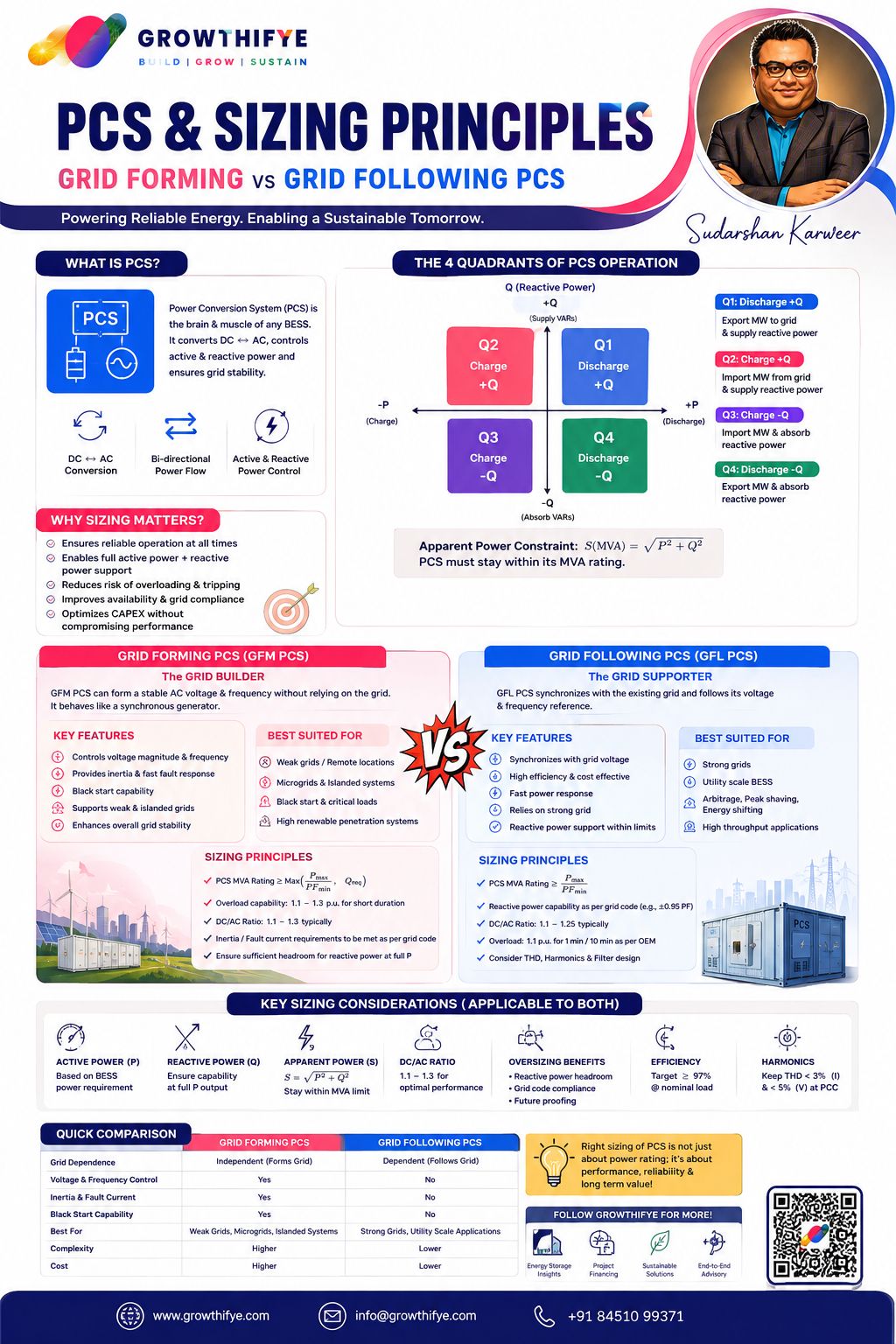
⚡ PCS is not just the inverter of a BESS. It is increasingly becoming the interface between the battery and the grid. As Battery Energy Storage Systems scale rapidly, one design decision deserves much more attention: How should the Power Conversion System (PCS) be selected and sized? A PCS does far more than convert DC ↔ AC. It determines how effectively a BESS can: 🔹 Charge and discharge active power 🔹 Supply or absorb reactive power 🔹 Operate across all four P–Q quadrants 🔹 Support grid voltage and frequency 🔹 Respond to disturbances 🔹 Manage harmonics and power quality 🔹 Deliver grid-suppor
26 Aug 2026, 01:30 am
 Data Centres
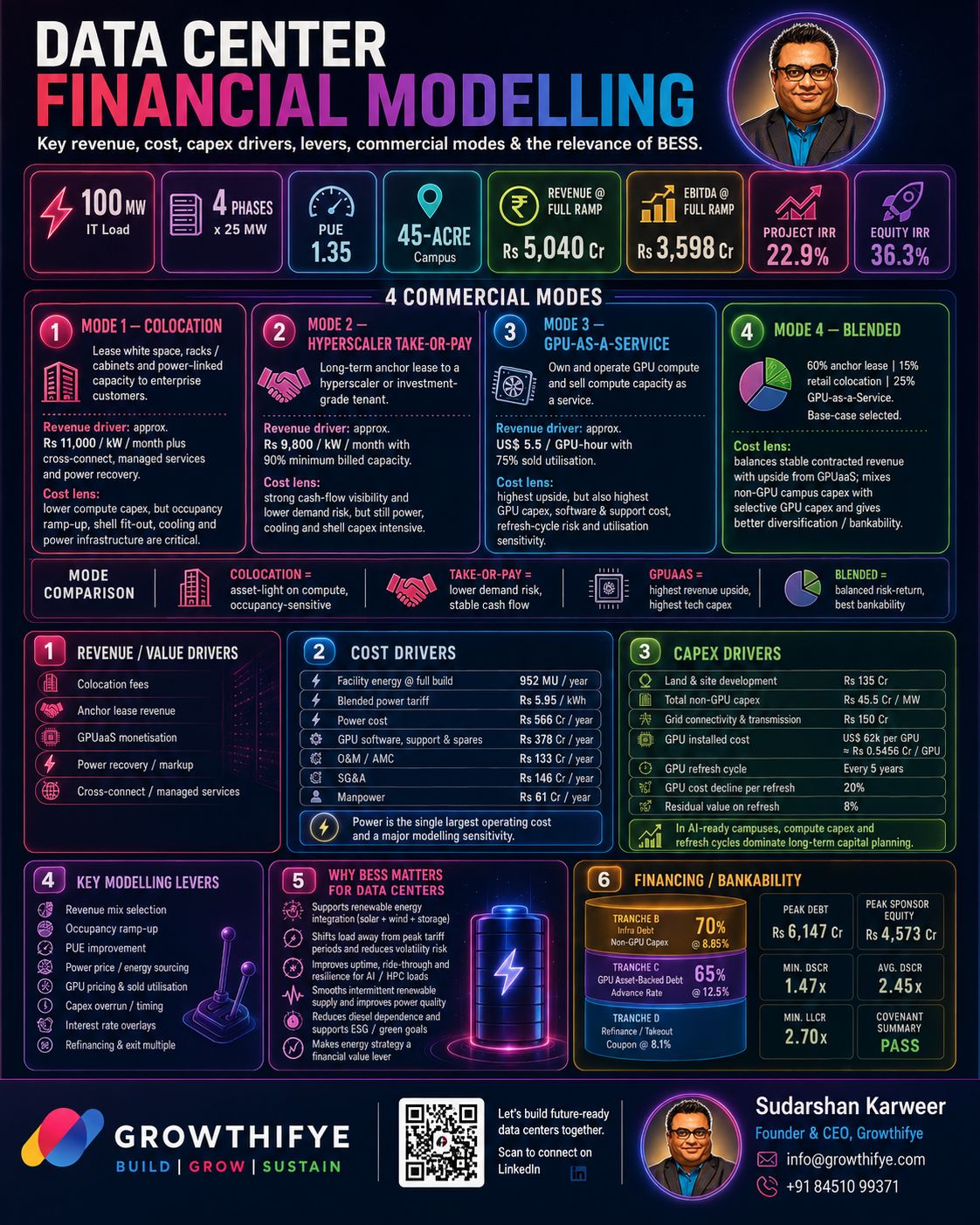
Data centers are no longer just real estate plays — they are power, compute and capital allocation platforms. At Growthifye, we recently mapped a 100 MW AI-ready data center financial model to understand the true revenue drivers, cost levers, capex structure, bankability metrics and the strategic relevance of BESS. Here are the 4 core commercial modes every serious data center model should evaluate: 1. Colocation Lease white space, racks/cages and powered capacity to enterprise customers. Strong infrastructure-led model Revenue comes from colocation fees, managed services and power recovery Ke
24 Aug 2026, 04:48 pm
 Wind & Small Hydro
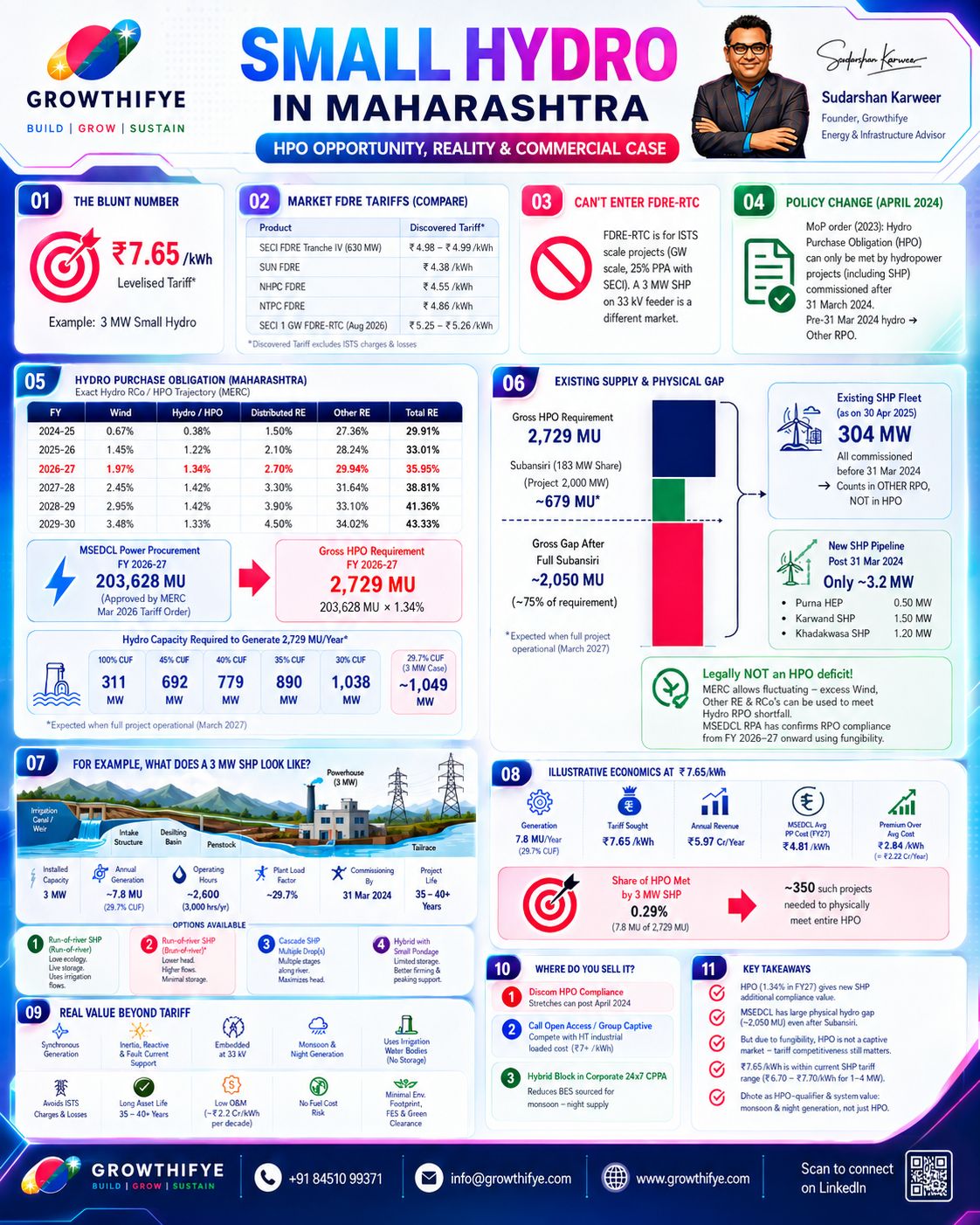
Small hydro deserves a smarter conversation in Maharashtra. Too often, it gets compared directly with large-scale FDRE or low-cost solar and dismissed on tariff alone. But that misses the real commercial and policy context. Here’s the reality: A new small hydro project commissioned after 31 March 2024 can qualify toward the Hydro Purchase Obligation (HPO). For FY 2026-27, Maharashtra’s Hydro RPO / HPO is 1.34%. Based on MSEDCL’s approved procurement, that translates into a gross hydro compliance requirement of roughly 2,729 MU. At the same time, much of the existing SHP fleet was commissioned
24 Aug 2026, 04:07 am
 Green Hydrogen & CBG
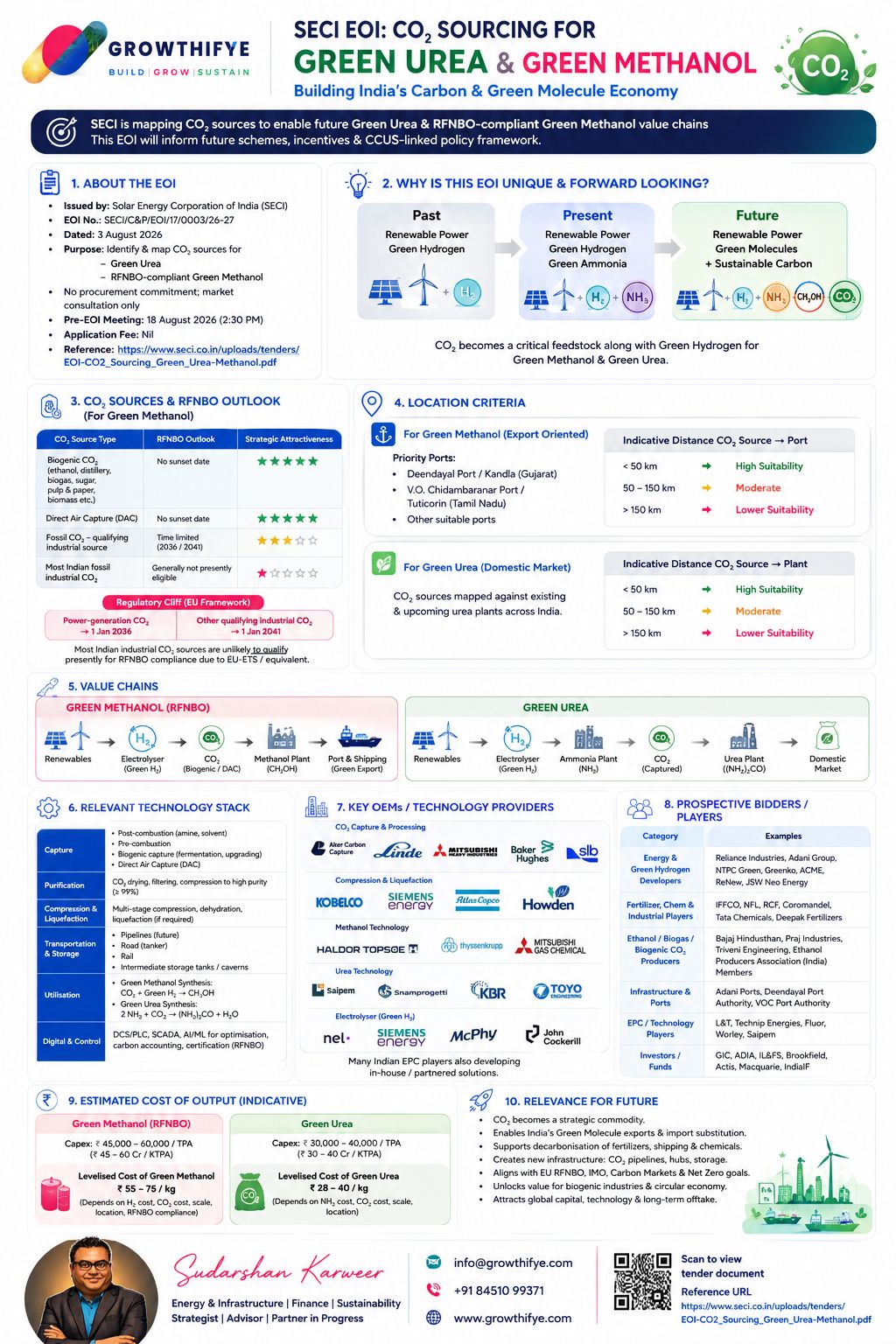
🌱 CO₂ is no longer just an emission. It could become a strategic feedstock. SECI has released one of the more forward-looking EOIs. At first glance, this looks like a CO₂ sourcing exercise. India’s Green Hydrogen economy is evolving into a Green Molecule + Sustainable Carbon economy. 🔄 The value chain is changing Until now, much of the discussion has been: ☀️🌬️ Renewable Energy → ⚡ Electrolysis → H₂ → Green Ammonia The emerging ecosystem could be: ☀️🌬️ Renewable Energy → Green H₂ + ♻️ Captured / Biogenic CO₂ ↓ 🟢 Green Methanol | Green Urea | Green Fuels | Green Chemicals And this creates an en
9 Aug 2026, 10:24 am
 Solar
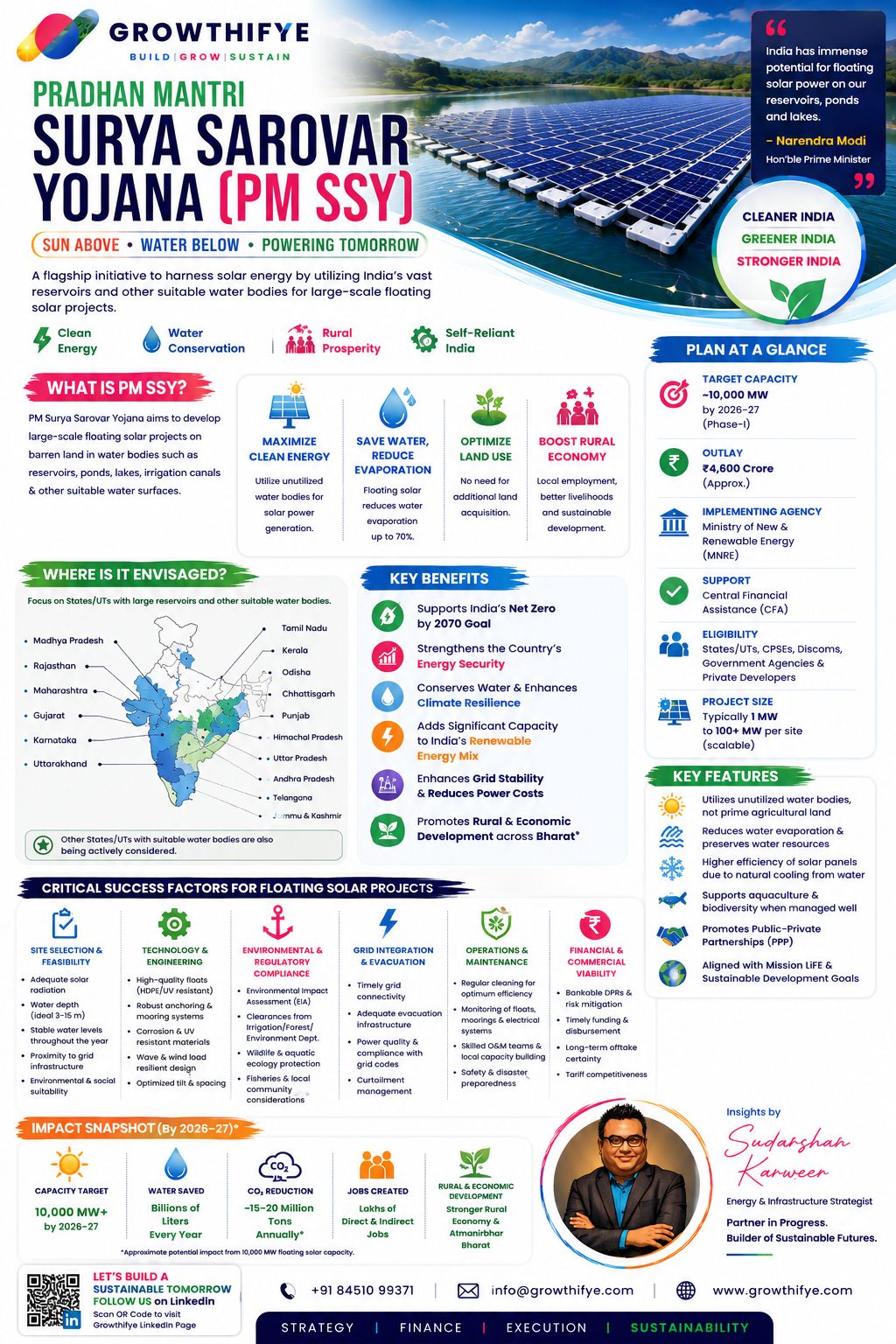
Solar☀️ India’s next solar frontier may not be on land. It could be floating on water. 🌊 The Pradhan Mantri Surya Sarovar Yojana (PM-SSY) brings an interesting proposition to India’s renewable-energy transition: unlock the solar potential of reservoirs, lakes, ponds and other suitable water bodies through floating solar. The opportunity goes beyond adding renewable capacity. ⚡ Generate clean power without competing for large land parcels 💧 Reduce evaporation and support water conservation 🌱 Optimise land use, particularly where land acquisition is difficult 🏘️ Create local economic activity and emp
8 Aug 2026, 11:57 am
 BESS & Storage
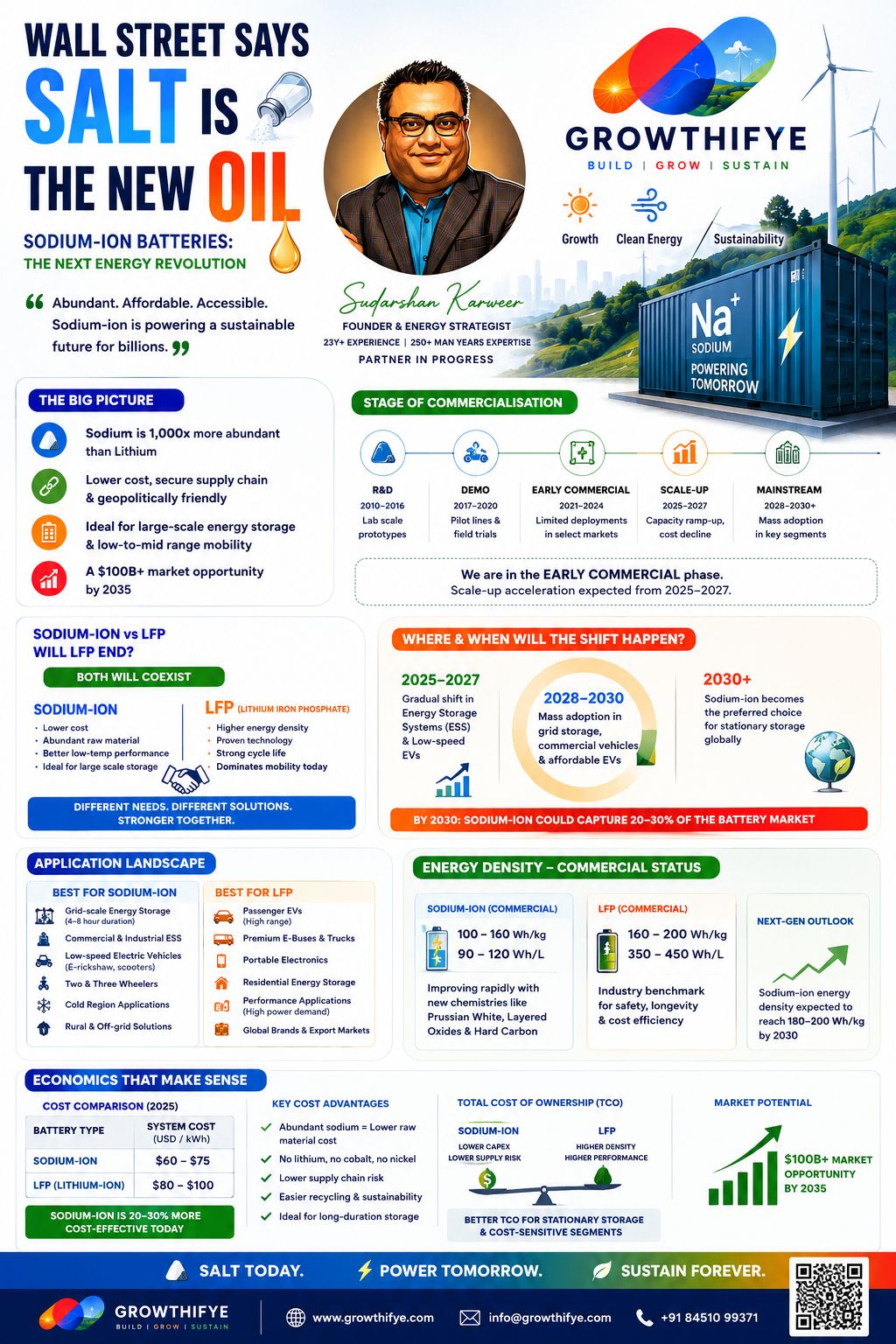
🧂 Wall Street Says "Salt is the New Oil" – But Is It Really? The battery industry is entering one of its biggest transitions since the rise of Lithium Iron Phosphate (LFP). Sodium-ion batteries are no longer a laboratory concept—they have entered the early commercialisation phase.While they won't replace LFP overnight, they are expected to become a major complementary technology, especially for stationary energy storage where cost, supply security, and sustainability matter more than maximum energy density. 🔋 Key Takeaways ✅ Sodium is ~1,000x more abundant than lithium, reducing raw material a
18 Jul 2026, 06:55 am
 Grid & Transmission
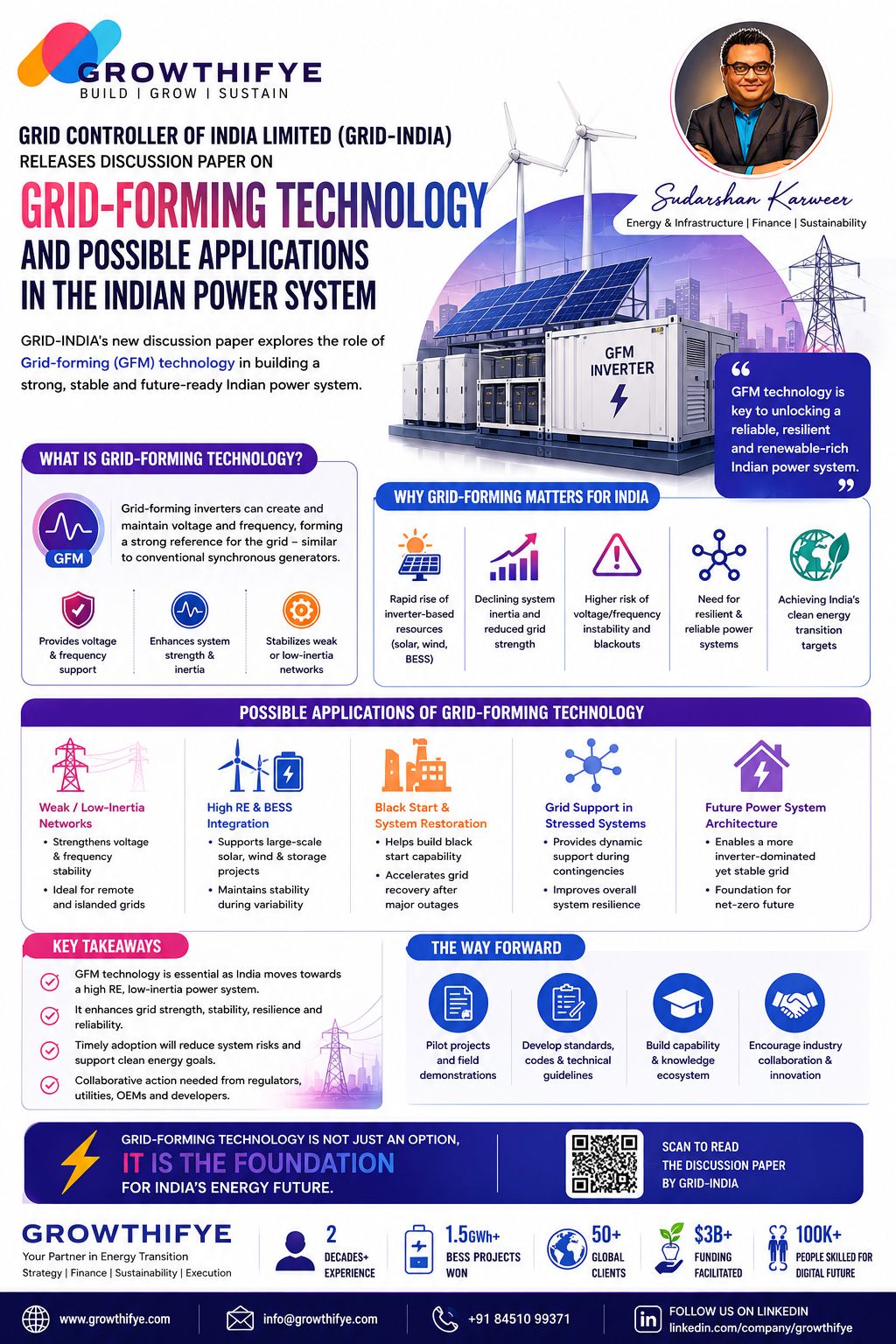
⚡ Grid-Forming Technology: The Next Leap for India’s Renewable Grid India’s power system is entering a new era. As renewable energy and Battery Energy Storage Systems (BESS) continue to scale, maintaining grid stability with conventional inverter technologies alone will become increasingly challenging. Recognising this transition, GRID-INDIA has released a discussion paper on “Grid-forming Technology and Possible Applications in the Indian Power System.” It highlights a critical shift—from power electronics that simply follow the grid to systems capable of actively supporting and stabilising i
12 Jul 2026, 04:45 pm
 BESS & Storage
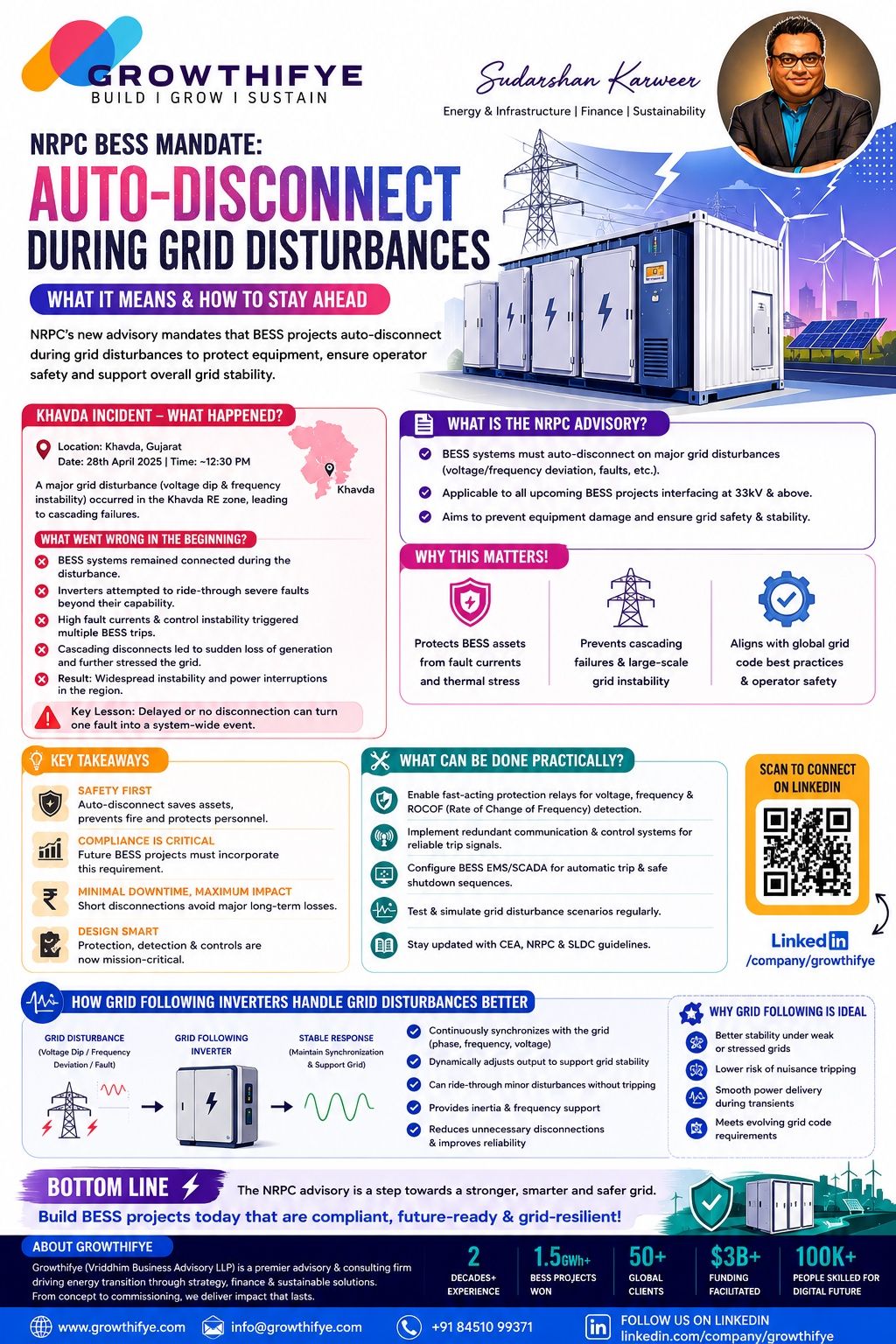
⚡ Khavda Grid Disturbance: A Defining Moment for India’s BESS Ecosystem The recent Khavda Renewable Energy Zone (REZ) grid disturbance is a reminder that Battery Energy Storage Systems (BESS) must be designed not only for energy storage, but also for intelligent grid response. The event has reinforced the importance of the NRPC advisory recommending automatic disconnection of BESS during severe grid disturbances to safeguard equipment and maintain grid stability. Key observations from the incident: • Severe voltage and frequency deviations stressed inverter-based resources. • Inadequate protec
12 Jul 2026, 10:20 am
 BESS & Storage
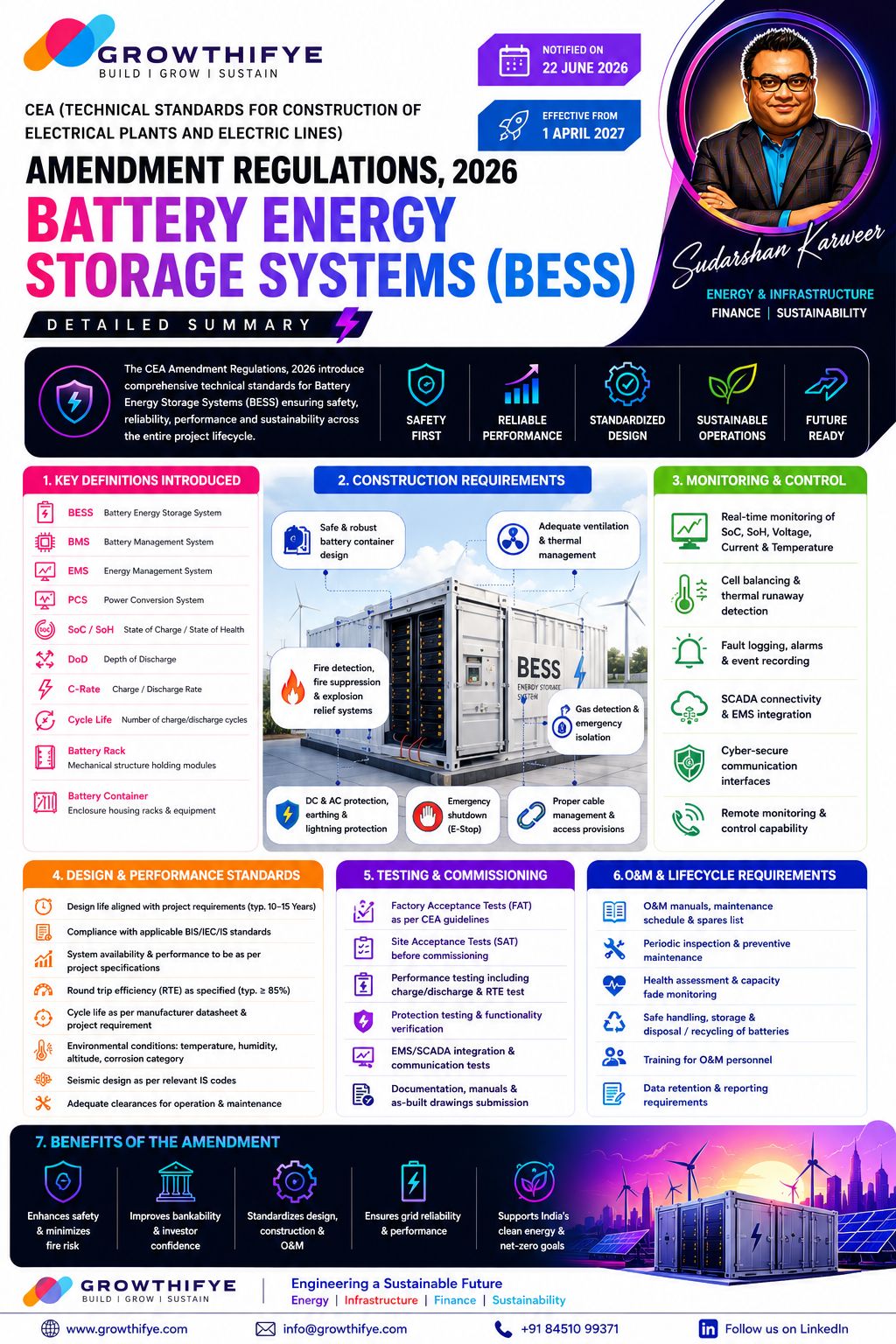
⚡ CEA’s 2026 Technical Standards: A New Benchmark for Battery Energy Storage Systems (BESS) India’s energy transition has entered a new phase. With the Central Electricity Authority (CEA) notifying the Technical Standards for Construction of Electrical Plants and Electric Lines (Amendment) Regulations, 2026, Battery Energy Storage Systems (BESS) now have a dedicated technical framework covering design, construction, safety, monitoring and lifecycle management. This is more than just another regulation—it establishes a common technical baseline that is likely to shape future projects from SECI,
11 Jul 2026, 02:36 am
 Tariffs & ToD
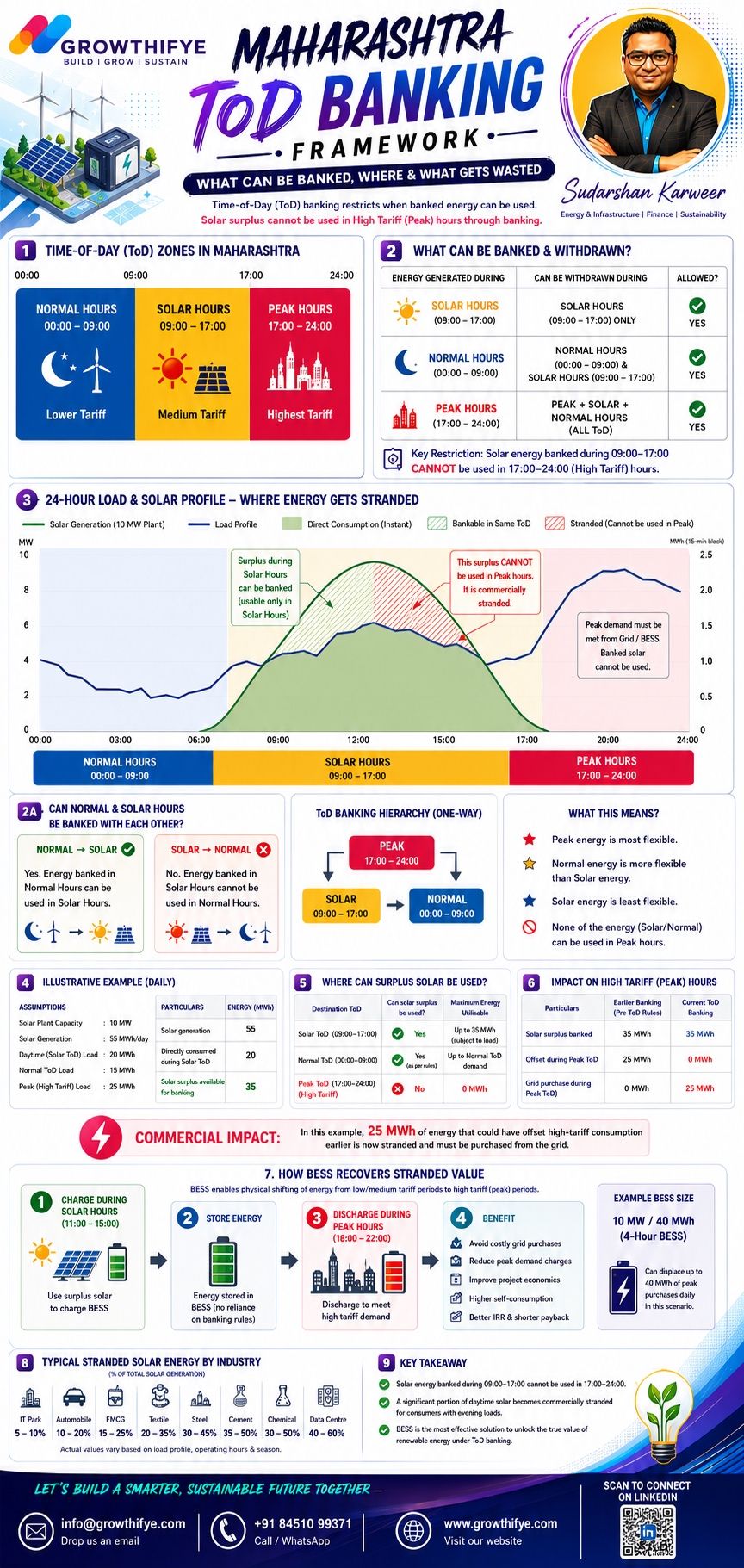
⚡ Is Your Solar Energy Really Being Utilised? Or Is It Becoming “Commercially Stranded”? With Maharashtra’s revised Time-of-Day (ToD) Banking Framework, the challenge for Captive and Group Captive consumers is no longer just installing more solar—it is maximising the value of every unit generated. Many industries are surprised to discover that a significant portion of their daytime solar generation cannot offset expensive evening (Peak) consumption under the revised banking regulations. The result? 🔴 Higher grid purchases during peak hours. 🔴 Reduced savings from open access and captive solar.
10 Jul 2026, 02:53 pm