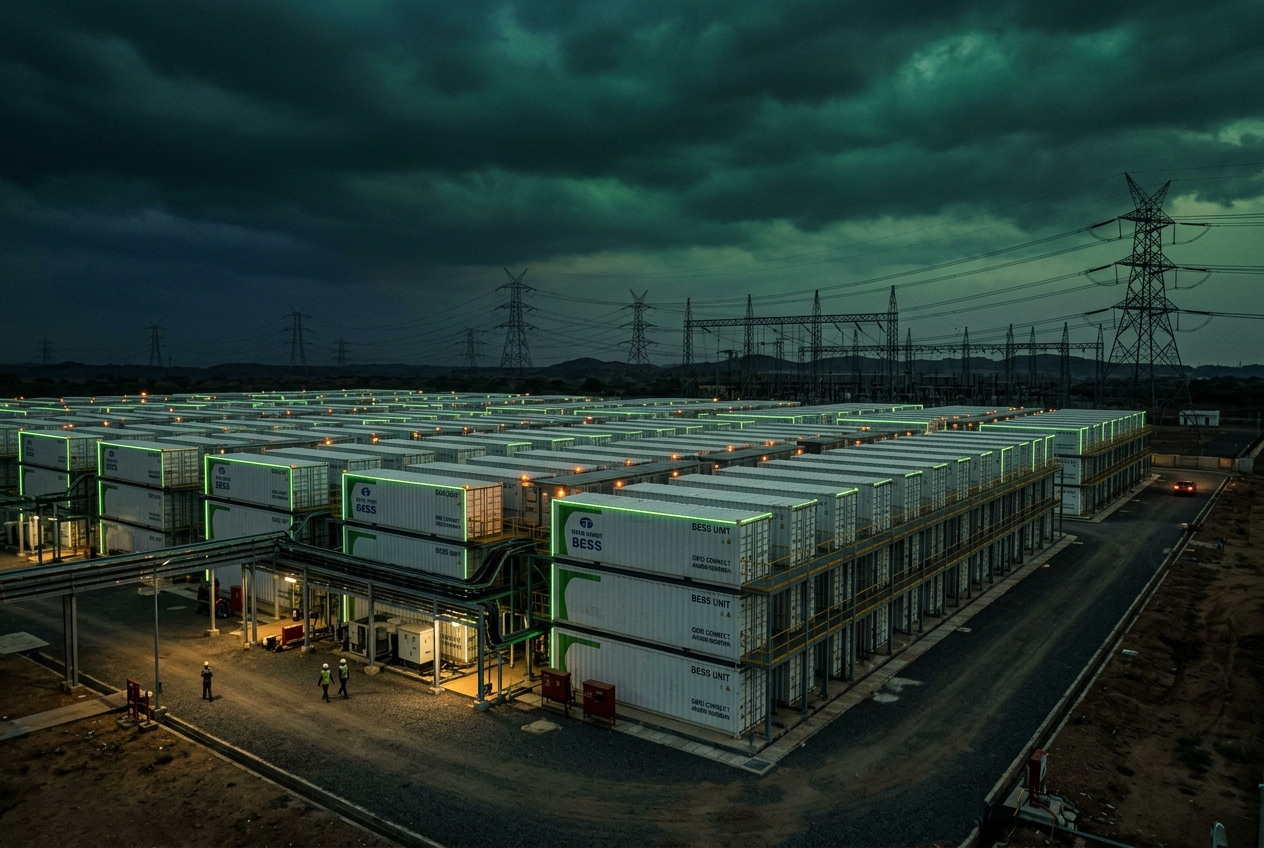
CATL's stacked containers, Cat-1/Cat-2 OEM landscape, India Inc's cell retreat, EMS control layer, CEA/MoP rulebook and the honest readiness verdict.
FDRE and round-the-clock tenders are stacking up as BESS cell costs keep sliding — watch discom offtake discipline, transmission connectivity queue congestion, and whether HP-DAM prices keep testing the near-₹20/kWh cap through evening peaks.
22%
CATL global BESS cell share (H1)
Hithium 10.2% · EVE 9% · BYD 6.7%
~10 yrs away
India cell self-sufficiency
226 GWh announced through 2035, negligible operating
9 MWh
Largest single container
CATL TENER Stack, two-in-one under 36 t/unit
Apr 2027
CEA BESS safety framework
Fire suppression, thermal runaway, BMS mandates
ALMM Watch — live enlistment alerts
MNRE ALMM watcher runs daily at 05:15 UTC — newly ratified enlistments appear here the moment they are detected. No new enlistments detected in the current window — the moment MNRE ratifies new List-I/List-II players, they appear here instantly.
01
Technology frontier — CATL TENER Stack & the density race
CATL's TENER Stack is a 9 MWh grid-scale system launched at ees Europe (May 2025) — a stacked, two-in-one configuration of half-height units, each under 36 tonnes, engineered specifically around global road-transport weight limits. It builds on the 6.25 MWh TENER platform and its five-year zero-degradation claim, lifting energy per container footprint by ~50%.
The cell race has moved past 314Ah: 587Ah-class ultra-large cells are the industry's primary development focus, though integrators remain in wait-and-see mode on which format standardises. Every jump in cell size compresses $/kWh at system level — and widens the technology gap for anyone outside China's supply chain.
Container energy density evolution (MWh per 20-ft class footprint)
02
Who's who — Cat-1 vs Cat-2 cell/system OEMs & India availability
Cat-1 here = gigafactory-scale, bankability-grade OEMs that clear lender/insurer diligence in Indian utility tenders. Cat-2 = credible challengers that win on price or niche but need wrapping (LDs, insurance, balance-sheet support) to be financed. Availability in India is shaped less by the OEM's appetite and more by Beijing's export-control posture and India's trusted-vendor screening.
Cell / system OEM landscape
OEM
Origin
Category
In India?
Notes
CATL
China
Cat-1
Imports only
Global #1 (22% H1 share). In component-supply talks with Reliance for Jamnagar assembly; no cell tech transfer
BYD
China
Cat-1
Restricted
6.7% global share. FDI screening (Press Note 3) blocks manufacturing entry; product imports only
EVE Energy
China
Cat-1
Active
9% global share. Regular cell/DC-block supplier into Indian integrators
Hithium
China
Cat-1
Active
10.2% global share. Reliance licensing deal collapsed under China's export controls; still ships product
Gotion High-Tech
China
Cat-1/Cat-2 border
Active
VW-backed. Supplies cells & containers into Indian C&I and utility tenders; aggressive pricing
Narada Power
China
Cat-2
Active
Long telecom/UPS legacy in India; grid-scale LFP containers now offered with local service
RJE Tech (Rongjie Energy)
China
Cat-2 rising
MoUs signed
3–4 GWh LFP cell supply pact with Pace Digitek's Lineage Power (2027); JSW Energy MoU for ~5 GWh of ESS on RJE 314Ah & 588Ah cells (5 / 6.26 MWh systems)
REPT Battero / Great Power
China
Cat-2
Selective
Price challengers appearing in Indian RFQs; bankability wrapping usually required
Samsung SDI / LG ES
Korea
Cat-1 (non-China)
Limited
NMC heritage, limited grid LFP; relevant where 'non-Chinese cell' is specified
Tesla / Fluence / Wärtsilä
US/EU
Cat-1 integrators
Selective
System + EMS layer on top of (mostly Chinese) cells; strong software, premium pricing
Global BESS cell shipment share — H1 2026 (Benchmark Minerals)
CATL 22%
Hithium 10.2%
EVE 9%
BYD 6.7%
Others 52.1%
03
India Inc's cell retreat — JSW stalls, Reliance pivots to sodium-ion
JSW Group has put its proposed 50 GWh Odisha cell plant on hold — leadership says LFP cell technology is 'tightly guarded by China and unavailable elsewhere', pushing the group downstream into cell-to-pack assembly for BESS and EVs. JSW has meanwhile signed an MoU with RJE Tech (Rongjie Energy) for 5 MWh and 6.26 MWh ESS systems built on RJE's 314Ah and 588Ah LFP cells — buying systems while cell manufacturing waits.
Reliance's licensing deal with Hithium collapsed after Beijing tightened export controls on sensitive clean-energy technologies (Jan 2026). Reliance has since pivoted from cell synthesis to containerised BESS assembly at Jamnagar, procuring components from CATL and others — while accelerating sodium-ion work: no Chinese LFP licence needed, domestic soda-ash feedstock, and better tolerance of Indian ambient temperatures than NMC.
The pattern repeats across India Inc (Adani included): retreat from upstream cell chemistry to system integration, because non-Chinese technology routes are costlier and slower than PLI milestones assumed.
Why the China wall is real
▸LFP cell IP, precursor know-how and manufacturing equipment are export-controlled by Beijing
▸India imports effectively 100% of grid-scale cells; graphite/anode chain is equally China-dominated
▸VGF-supported projects need ≥20% domestic content — met today via containers, EMS, PCS & BoP, not cells
▸Developers optimise duty via AIFTA routes (Malaysia/Indonesia) — a workaround, not a fix
▸Every large-format cell generation (314Ah → 587Ah) resets the catch-up clock for Indian fabs
04
Indian champions — who is actually building (Pace Digitek, AmpereHour, Replus & co.)
Indian BESS ecosystem — manufacturing & integration
Company
What they do
Proof points
Pace Digitek / Lineage Power
Integrated BESS manufacturing + EPC + O&M
NTPC Nabinagar 200 MW/400 MWh EPC; SECI 600 MW/1,200 MWh (~₹1,159 cr); 5 GWh line by Oct-2026, scaling to 10 GWh; 4 GWh LFP cell framework with RJE Tech (2027); BESS MoU with Bondada Renewable
AmpereHour Energy
Software-driven, hardware-agnostic EMS (ELINA) + turnkey systems
Multi-OEM real-time monitoring, predictive dispatch; one of few Indian EMS stacks running utility assets
Replus Engitech
Pune-based BESS OEM — packs, containers, EMS
C&I and utility containers with indigenous BMS/EMS integration
Neuron Energy / Feston SEV
Container-level assembly plants
Early movers in localising the container & pack layer
Waaree ESS / Exicom
Storage systems, telecom & EV charging heritage
Leveraging existing power-electronics channels into grid BESS
Delectrik Systems
Indian VRFB (vanadium flow) OEM
India's first utility-scale flow battery — 100 MWh / 16.7 MW at Khavda for NTPC REL (with Bondada, 2027); 3 MWh NTPC pilot at Greater Noida
Bondada Engineering
EPC & storage deployment partner
Partner on NTPC REL's 100 MWh Khavda VRFB; BESS MoU with Lineage Power (Pace Digitek)
05
The EMS layer — who controls the brain (and why origin matters)
The EMS decides dispatch, SoC strategy, curtailment response and market bidding — it sees every telemetry point in the plant. That makes EMS origin a cybersecurity and sovereignty question, not just a software choice. CEA's cyber regime effectively pushes critical-grid operators toward auditable, India-resident control layers.
Ships 'free' with containers — the exact layer CEA cyber rules scrutinise
06
CEA, MoP & cybersecurity — the rulebook is hardening
2021
CEA Cyber Security in Power Sector Guidelines
ISMS baseline, CISO mandates, incident reporting for grid entities
2022
MoP trusted-vendor order
Grid-connected equipment from 'prior-reference' countries needs testing/approval — aimed squarely at Chinese power electronics
2024
CEA Cyber Security Regulations
CSIRT-Power, ISO-27001 alignment, data residency, no remote firmware/configuration access from outside India
2026
GRID India grid-forming directive
BESS >50 MW must provide grid-forming (GFM) capability — frequency/voltage support, not just grid-following
Apr 2027
CEA BESS safety framework in force
Fire suppression, thermal-runaway management and BMS requirements for all new grid BESS
Net effect: imported cells are tolerated, but imported control layers (BMS/EMS with offshore telemetry) are increasingly not. Compliance-ready, India-resident EMS is becoming a tender differentiator — which is precisely where Indian software players can win before Indian cells exist.
07
Honest readiness verdict — is the Indian ecosystem ready?
Container fabrication & system integration
8/10
Pace Digitek, Replus, Neuron scaling now
EMS / software control layer
6/10
ELINA & co. credible; needs utility-scale references
PCS / power electronics
5/10
Assembly exists; semiconductors imported
Cells
1/10
No grid-scale LFP cell production; tech access blocked
Upstream minerals & precursors
2/10
NCMM & recycling schemes are seeds, not supply
Verdict: India is execution-ready and cell-deficient. The 2026–2030 play is unapologetically import-cells → localise-everything-else, with sodium-ion and recycling as the sovereign hedges. Anyone underwriting 'domestic cells by 2028' into a bid is taking technology-transfer risk that JSW and Reliance have already repriced.
OEM directory — deep-dive profiles with daily updates
Every manufacturer gets its own page: India presence, partnerships, key facts and the latest stories, refreshed daily. Indian-origin OEMs highlighted.
Editorial market intelligence compiled from public reporting and daily news feeds. Directional reference only — not price discovery or investment/procurement advice. Growthifye is not accountable for decisions taken on these pages.
Daily BESS intelligence
Today's analyst-written brief & latest updates
Auto-generated every morning from the last 72 hours of public reporting · sources linked
Updated as on 30 Sept 2026, 08:50 am IST
2026-09-30 · BESS · India Energy Storage · Battery Manufacturing · Renewable Integration
India's BESS Buildout Accelerates: 45-50 GWh Target by FY28 Faces Cell Supply Test
Crisil and CareEdge project massive battery storage capacity additions through FY28, but domestic cell manufacturing gaps and INR 4 lakh crore funding needs could determine execution pace.
Crisil Ratings projects India will commission 45-50 GWh of BESS capacity across FY27-FY28, marking a step-change from current deployment levels [1,3,4,7,8,18,19]
CareEdge Ratings estimates INR 4 lakh crore (~$48B) financing requirement for storage infrastructure through FY32, signaling capital-intensive scale-up ahead [5]
Domestic manufacturing push is underway but cell dependence remains the key bottleneck per SMM analysis, exposing supply chain vulnerability [2]
Active project pipeline includes NTPC's 200 MW/400 MWh Maharashtra tender, SJVN's 265 MW Haryana bid, and APPCC seeking 1,000 MW/4,000 MWh from commissioned assets [9,10,13,14]
NLC India is diversifying into BESS and exploring pumped storage consultancy, reflecting PSU diversification into storage beyond core generation [6,15]
Capacity Trajectory: From Pilot to Scale
Multiple reports citing Crisil Ratings converge on a consistent projection: India's BESS capacity will jump to 45-50 GWh by FY27-FY28, a significant leap from today's nascent base [1,3,4,7,8,18,19]. This repeated coverage across outlets underscores growing analyst confidence in the storage ramp-up trajectory, likely driven by falling battery costs, renewable integration mandates, and grid balancing needs as solar-wind capacity additions continue to outpace storage as noted in broader capacity trend coverage [16]. However, the headlines provide capacity projections without granular breakdowns on standalone versus co-located BESS, or state-wise distribution, limiting depth of analysis on where this growth will concentrate. The consistency across CareEdge and Crisil signals institutional alignment on India's storage inflection point, though execution risk from manufacturing and grid integration remains understated in current commentary.
Manufacturing Push Meets Cell Dependence Reality
SMM's analysis highlights that India's BESS manufacturing ecosystem is accelerating, yet cell dependence—likely on imported lithium-ion cells from China and other markets—remains the critical bottleneck [2]. This tension between domestic assembly capability and upstream cell sourcing mirrors challenges seen in India's broader battery and EV supply chains. The headline set includes GFCL EV Battery's Q1 FY27 concall analysis, suggesting domestic players are actively reporting on battery business performance, though details are limited [12]. Without deeper localization of cell manufacturing, India's 45-50 GWh ambition could face import cost exposure and geopolitical supply risk. The article's framing as a 'key bottleneck' suggests this is a structural constraint policymakers and manufacturers must address to de-risk the storage buildout timeline.
Financing Scale and Institutional Capital Needs
CareEdge Ratings quantifies the financing challenge: India needs INR 4 lakh crore for storage by FY32 [5]. This figure signals the scale of capital mobilization required—spanning debt, equity, and blended finance—to support the storage transition alongside solar and wind capacity growth. The headline does not break down funding sources or the split between public and private capital, nor does it address whether this figure covers standalone BESS, pumped hydro, or both. Given parallel PSU activity—NLC India's consultancy tender for pumped storage [15] and its expanding BESS portfolio [6]—it appears public sector entities are positioning to capture a share of this investment wave, potentially alongside private developers responding to NTPC and SJVN tenders [9,10,13,14].
Tender Activity Signals Near-Term Deployment
Concrete tender activity provides evidence of near-term momentum: NTPC has invited bids for a 200 MW/400 MWh BESS project in Maharashtra [13,14], while SJVN launched bidding for 265 MW battery storage in Haryana [10]. Separately, APPCC is seeking 1,000 MW/4,000 MWh from already-commissioned BESS projects [9], suggesting demand-side integration efforts are catching up with supply additions. These tenders collectively represent a mix of MW/MWh ratios (roughly 2-hour duration systems), consistent with grid balancing and peak-shifting use cases rather than long-duration storage. The geographic spread—Maharashtra, Haryana—indicates multi-state procurement rather than concentration in traditional renewable-heavy states like Rajasthan or Gujarat, though the headlines don't clarify whether this reflects a broader national rollout pattern.
So what: For developers, tender volume signals genuine near-term offtake opportunity, but cell import dependence raises cost and delivery risk. DISCOMs face integration timelines that may outpace grid-readiness. Lenders should scrutinize INR 4 lakh crore financing gap allocation and manufacturing localization progress before committing to long-tenor project debt.
We use essential cookies to run the site and, with your consent, track your activity to personalise your learning and recommendations. See our Privacy Policy.