Battery Fire-Safe Recycling Parks in India 2026: Siting, Capex and Compliance
By Sudarshan Karweer · sudarshan@growthifye.com · +91 84510 99371 (Call / WhatsApp) · 2026-08-28
India’s battery recycling market is often discussed through metal prices, recovery yields and EPR obligations. In practice, many projects fail much earlier in the decision chain: site selection, fire protection design, hazardous storage, logistics routing, utility connectivity, local permissions and lender confidence. In 2026, India needs more than standalone shredding lines or fragmented collectors. It needs battery recycling parks designed around safety, compliance and throughput.
This matters because feedstock is broadening fast. EV batteries from 2W, 3W, buses and LCV fleets are reaching early replacement streams. Consumer electronics continue to generate high-volume small-format cells. Stationary storage pilots are beginning to create damaged and warranty-return packs. Imports remain tightly regulated, so most developers are underwriting domestic feedstock. That makes park-level operating discipline, not just metallurgical ambition, the differentiator.
For Indian C&I consumers, developers, lenders, utilities and policymakers, the key question is simple: what does a bankable, fire-safe battery recycling park look like in 2026, and what project assumptions are realistic?
Why the battery recycling park model is emerging
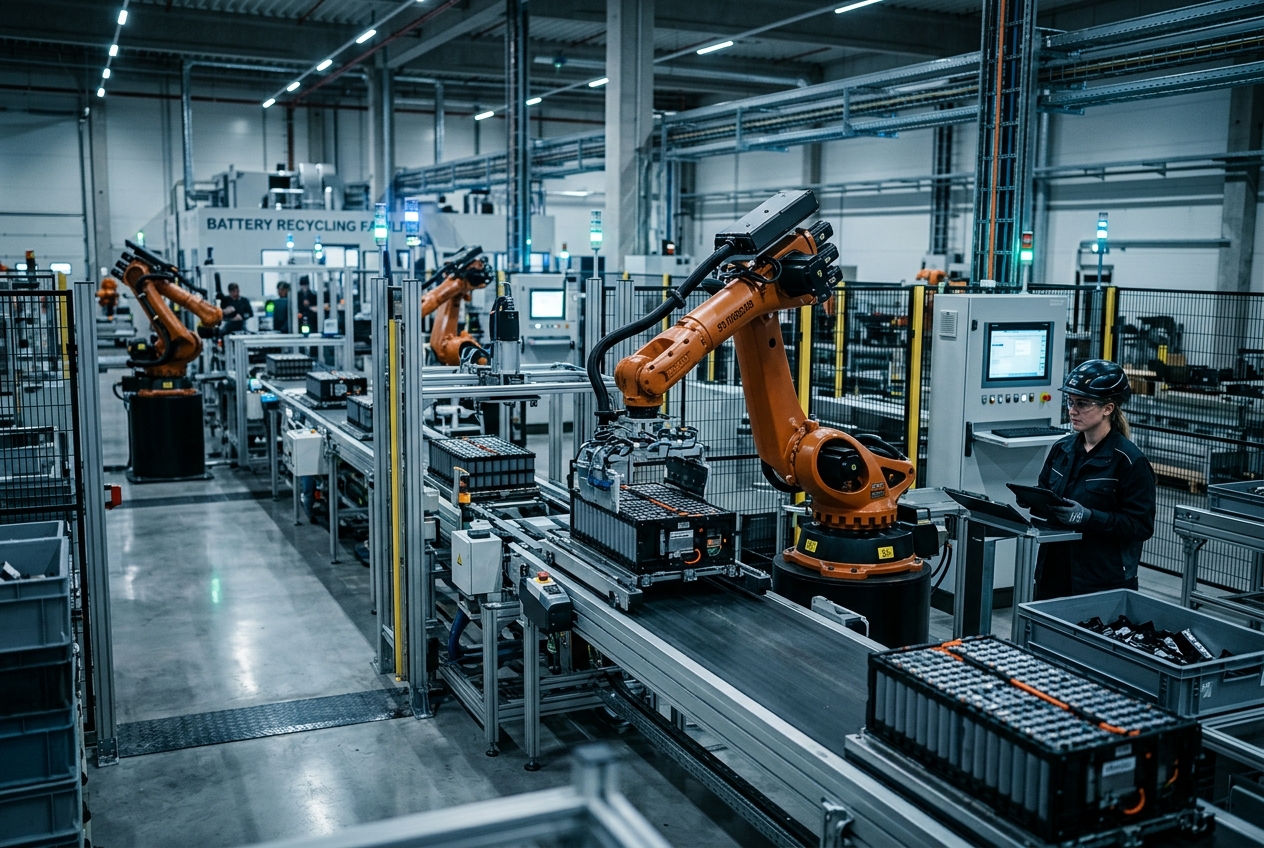
A recycling park is not just a large plant. It is an integrated layout that separates incompatible risks and streamlines chain of custody from receipt to dispatch. A typical park combines:
- inbound testing, weighing and digital registration
- quarantine and damaged-battery isolation areas
- discharge stations for different chemistries and form factors
- dismantling and pack-to-cell handling zones
- pre-processing and shredding under controlled atmosphere where required
- black mass storage and dispatch
- plastics, aluminium, copper and steel segregation
- wastewater, off-gas and dust management systems
- emergency response, fire-water storage and hazardous waste yards
This model solves three India-specific problems.
First, land-use and safety separation. A recycler handling mixed chemistries, including damaged lithium-ion batteries, should not be shoehorned into a generic warehouse cluster with weak firefighting access. Parks allow setbacks, one-way truck movement, thermal event isolation and future expansion.
Second, compliance visibility. Under India’s Battery Waste Management Rules, 2022 and the CPCB-led EPR framework now embedded in 2026 operating practice, producers and recyclers need auditable movement records, recovery documentation and traceable output accounting. Co-locating receipt, discharge, dismantling and dispatch improves verifiability.
Third, logistics economics. Reverse flows in India remain costly because batteries move from dealerships, service centres, fleet depots, municipal scrap channels and informal aggregators. Consolidation at a park reduces handling losses, shrinkage, safety incidents and per-tonne compliance costs.
Feedstock reality in India in 2026
The biggest mistake in battery recycling underwriting is assuming steady, homogeneous feedstock. India’s market is still fragmented.
LFP and NMC dominate strategic discussion, but actual inbound streams can include:
- NMC packs from premium 4W and some buses
- LFP packs from buses, commercial vehicles and stationary systems
- LTO in selected bus fleets and industrial applications
- lead-acid replacement overlap in telecom, inverter and mobility channels
- mixed small cells from consumer electronics and tools
- production scrap from cell, module and pack assembly plants
Production scrap is often the cleanest and most profitable initial feedstock because chemistry is known, contamination is lower and logistics are predictable. In 2026, several Indian recyclers are still relying on a blend of production scrap plus consumer and mobility end-of-life flows to stabilise plant utilisation.
For project sizing, developers should avoid modelling full-nameplate throughput in year one. A more practical ramp-up for a new park is:
- Year 1 utilisation: 35% to 50%
- Year 2 utilisation: 55% to 70%
- Year 3 utilisation: 70% to 85%
A 10,000-15,000 tonne per annum pre-processing park may be easier to fill than a 25,000+ tonne per annum facility unless the sponsor has captive OEM relationships or long-term collection contracts. This is where Growthifye capabilities such as Reverse logistics and End-of-life fleet audits become commercially relevant: feedstock mapping is now a project-finance issue, not just an operations issue.
Siting criteria: where parks will work and where they will struggle
Not every industrial plot is suitable. In 2026, good siting decisions usually balance seven factors.
- Proximity to feedstock clusters: EV manufacturing belts, major urban consumption centres, bus depots, 3W fleet clusters and electronics markets matter more than port adjacency for most domestic-focused projects.
- Fire and emergency access: dual road access, turning radii for emergency vehicles and separation from dense mixed-use industrial occupancy are essential.
- Hazardous-material handling compatibility: state pollution control boards and local industrial authorities will scrutinise this closely.
- Reliable power supply: shredding, ventilation, discharge systems, dust control and safety infrastructure all require stable electricity.
- Water availability and wastewater disposal route: especially for wet processes or significant washing and scrubber systems.
- Labour and EHS talent: battery dismantling and safe handling are not generic warehouse skills.
- Outbound route to refiners/offtakers: black mass and segregated metals need compliant transport channels.
In India, locations near auto and electronics corridors in Tamil Nadu, Karnataka, Maharashtra, Gujarat, Telangana, NCR and selected nodes in Uttar Pradesh are attracting the most attention. But local execution risk differs sharply by district. A weaker site in a famous industrial state can still be less bankable than a well-serviced site in a secondary cluster with better safety buffers and permitting clarity.
Land cost also changes the economics. For a 5-10 acre battery recycling park, industrial land in top-tier clusters can vary from roughly Rs 1.5 crore to over Rs 6 crore per acre depending on utility readiness, frontage and zoning. Sponsors often under-budget civil and safety infrastructure after overpaying for strategically located land.
Capex ranges and cost structure in 2026
Capex depends heavily on whether the project is only a pre-processing park or includes hydrometallurgical refining. For many Indian developers, the park model in 2026 is best staged: phase 1 for safe collection, discharge, dismantling and black mass generation; phase 2 or partner model for refining.
Indicative capex ranges for 2026:
- Collection, discharge and dismantling hub at small scale: Rs 8 crore to Rs 20 crore
- Pre-processing plant with shredding, sorting, emissions control and safety systems at 5,000-10,000 TPA: Rs 25 crore to Rs 60 crore
- Larger integrated pre-processing park at 10,000-20,000 TPA with stronger automation and warehousing: Rs 60 crore to Rs 120 crore
- Hydrometallurgical refining addition, depending on chemistry focus and purity targets: can add Rs 80 crore to Rs 250 crore or more
These numbers exclude major land premium in expensive corridors and can move materially based on imported equipment content, automation level and environmental-control architecture.
What lenders now look for is not just process capex but “risk capex”:
- thermal monitoring and gas detection
- compartmentalised storage bays
- fire-water tanks and hydrant coverage
- inerting or controlled-atmosphere elements where applicable
- emergency shutdown systems
- blast relief and dust control where needed
- battery discharge infrastructure
- digital traceability systems for inbound and outbound material
A common mistake is to benchmark capex against scrap-processing plants. Battery projects are closer to hazardous-material industrial infrastructure with process engineering on top.
Compliance stack: what project sponsors must plan for
By 2026, serious project sponsors are building compliance architecture from day one rather than treating it as a post-commissioning exercise. The relevant stack usually includes:
- Battery Waste Management Rules, 2022 and related CPCB procedures
- EPR registration and transaction requirements for eligible entities
- Hazardous and Other Wastes management compliance where applicable
- State Pollution Control Board consent to establish and consent to operate
- Factory licensing, fire NOC and local building approvals
- Worker safety obligations under applicable labour and industrial safety norms
- Transport compliance for damaged, defective and end-of-life batteries
For OEMs and producer-importers, recycler selection is now a board-level risk issue. If a recycler cannot demonstrate auditable recovery, inventory controls and EPR-compliant documentation, the producer’s own compliance position weakens. That is why services such as EPR compliance and Circularity reporting are becoming embedded in procurement and offtake contracts.
Policy enforcement remains uneven across states, but the direction is clear: informal and semi-formal handling of lithium-ion batteries is facing a tougher operating environment. This should benefit compliant recycling parks, provided they can stay cost-competitive.
Unit economics: where margins are made and lost
In 2026, battery recycling margins in India are shaped by six variables more than anything else:
- feedstock acquisition cost
- chemistry mix and state of health
- safe logistics and packaging cost
- recovery yields and contamination levels
- refining/offtake terms for black mass and segregated metals
- compliance overhead and working capital
Indicative cost elements for domestic reverse flows can look like this:
- collection and aggregation: Rs 8,000 to Rs 25,000 per tonne depending on source fragmentation
- compliant packaging, discharge preparation and transport: Rs 10,000 to Rs 35,000 per tonne, significantly higher for damaged packs
- dismantling and pre-processing opex: Rs 12,000 to Rs 30,000 per tonne depending on automation and chemistry complexity
- EHS, insurance, compliance and administration: often another Rs 5,000 to Rs 15,000 per tonne equivalent at moderate scale
The revenue side depends on recoverable metals, usable components and EPR-linked commercial arrangements. But operators should not overestimate recoverable value from mixed small-format batteries or degraded, contaminated mobility packs. In many cases, profit is made by superior sourcing discipline, low incident rates and better downstream contracts, not by headline cobalt or nickel narratives.
For LFP-heavy streams, the metals value story is structurally different from high-nickel chemistries. This makes low-cost, safe handling and scale efficiency even more important. Developers banking on uniform high-value black mass economics across all chemistries are likely to disappoint equity and lenders.
Lender and investor questions in 2026
Capital providers have become more sophisticated. The first round of questions is now operational, not promotional.
Expect diligence on:
- provenance and enforceability of feedstock agreements
- chemistry-wise throughput assumptions
- fire-loss scenarios and insurance availability
- environmental liability allocation
- key equipment redundancy and spare-part dependence
- output offtake and price-indexation mechanisms
- management capability in EHS and hazardous operations
- data systems for material traceability and EPR accounting
Insurance is a growing pain point. Premiums for facilities storing damaged lithium-ion batteries remain elevated, and some underwriters are imposing tighter storage and suppression conditions. This directly affects DSCR resilience and reserve requirements. Sponsors should involve insurers during design, not after construction.
From a project-finance perspective, the most financeable structure today is often a staged build with contracted feedstock, conservative utilisation assumptions, pre-agreed downstream partners and documented emergency-response protocols. State support through industrial land, utility readiness, faster clearances and common hazardous-infrastructure planning can materially improve bankability.
Strategic implications for states, OEMs and industrial users
For state governments, battery recycling parks can be a practical industrial policy tool if designed as safety-led circularity infrastructure rather than generic waste yards. Plug-and-play industrial estates with firefighting backbone, hazardous storage norms, testing labs and digital compliance support would shorten development cycles.
For OEMs, fleet operators and large C&I users, the implication is clear: recycler engagement should begin before batteries reach end of life. Contracting for take-back, condition assessment, pack segregation and documented recovery improves both compliance and residual-value outcomes. It also lowers the probability of unsafe leakage into informal channels.
For utilities and public transport agencies, large replacement cycles in buses and stationary storage will need structured tender clauses covering data disclosure, handover condition, packaging, discharge responsibility, liability during transit and approved recycler pathways.
In short, India’s battery circularity story in 2026 is shifting from isolated recycling capacity announcements to integrated infrastructure design. The winners will be those who can combine siting discipline, process safety, traceability and realistic economics. A battery recycling park is not a silver bullet, but it is increasingly the right template for scaling compliant capacity.
If your organisation is evaluating battery recycling infrastructure, recycler partnerships, OEM take-back strategy or lender-grade circularity diligence, contact Growthifye’s advisory desk. We support market assessment, site-screening, compliance design and commercial strategy across Module & battery recycling, EPR compliance and Reverse logistics.
Explore Growthifye's related capabilities
This analysis connects directly to our advisory practice: End-of-life fleet audits · Second-life battery applications · Module & battery recycling · EPR compliance.
About the author

Chief Executive Officer, Growthifye — With over 23 years in management consulting, Sudarshan has taken businesses from concept to scale — building and scaling new-age digital and energy businesses.
- 23+ years in management consulting
- EY alumnus
- Led large-scale BESS programmes, capital raises and advisory mandates
Want this analysis applied to your project?
Talk to our team