Utility interface
Utility Interface: Securing Grid Connectivity, Compliance & Commissioning Sign-off
This step converts your detailed design into a bankable grid connection — managing the full utility engagement lifecycle from connectivity/LTA applications through grid-code compliance studies to joint commissioning with the transmission utility. We act as your technical interface with STU/CTU teams, tracking approvals, resolving protection and metering queries, and steering the project to a clean charging and COD certificate.
Typical duration · 4-9 months (running in parallel with construction; timeline driven by utility processing cycles)
Samples generated 05 Sept 2026, 11:26 pm ISTWhat happens in this step
- 01Prepare and file connectivity/LTA (Long Term Access) applications with the nodal STU/CTU, including load flow and short-circuit study inputs
- 02Coordinate technical scrutiny meetings; respond to utility queries on fault level, reactive power capability and protection philosophy
- 03Develop grid-code compliance documentation — voltage ride-through, frequency response, harmonic and flicker compliance reports per IEGC/CEA regulations
- 04Prepare and submit protection coordination studies, relay setting proposals and metering scheme drawings for utility approval
- 05Support SCADA/RTU integration and communication protocol testing (IEC 61850/60870-5-104) with utility control centre
- 06Coordinate charging clearance, joint commissioning tests (CT/PT ratio checks, interlock verification, protection trip tests) with utility engineers
- 07Track punch-list closure and obtain final COD/CEIG certification for commercial operation
What we need from you
- Approved detailed design package (SLDs, protection schemes, relay coordination study)
- Equipment datasheets for transformers, PCS/inverters, switchgear and protection relays
- Site single-line diagram with metering and communication architecture
- Utility's connectivity standards, tariff order references and applicable grid-code circulars
- EPC commissioning schedule and test procedure documents
- Statutory NOCs (CEIG, forest/wildlife if applicable) status

Worked example (anonymised, illustrative)
Standalone BESS Grid Connectivity Program · 400 MW / 800 MWh · Western India, 220 kV pooling substation
Battery storage project requiring LTA at 220 kV, grid-code compliance for four-quadrant reactive support, and joint commissioning with the state transmission utility ahead of a DISCOM tender COD deadline.
Sample deliverables from this step
Every sample below is analyst-written and anonymised for illustration — structure and depth mirror our real deliverables; figures and names are not from any client engagement.
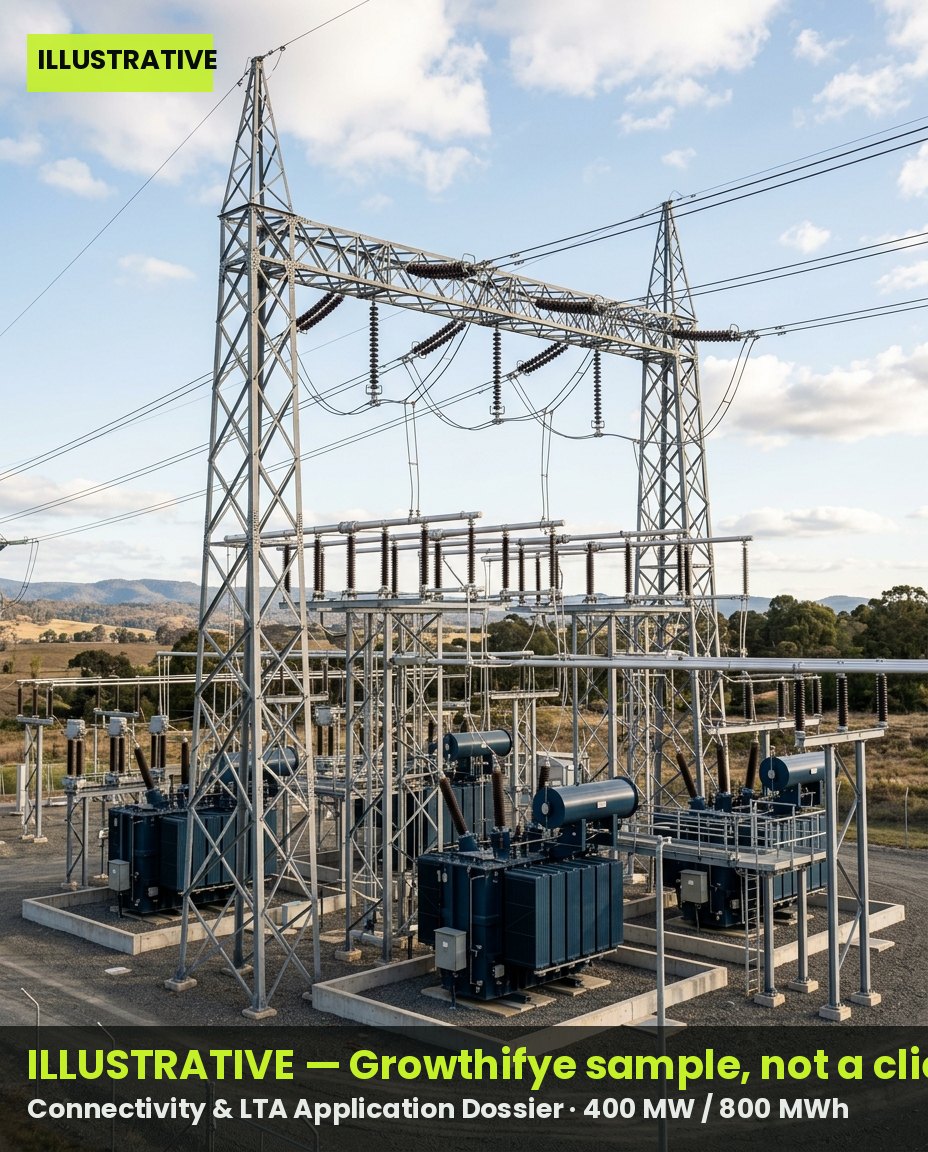 Illustrative · Growthifye-prepared
Connectivity & LTA Application Dossier
Complete technical submission package for grid connectivity, covering load flow, short-circuit and stability study summaries as required by the STU.
Sample excerpt · LTA Application — Document Checklist & Status — illustrative figures
| Document | Description | Status | Submitted To |
| Load Flow Study | N-1 contingency, 220 kV pooling bus | Approved | STU Planning Cell |
| Short Circuit Study | Fault level at PCC, pre/post project | Approved | STU Planning Cell |
| Reactive Capability Curve | PCS Q-V envelope, ±0.95 PF | Under Review | STU Protection Wing |
| Metering Scheme SLD | ABT-compliant CT/PT arrangement | Approved | SLDC |
| Protection Coordination Report | Relay grading, 220/33 kV interface | Resubmission Requested | STU Protection Wing |
- Application tracked against CEA (Connectivity) Regulations timelines
- Resubmission driven by revised fault-level input from utility
 Illustrative · Growthifye-prepared
Grid-Code Compliance Report
Demonstrates compliance with IEGC voltage/frequency ride-through, harmonic limits and reactive power obligations using PSCAD/PSSE simulation evidence.
Sample excerpt · Compliance Test Summary — Key Parameters — illustrative figures
| Parameter | Grid-Code Requirement | Simulated/Tested Value | Result |
| LVRT | Ride through to 0 pu for 150ms | Ride through to 0 pu, 160ms | Pass |
| Frequency Response | 47.5-52 Hz continuous operation | 47.0-52.5 Hz demonstrated | Pass |
| Reactive Power Range | 0.95 lag - 0.95 lead at rated MW | 0.93 lag - 0.96 lead | Pass |
| THD (Voltage) | < 3% at PCC | 2.1% measured | Pass |
| Flicker (Pst) | < 0.8 | 0.55 | Pass |
- Field validation conducted during commissioning trial runs
- Report co-signed by utility protection engineer for record
Joint Commissioning & Charging Plan
Milestone schedule coordinating utility witness tests, protection trip checks, SCADA integration and charging sequence to achieve COD.
Sample excerpt · Commissioning Milestones — illustrative figures
| Milestone | Responsible Party | Target Date | Status |
| CT/PT Ratio & Polarity Check | EPC + Utility Metering | Week 1 | Complete |
| Protection Relay Trip Test | EPC + STU Protection Team | Week 2 | Complete |
| SCADA/RTU Handshake Test | SI Vendor + SLDC | Week 3 | In Progress |
| First Charging (No-Load) | Utility + Project O&M | Week 4 | Scheduled |
| Trial Run (72-hour) | Joint Team | Week 5-6 | Scheduled |
| COD Certificate Issuance | STU / CEIG | Week 7 | Pending |
- Trial run data logged for RE generation/discharge certification
- Punch-list items tracked jointly to avoid COD slippage
Outcomes
- Formal connectivity/LTA grant secured from the transmission utility within regulatory timelines
- Documented, utility-endorsed grid-code compliance reducing risk of post-COD penalties
- Smooth joint commissioning with minimal punch-list disputes, protecting the COD schedule
- Clean charging clearance and COD certificate enabling commercial operation and revenue commencement
Questions clients ask
How early should utility interface engagement begin relative to construction?
Connectivity/LTA applications should be filed as soon as detailed design load flow and fault-level inputs are frozen — typically 6-9 months before planned COD, since utility processing and study review cycles run in parallel with EPC construction.
What causes the most delays in this stage?
Common delays include mismatched fault-level assumptions between developer and utility studies, incomplete metering/protection documentation, and SCADA protocol mismatches during integration testing — all of which we pre-empt through early utility liaison.
Do you represent the client directly in utility meetings?
Yes, we attend technical scrutiny committee meetings and joint commissioning sessions as the client's technical representative, preparing responses and negotiating study assumptions on their behalf.