Behind-the-Meter BESS for India Data Centres in 2026: Tariffs, Design and ROI
By Sudarshan Karweer · sudarshan@growthifye.com · +91 84510 99371 (Call / WhatsApp) · 2026-08-25
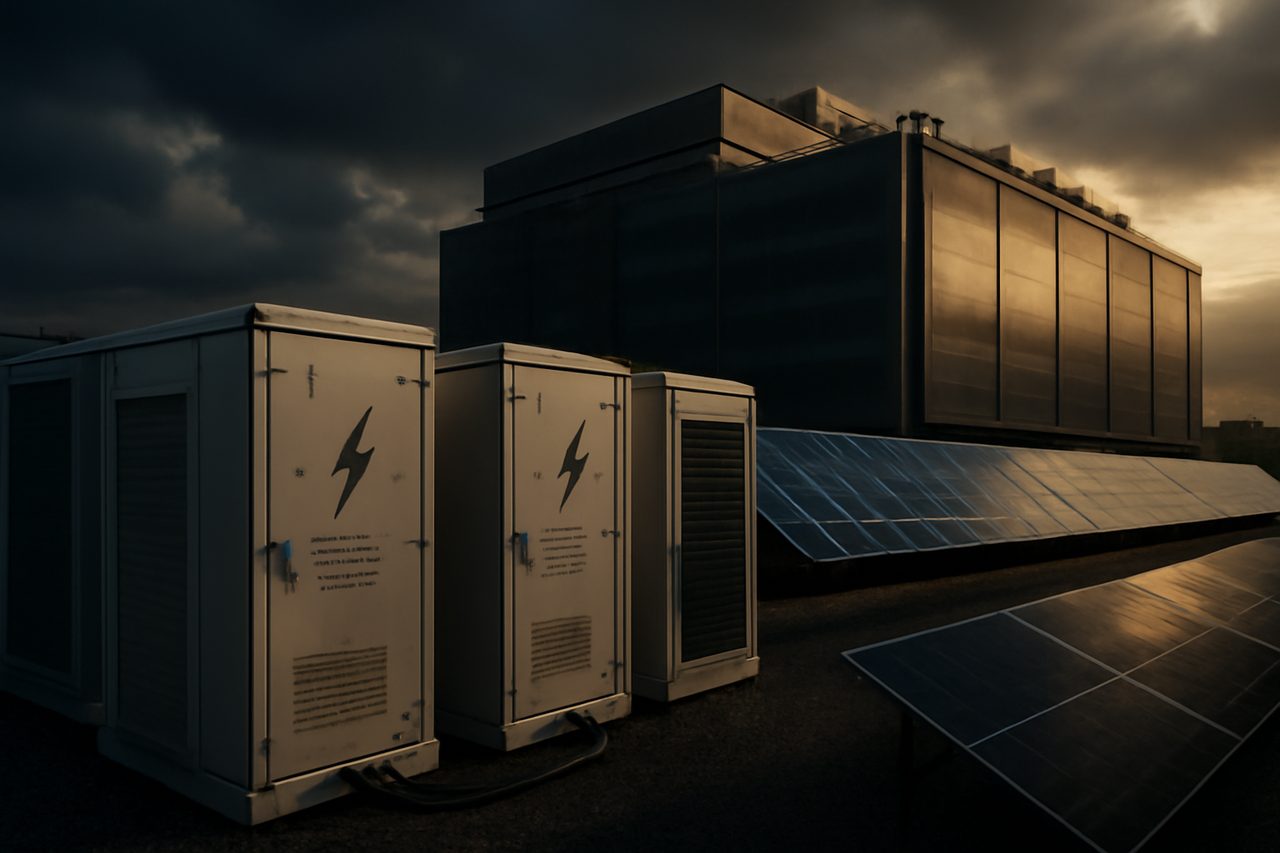
Data centre operators in India have spent the last two years discussing open access, RTC renewable procurement, ISTS waiver timelines and grid connectivity. Those topics matter, but a different lever is now moving from pilot stage to board-level capex approval: behind-the-meter battery energy storage systems, or BESS, integrated with data centre electrical architecture and energy management systems.
For Indian data centres in 2026, on-site BESS is no longer only a resilience asset. It is increasingly a tariff-management tool, a bridge between diesel-backup minimisation and renewable integration, a way to manage contracted demand and power-quality events, and in some cases a practical route to lower blended energy cost without compromising uptime. The business case is strongest where facilities face high demand charges, time-of-day tariff spreads, recurring grid disturbances, transformer loading constraints, or ambitious diesel reduction targets from hyperscale customers.
This article focuses specifically on behind-the-meter BESS for Indian data centres in 2026: where it fits technically, how the economics work, what lenders and operators should test, and how Growthifye approaches sizing, integration and commercial evaluation.
Why behind-the-meter BESS is becoming a core data centre asset
India's data centre load is concentrated in markets such as Maharashtra, Tamil Nadu, Telangana, Karnataka, Uttar Pradesh and NCR, where utilities are tightening grid processes, urban substations are constrained, and tariff structures can materially penalise peak demand. A large colocation facility with 20-60 MW IT load can face a delivered power cost that is not just an energy-rate question. Fixed demand charges, wheeling and banking design, standby provisions, diesel backup O&M, harmonic mitigation, transformer headroom and uptime obligations all affect total cost of ownership.
In that context, a behind-the-meter BESS can deliver value across five use cases:
- peak shaving against sanctioned or billed maximum demand
- load shifting from expensive time blocks to cheaper periods
- fast response during voltage sags, short outages or transfer events
- renewable smoothing for on-site solar or hybrid captive supply landing behind the meter
- diesel runtime reduction during short-duration interruptions and testing events
The commercial reality in 2026 is that lithium-ion BESS pricing has become more bankable for C&I applications, though it remains highly configuration-dependent. Fully installed turnkey costs for data-centre-grade systems in India can vary widely, but a practical range for utility-quality behind-the-meter installations is often around Rs 4.5 crore to Rs 7.5 crore per MWh depending on power rating, fire-safety architecture, redundancy, import content, PCS design, augmentation strategy, HVAC, black-start requirements, SCADA/EMS stack and site conditions. Four-hour systems generally offer a better rupees-per-kWh capex than one-hour systems, but many data-centre use cases are actually driven by 15-minute to 2-hour dispatch windows rather than long-duration shifting.
The tariff logic: where the savings really come from
A common mistake in BESS proposals is to assume the business case comes mainly from simple energy arbitrage. For most Indian data centres, that is only one component and often not the largest one.
The bigger savings levers can include:
- avoiding incremental contract demand revision or reducing billed maximum demand excursions
- reducing distribution demand charges that may range from roughly Rs 250 per kVA per month to above Rs 450 per kVA per month, depending on state, voltage level and consumer category
- shifting consumption away from expensive peak time-of-day blocks where the spread versus solar hours or off-peak hours can be meaningful
- deferring internal electrical infrastructure upgrades, especially transformer and HT-side loading constraints
- reducing diesel consumption during short outages, synchronisation events, routine testing and unstable feeder conditions
Consider a simplified example. A 25 MW data centre in an urban utility area has a sanctioned demand close to its operational peak and experiences repeated 2-3 MW spikes during cooling load ramps, UPS charging recovery and tenant step-load events. If the applicable demand charge is Rs 350 per kVA per month, preventing even 2,000 kVA of incremental billed demand can represent approximately Rs 70 lakh per month, or about Rs 8.4 crore annually, before taxes and other adjustments. In practice, actual savings depend on billing methodology, ratchet clauses, coincidence patterns and EMS performance, but this example shows why demand management often dominates BESS economics.
Time-of-day arbitrage can still matter. In states or tariff categories with peak surcharges of Rs 1.0 to Rs 3.0 per kWh over solar-hour energy cost, a daily-cycling BESS can capture savings, especially when paired with behind-the-meter solar, captive procurement or fixed-block day power. However, arbitrage economics must be tested against round-trip efficiency, degradation, augmentation capex, financing cost and the value of preserving battery cycles for higher-priority resilience functions.
For many data centres, the correct financial model is stacked-value modelling, not a single-use-case model.
BESS architecture choices for Indian data centres
Not every battery configuration suits a high-availability data centre. The design must reflect uptime tier, UPS philosophy, generator topology, protection coordination and fire-safety requirements.
The main architecture questions in 2026 are:
- AC-coupled BESS versus DC-coupled integration with selected systems
- front-of-UPS versus behind-main-incomer placement
- whether the BESS is designed for tariff optimisation only, resilience only, or stacked use
- duration choice: 15 minutes, 30 minutes, 1 hour, 2 hours or 4 hours
- whether the battery should support black-start or generator bridging
In most Indian data centres, AC-coupled systems integrated at the HT/LT distribution level remain the practical choice. They are easier to retrofit, simpler to ring-fence from critical IT power paths, and more compatible with multi-source power contracts and campus-wide EMS dispatch. For pure peak shaving and tariff optimisation, a one-hour or two-hour battery is often enough. For feeder ride-through, diesel minimisation and renewable shaping, the answer may differ by site.
Operators should be careful not to confuse UPS batteries with site-level BESS. UPS systems serve mission-critical continuity at sub-second response times with highly controlled duty cycles. A site-level BESS is a flexible energy asset with broader dispatch logic. The two can complement each other, but they should not be treated as interchangeable unless the electrical design and warranty framework explicitly allow it.
For data centres targeting lower diesel dependency, one emerging model is BESS plus generator optimisation. Instead of starting all DG sets immediately after every disturbance, the BESS absorbs the first minutes of the event while controls determine whether a full generator start is actually necessary. This reduces fuel burn, maintenance and wear from nuisance starts, particularly in locations with frequent short interruptions.
EMS is the real value engine, not just the battery container
A battery without an intelligent EMS is an expensive box with limited monetisation. The highest-performing projects in 2026 are those where the EMS is designed around tariff logic, redundancy constraints, load forecasts, weather, chiller plant behaviour, DG status and utility event signals.
For data centres, EMS design should incorporate at least the following functions:
- 15-minute or finer load forecasting using IT load, cooling load and historical profiles
- dynamic demand-limit control aligned to billing interval methodology
- state-of-charge reservation logic for contingency versus commercial dispatch
- chiller and thermal-load coordination to avoid rebound peaks after discharge events
- renewable generation forecast inputs where rooftop or captive scheduling is linked
- automatic priority shifting during utility alerts, feeder disturbances or DG unavailability
- audit-ready data logging for operations, lenders and enterprise sustainability reporting
One practical issue in India is billing interval alignment. If the utility calculates maximum demand on a 15-minute block basis, the BESS dispatch logic must optimise for that specific interval, not for generic shorter spikes that may not influence the bill. Another issue is state-of-charge reservation. A facility cannot monetise every available cycle if customer SLAs require a portion of the battery to remain reserved for resilience support.
This is where project models often fail. Vendors present theoretical annual dispatch savings based on daily full cycling, but the operations team later imposes conservative reserve bands, reducing realised returns. A credible advisory approach needs to model commercial dispatch constraints exactly as operations will run them.
Sizing methodology: avoid the common oversizing and undersizing errors
There is no universal BESS size for a data centre. Growthifye typically starts with interval load data, tariff structure, outage logs, DG runtime records, cooling behaviour and future expansion schedule before recommending power and energy ratings.
A disciplined sizing workflow in 2026 should test:
- sanctioned demand versus actual measured demand profile
- frequency and duration of peak excursions above target threshold
- feeder reliability and typical disturbance duration bands
- DG start time, synchronisation behaviour and minimum loading constraints
- tenant ramp patterns and occupancy build-out trajectory
- rooftop solar profile, if any, and captive renewable scheduling profile
- target payback period and minimum IRR after degradation and augmentation
A common oversizing error is selecting a four-hour system when the actual value stack is 20-minute peak shaving plus occasional short outage support. Another is undersizing power output. A battery with sufficient MWh but inadequate MW cannot clip fast load ramps effectively. For demand-charge optimisation, MW rating can matter more than energy duration.
As an illustration, a 10 MWh battery rated at 2.5 MW behaves very differently from a 10 MWh battery rated at 5 MW. The second option may create higher capex but can generate better demand-management value if the site experiences sharp peaks. Conversely, if the site needs controlled two-hour shifting for evening tariff management, the lower-power configuration could be acceptable.
Degradation also matters. If the project economics assume aggressive daily cycling, the model should include annual capacity fade, round-trip efficiency drift, augmentation timing and replacement assumptions. Lenders and credit committees in 2026 are increasingly asking for scenario analysis under lower-than-planned dispatch, higher ambient temperature stress and delayed augmentation.
Risk allocation, bankability and contracting points in 2026
Behind-the-meter BESS contracts for data centres are becoming more sophisticated. The key issue is not just EPC price; it is performance accountability under real operating conditions.
Important bankability and contracting points include:
- guaranteed usable energy at commissioning and over time
- availability guarantee and exclusions for EMS, PCS, HVAC and auxiliary systems
- round-trip efficiency guarantee under specified temperature and dispatch bands
- liquidated damages linked to MW response and MWh delivery shortfall
- cell warranty, throughput warranty and augmentation responsibility allocation
- fire detection, suppression and thermal-runaway containment obligations
- cybersecurity standards for EMS/SCADA interfaces
- integration scope with utility meter, BMS, DG controls, chiller plant and UPS environment
Data centre clients should insist on clarity around dispatch hierarchy. If the battery is contractually intended to provide both commercial optimisation and resilience support, the control philosophy must define which service has priority and what happens under a conflict. This affects realised savings and warranty compliance.
A second issue is statutory and utility interface risk. In some cases, the utility may scrutinise export blocking, protection settings, harmonic performance and change-in-load behaviour. The project must be engineered so that the BESS does not create metering disputes or grid-code compliance issues at the point of interconnection.
When does on-site BESS outperform alternatives?
On-site BESS is not always the first or best answer. Some sites can achieve better economics from tariff restructuring, chiller optimisation, transformer augmentation, demand-control software, or revised procurement contracts. But BESS tends to outperform alternatives when several conditions coincide:
- high demand charges and recurring demand excursions
- limited ability to raise sanctioned demand quickly or economically
- frequent short-duration power quality events
- strong internal target to reduce diesel run hours
- meaningful time-of-day tariff spread
- available capex and a site capable of safe installation
It is also increasingly useful in phased campuses. A battery can temporarily relieve electrical bottlenecks while future utility upgrades, additional transformer capacity or tenant occupancy stabilise. In this role, part of the return comes from infrastructure deferral rather than pure electricity-bill reduction.
From a PUE perspective, BESS does not automatically improve efficiency. In fact, conversion losses can worsen the energy balance if the dispatch strategy is poor. But integrated correctly with cooling controls and demand management, BESS can reduce peak-driven operating inefficiencies, avoid suboptimal DG operation, and support a smoother load profile that benefits plant performance. The right KPI is not battery deployment by itself; it is total facility cost and reliability outcome.
The 2026 advisory takeaway for operators, lenders and developers
For Indian data centres in 2026, behind-the-meter BESS should be evaluated as a multi-service infrastructure asset rather than a standalone battery purchase. The decision should rest on interval-data analytics, tariff engineering, control-system design, outage behaviour, safety architecture and financeability.
The strongest projects are those with a clearly stacked value proposition: peak shaving, demand-charge control, diesel minimisation, selective energy arbitrage, and resilience support, all governed by an EMS that reflects actual billing rules and uptime obligations. The weakest projects are those sold on generic cycle assumptions without alignment to utility tariff design or mission-critical operating constraints.
As policy, tariffs and data centre density evolve across Indian states, on-site BESS will increasingly sit alongside open access procurement, captive renewable structures, grid connectivity strategy and PUE optimisation as a core part of power planning. The question is no longer whether batteries have a role. The question is whether they are being sized, integrated and contracted in a way that creates durable, auditable value.
If your team is evaluating BESS for a new or operating data centre, contact Growthifye's advisory desk for a site-specific assessment covering tariff analytics, sizing, EMS logic, EPC risk allocation and project-finance readiness.
About the author

Chief Executive Officer, Growthifye — With over 23 years in management consulting, Sudarshan has taken businesses from concept to scale — building and scaling new-age digital and energy businesses.
- 23+ years in management consulting
- EY alumnus
- Led large-scale BESS programmes, capital raises and advisory mandates
Want this analysis applied to your project?
Talk to our team