Competitive process
Competitive Process: Structured RFPs and bid evaluation to secure the lowest sustainable PPA tariff
Once sourcing strategy is set, we run a disciplined, multi-developer RFP process — standardised bid formats, transparent evaluation criteria, and live tariff benchmarking — so you can compare offers on a like-for-like basis and negotiate from a position of data-backed strength, not developer-supplied assumptions.
Typical duration · 8-12 weeks from RFP issue to preferred bidder selection
Samples generated 05 Sept 2026, 11:27 pm ISTWhat happens in this step
- 01Draft and issue a structured RFP to a shortlist of 8-12 pre-qualified developers with standardised technical, commercial and legal submission templates
- 02Host a bidder query window and pre-bid clarification call to align assumptions on connectivity, land, evacuation timelines and payment security
- 03Receive sealed bids and normalise them onto a common basis (capacity utilisation factor, degradation, escalation, banking charges) to enable true tariff comparability
- 04Run tariff benchmarking against recent DISCOM tenders, IEX/GTAM trends and captive/group-captive precedents in the same state
- 05Score bids on a weighted matrix covering tariff, developer track record, financial strength, land/connectivity readiness and contract flexibility
- 06Shortlist top 2-3 bidders for a negotiation round on tariff, change-in-law pass-through and termination payments
- 07Present a recommendation memo with sensitivity analysis to support final developer selection
What we need from you
- Approved sourcing strategy and target commissioning window
- Client load profile and desired open-access/captive structure from the demand study
- Credit rating or payment security posture the client can offer bidders
- Any preferred sites, states or DISCOMs already under consideration
- Internal approval thresholds and decision-making timeline
- Existing NDAs or developer relationships to be factored into the shortlist

Worked example (anonymised, illustrative)
Group-captive solar-wind hybrid RFP · 80 MW hybrid (60 MW solar + 20 MW wind, ~30% CUF blended) · Karnataka, group-captive structure
A manufacturing group targeting 25% open-access renewable coverage ran a competitive RFP across nine developers to benchmark hybrid tariffs before committing to a 15-year PPA.
Sample deliverables from this step
Every sample below is analyst-written and anonymised for illustration — structure and depth mirror our real deliverables; figures and names are not from any client engagement.
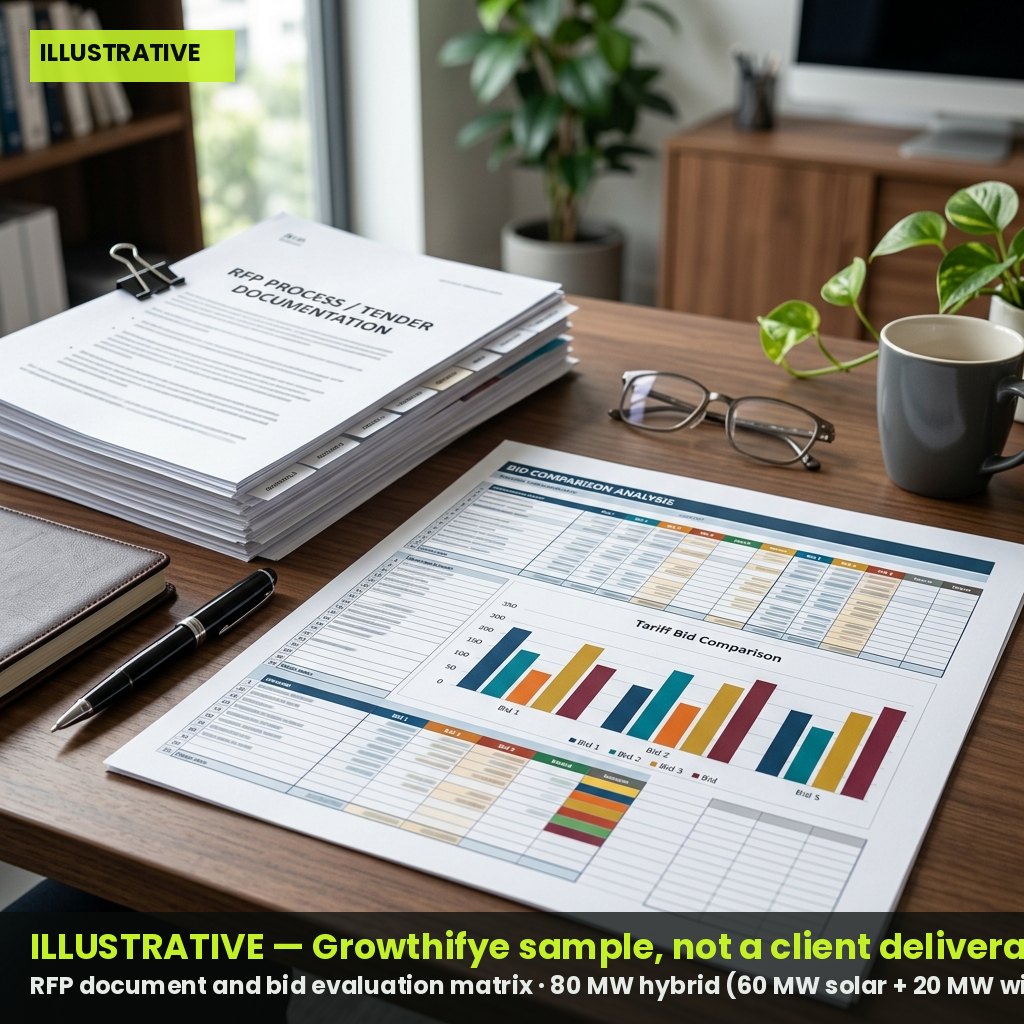 Illustrative · Growthifye-prepared
RFP document and bid evaluation matrix
Standardised RFP pack issued to developers plus a normalised, weighted scoring matrix used to compare all received bids on tariff and non-tariff parameters.
Sample excerpt · Bid evaluation matrix (illustrative, top 5 of 9 bidders) — illustrative figures
| Bidder | Tariff (Rs/kWh, Yr1) | Escalation | CUF guarantee | Weighted score |
| Bidder A | 3.42 | 3%/yr, 5 yrs | 29.5% | 87/100 |
| Bidder B | 3.38 | Flat | 28.0% | 84/100 |
| Bidder C | 3.55 | 3%/yr, 3 yrs | 30.5% | 81/100 |
| Bidder D | 3.47 | Flat | 27.5% | 78/100 |
| Bidder E | 3.60 | 2%/yr, 5 yrs | 31.0% | 75/100 |
- Tariffs are illustrative and normalised to a common CUF/escalation basis for comparability
- Scoring weights (tariff 50%, track record 20%, financial strength 15%, flexibility 15%) agreed with client before bid opening
 Illustrative · Growthifye-prepared
Tariff benchmarking report
Market intelligence comparing received bids against recent state DISCOM tender results, exchange (IEX/GTAM) price trends and comparable group-captive deals.
Sample excerpt · Tariff benchmark comparison (illustrative) — illustrative figures
| Reference point | Segment | Tariff (Rs/kWh) | Notes |
| Recent state DISCOM solar tender | Utility-scale solar | 2.85 | 25-year PPA, single-axis tracker |
| Group-captive wind-solar hybrid (peer) | C&I hybrid | 3.30-3.60 | 15-year term, similar state |
| IEX average day-ahead (blended) | Merchant exposure | 3.10 | 12-month trailing average |
| Current RFP shortlisted bids | C&I hybrid | 3.38-3.55 | Normalised basis |
- Benchmarks drawn from publicly available tender results and anonymised peer transaction data
- Used to test whether bid tariffs are within a defensible market range before negotiation
Negotiation and recommendation memo
Concise memo for client leadership summarising the shortlisted bidders, negotiated concessions achieved, key contract risk items and a recommended preferred bidder.
Sample excerpt · Recommendation memo — key negotiated points — illustrative figures
| Item | Initial bid position | Negotiated position |
| Tariff (Yr1, Rs/kWh) | 3.55 | 3.45 |
| Termination payment cap | Uncapped | Capped at 24 months' billing |
| Change-in-law pass-through | Developer discretion | Mutually agreed formula |
| Commissioning delay LDs | Not specified | 0.5%/week, capped 10% |
- Memo is designed for board/investment-committee level sign-off
- Includes a sensitivity table showing tariff impact of +/-5% CUF variance
Outcomes
- A transparent, defensible record of how the preferred developer and tariff were selected
- Tariff outcomes tested against real market benchmarks, avoiding overpayment or unfavourable long-term escalation terms
- Key risk items (termination liability, change-in-law, delay LDs) improved through structured negotiation before contract drafting
- A shortlisted, credit-checked developer ready to proceed directly into contracting and connection
Questions clients ask
How many developers should we invite to bid?
We typically recommend 8-12 pre-qualified developers to balance competitive tension with manageable evaluation effort; fewer than 5 rarely produces genuine price discovery.
Can bids be compared fairly when developers assume different CUFs or escalation structures?
Yes — we normalise every bid onto a common technical and commercial basis (CUF, degradation, escalation) before scoring, so tariff comparisons reflect true cost rather than differing assumptions.
Do you handle negotiation directly with developers?
We lead or co-lead negotiations on your behalf, focusing on tariff, termination liability and change-in-law terms, while you retain final commercial sign-off at every stage.