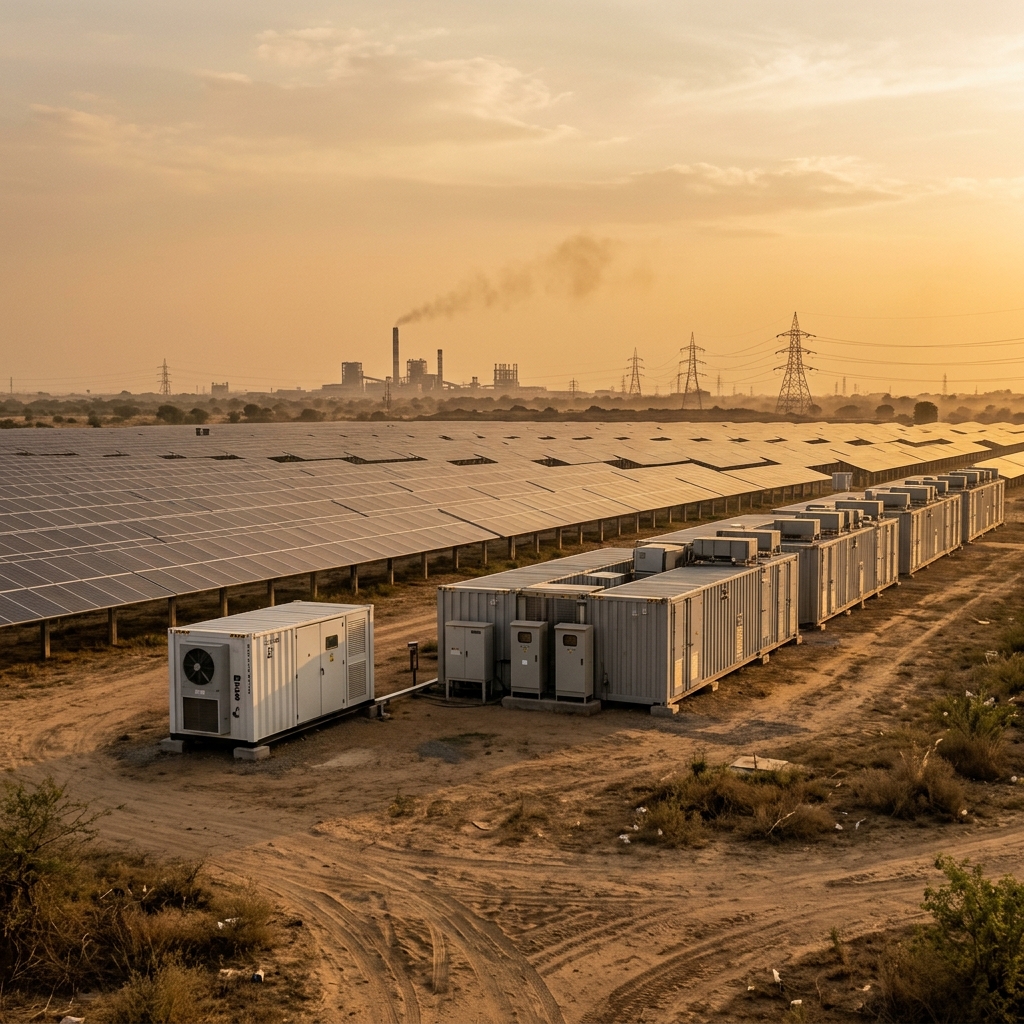
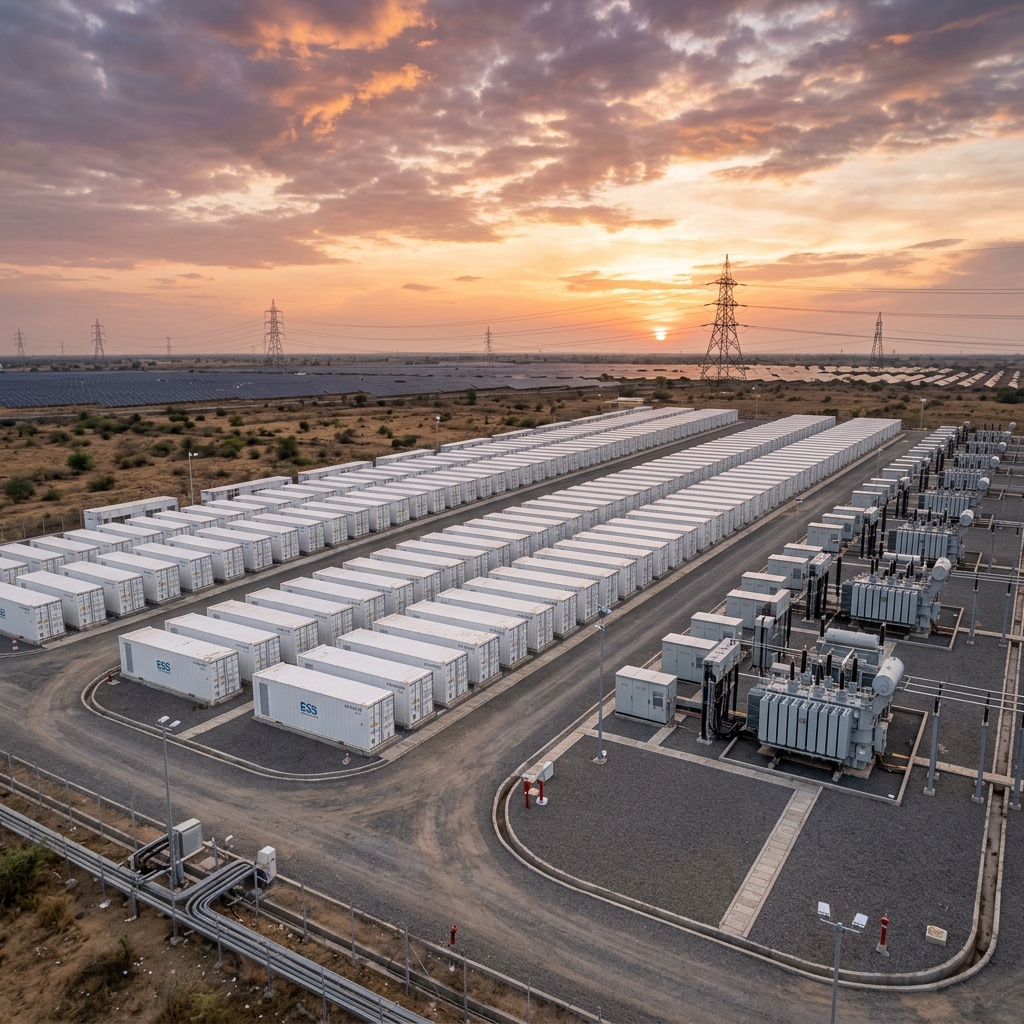
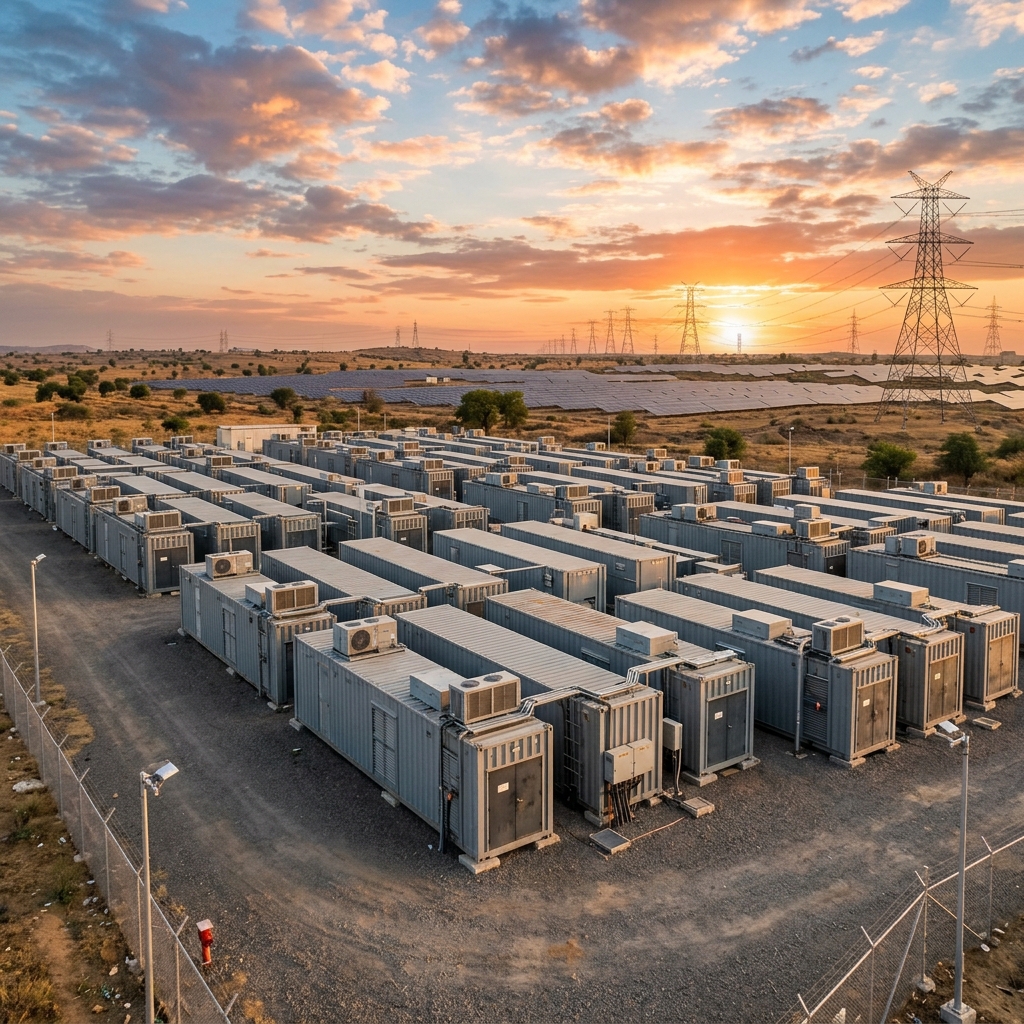
The Mandatory BESS Rule — Are RE Developers Ready?
0:00 / 11:19 · Episode 1
- 01CEA's draft mandates co-located storage (10%/2-hr, rising to 4-hr after 2029) plus grid-forming inverters for solar and wind plants commissioned after July 2027 — it's a plant architecture rule, not just a battery add-on
- 02A compliance-only battery adds 6-8% to capex and 15-25 paise/unit to tariff while shifting only about 4% of daily energy — it raises cost without adding value, squeezing IPPs on ~40-50 GW of pipeline PPAs locked at old tariffs
- 03The 10%/2-hour mandate doesn't solve the DISCOM's real evening-peak problem, which needs 4-6 hours of storage at 25-50% of capacity — so DISCOMs may pay more via change-in-law claims without getting a solution
- 04The fix has two parts: extend VGF to co-located compliance storage (the money fix), and redesign PPAs with two-part tariffs, merchant carve-outs, and DSM linkage so the battery can actually earn (the product fix)
- 05Developers should audit their post-2027 pipeline now, reprice bids to include storage and grid-forming costs, lock architecture decisions early, model storage as a revenue asset, and file comments on the draft before it's finalised
Sudarshan Karweer unpacks CEA's draft Technical Standards for Construction of Electric Plants and Electric Lines, 2nd Amendment Regulations, 2026 (released 3 September 2026), which mandates co-located storage and grid-forming capability for solar and wind plants commissioned after July 2027. He walks through the capex and tariff math, explains why this squeezes IPPs without solving DISCOMs' evening-peak problem, and lays out a two-part fix — VGF extension plus RTC-linked PPA redesign — along with a five-point action playbook for developers and EPCs. Cost figures discussed are back-of-envelope ranges, not precise forecasts, given the regulation is still in draft form.
23 turns · 1,617 words · click a timestamp to listen from there
Sudarshan Karweer
Neha, let me put it in three lines, because honestly the headlines have created more confusion than clarity. One — any ground-mounted solar or onshore wind plant commissioned after the first of July 2027 needs a co-located energy storage system, minimum ten percent of installed capacity, minimum two hours. So a hundred megawatt plant needs a ten megawatt, twenty megawatt-hour battery. Two — if you commission between July 2029 and June 2031, the duration goes up to four hours. That's forty megawatt-hours on the same hundred megawatt plant. Three — and this is the bit people are missing — grid-forming. After July 2027, at least fifteen percent of the plant's inverters must have grid-forming control, and every BESS PCS must be grid-forming. So this is not just a put-a-battery-in rule. It's a plant architecture rule.
The Hook — What the CEA Draft Actually Says
Neha
Welcome back. Today's topic has really set the industry on fire, Sudarshan. On the third of September, CEA released a draft regulation, and it says every ground-mounted solar and onshore wind plant commissioned after July 2027 must have storage attached — mandatory. So first things first, what does the rule actually say?
Neha
And this is still only a draft, right?
Sudarshan Karweer
Yes, it's a draft, it takes effect on publication in the Gazette. But I tell developers very clearly — do not treat a draft as a draft. CEA has given the direction. The percentages, the hours, they may move up or down a bit. The direction will not change.
Neha
Okay, so your thesis, as I understand it, is that this rule will make cheap RE expensive. But ten percent storage sounds small on paper. How much difference does it really make to the economics?
The Cost Math — Twenty Paise That Changes Everything
Sudarshan Karweer
Let's go to the numbers, because policy shouldn't be made on gut feeling. A hundred megawatt solar plant today is roughly a three hundred fifty to four hundred crore rupee project. Add a twenty megawatt-hour BESS block — battery, PCS, balance of system, integration — that's broadly twenty to twenty-five crore rupees more. The grid-forming premium sits on top of that, on both the inverters and the PCS. So capex goes up six to eight percent. Now convert that into tariff terms. If that battery earns no additional revenue — if it's sitting there purely for compliance — you're loading fifteen to twenty-five paise per unit onto the solar tariff. A tariff of two rupees fifty paise becomes two rupees seventy to two rupees seventy-five paise.
Neha
Is twenty paise really that big a deal in the larger scheme of things?
Sudarshan Karweer
For two reasons. First — Indian solar bids are won on the margin. Five paise is often the difference between L1 and L4. Twenty paise means the entire bid economics reset. Second, and this is the real problem — a ten percent, two-hour storage does not change the plant's profile at all. A hundred megawatt plant generates roughly four hundred fifty to five hundred megawatt-hours a day. The battery shifts twenty megawatt-hours — that's about four percent. It doesn't make the plant round-the-clock, it doesn't make it peaking, it doesn't make it firm. It's a compliance battery — it's a cost, not a product. That's why I keep saying, the rule makes solar more expensive, but it doesn't make solar more valuable. And that gap is exactly what will squeeze the IPPs.
Who Actually Pays — Developer, DISCOM, or the Regulator
Neha
So who actually absorbs this cost then — the developer or the DISCOM?
Sudarshan Karweer
That's the forty-to-fifty gigawatt question, quite literally, because that's roughly the solar and wind pipeline in the country that's been awarded, has a signed PPA, but will commission after July 2027. Those PPAs have tariffs locked around two rupees fifty paise. Now the developer will say, this CEA regulation is a change in law, compensate me. The DISCOM will say, you committed to following technical standards, this is your risk. And then the matter goes to CERC or the SERC. Neha, the average life cycle of a change-in-law petition is two to four years. Who carries the developer's cash flow in the meantime? Not the lender, I can tell you that.
What Do DISCOMs Get? Busting the Myth
Neha
So the IPP is really stuck on both sides here.
Sudarshan Karweer
Exactly. Either you put equity in front of the bank, or you wait in front of the regulator. Small and mid-size IPPs have neither the equity nor the patience for that. The large players, the ones with strong balance sheets, they'll simply consolidate. If the design isn't fixed, this rule quietly becomes a consolidation rule.
The Fix — VGF and RTC-Linked PPA Design
Neha
But surely the DISCOM benefits somewhere — storage is coming onto the grid either way?
Sudarshan Karweer
This is exactly the myth I want to break today. What is the DISCOM's actual problem? It's the six PM to ten PM peak, when solar generation is zero. To serve that peak you need four to six hours of storage, sized at twenty-five to fifty percent of plant capacity. A ten percent, two-hour battery does not build an evening peak. It's a small shock absorber for the grid — useful for ramping, for frequency, for deviation settlement — but it doesn't even touch the DISCOM's evening capacity problem. And here's the twist — if developers win their change-in-law cases, the DISCOM ends up paying twenty paise more, and gets what in return? A four percent energy shift. So the DISCOM pays more, and still has to run a separate standalone BESS tender for the actual peak. Hence the second half of my thesis — this rule doesn't save the DISCOMs either. It's a mandate, not a solution.
Are Developers Ready? The Five-Point Playbook
Neha
Okay, so then what does the right design look like? You keep talking about VGF and RTC-linked PPAs.
Sudarshan Karweer
There are two fixes, one for the money, one for the product. The money fix is viability gap funding. Government already has a VGF scheme for standalone BESS. If you're making storage mandatory on co-located plants too, extend VGF to that co-located compliance storage. Otherwise this is an unfunded mandate — the Centre writes the rule, the IPP puts up the money, the DISCOM refuses to pay. And link that VGF trigger to commissioning, not to some future court order. The product fix is PPA design. A battery only earns money if the PPA lets it earn. There are really three options here. One — a two-part tariff. An energy charge for the solar, a capacity charge for the storage, linked to an RTC or a peak-supply obligation, so the developer knows exactly which slot that twenty megawatt-hour discharge earns a premium in. Two — a merchant carve-out. MNRE clarified in April that power from a battery charged with non-RE energy can be sold merchant or third-party, without needing the procurer's NOC. Make that standard in every PPA template. Then the compliance battery can recover its own cost on the exchange. Three — DSM linkage. CERC's DSM draft is going to measure RE generation against schedule. A ten percent battery is enough to manage deviation. If the mandate is linked to DSM relief, that battery turns from a cost centre into a genuine risk-management asset for the developer.
Closing — The Era of Plain Solar Is Ending
Neha
So the rule itself isn't wrong — it's the packaging around it that's the problem.
Sudarshan Karweer
Exactly that. The direction is right — India needs firm RE, India needs grid-forming capability. But issuing a technical standard without a commercial framework around it is like making seatbelts mandatory and then billing the driver for them instead of the insurance company.
Neha
Let's get practical now. An IPP or an EPC contractor is listening to this — what should they actually do tomorrow morning?
Sudarshan Karweer
Five things, and I'm saying these in coaching mode, because these are leadership decisions, not engineering ones. One — pipeline audit. Every project with a scheduled commissioning date after July 2027, put it on the table. Which PPA covers change in law, which one doesn't. For the ones that don't, go talk to your lender now, not after commissioning. Two — reset your bid strategy. Any bid you submit from today with an SCOD after July 2027, storage and grid-forming have to be built into the price. A developer still bidding at two rupees fifty paise isn't really bidding, he's hoping. Three — make the architecture decision now. DC-coupled or AC-coupled, which grid-forming inverter OEM, can the two-hour block be augmented to four hours later without redoing the civils. Design the 2029 rule into today's layout, or you'll end up doing the civil work twice. Four — treat storage as a revenue asset, not a compliance line item. Merchant window, ancillary services, DSM avoidance — model all three seriously. In our own modelling, we've seen that with the right dispatch strategy, a compliance battery can recover forty to sixty percent of its cost. That's a lot better than zero. Five — comment on the draft. This is still a draft. Through industry associations, or individually, put three asks on record — VGF extension, standard change-in-law treatment, and a PPA template with a storage component built in. Whoever stays quiet now will be the one filing a petition later.
Neha
Last question then — in one line, is the era of cheap RE over?
Sudarshan Karweer
No. The era of plain solar is ending. Cheap RE will survive, but from now on cheap will mean cheap firm power, not just cheap daytime power. The developer who sees this as a threat will get squeezed. The developer who sees it as a product redesign will own the next five years of this market. The rule is the same for everyone — the reaction is what's different. And the reaction is the strategy.
Neha
Sudarshan, thank you for breaking this down. And to everyone listening — if you have a project in your pipeline commissioning after July 2027, forward this episode to your CFO today.
Got a question this episode left open? Ask in Hindi, English or Hinglish — Neha reads the queue before every recording, picks listener questions and reads them out in Hindi and English before Sudarshan answers, crediting you by first name.
अपना सवाल हिंदी या English में लिखिए — नेहा अगली रिकॉर्डिंग में चुने गए सवाल दोनों भाषाओं में पढ़ेंगी और सुदर्शन जवाब देंगे।
0 questions on this episode
No questions yet — be the first to put one to Sudarshan. · पहला सवाल आप पूछिए।