India Data Centres in 2026: Open Access, ISTS Waiver, CSS and BESS Economics
By Sudarshan Karweer · sudarshan@growthifye.com · +91 84510 99371 (Call / WhatsApp) · 2026-08-25
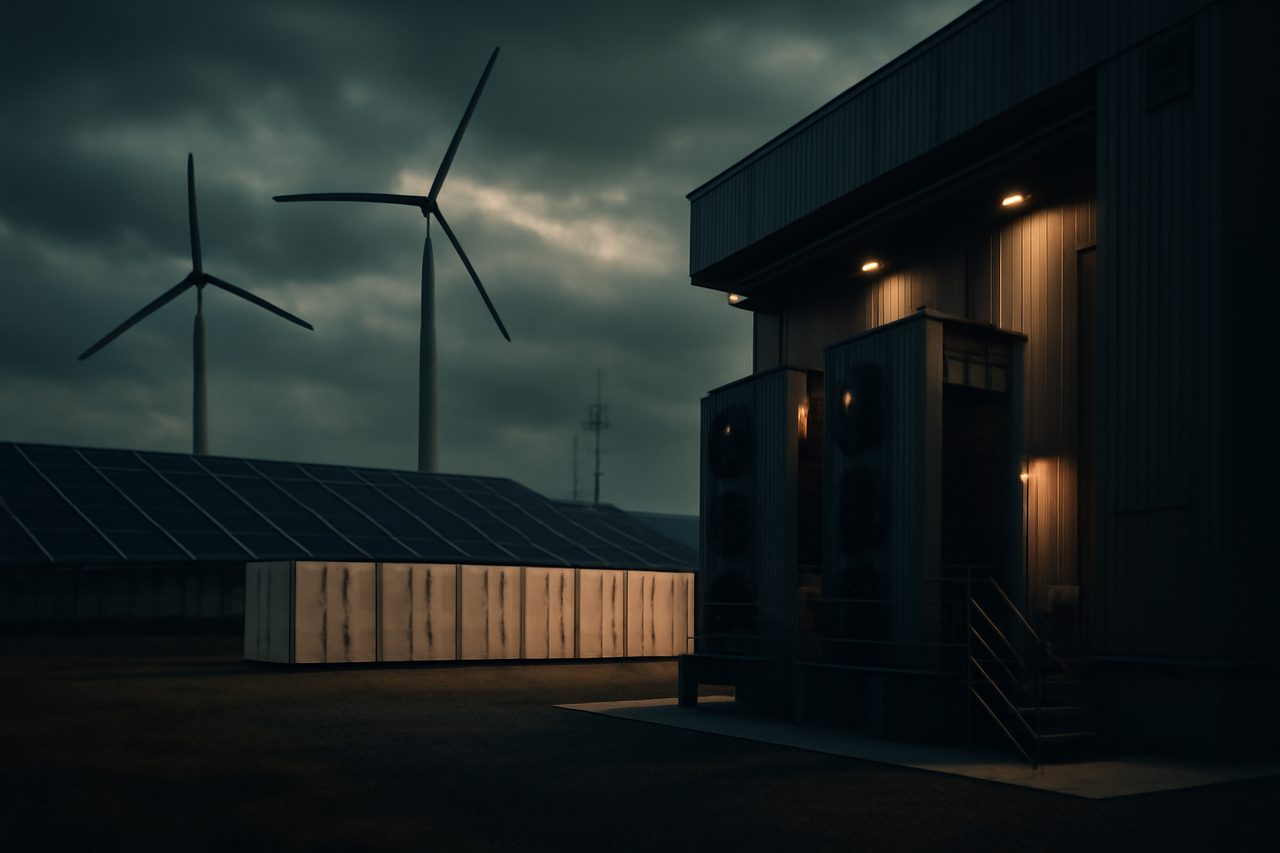
India’s data-centre pipeline is expanding faster than most grid-connected industrial segments, but the real constraint in 2026 is not land or server demand. It is power strategy. For operators planning campuses in Mumbai, Chennai, Hyderabad, Bengaluru, Pune, Noida and emerging secondary markets, the key question is no longer whether renewable energy can reduce cost. The question is how to structure open access, transmission, cross-subsidy charges, banking, on-site storage and backup architecture so that energy cost, uptime and carbon targets move together rather than in conflict.
This article takes a different angle from the usual 24/7 carbon-free energy discussion. Instead of focusing on hourly matching and RTC procurement design, it examines the operating economics and regulatory structure behind Indian data-centre power supply in 2026: open access routes, interstate transmission waivers, cross-subsidy and additional surcharge exposure, state-level banking conditions, and where on-site BESS actually works financially.
For data-centre operators, RE developers, lenders, utilities and policymakers, this is the practical layer where project viability is won or lost.
Why data-centre power strategy in India is now an access-and-charges problem
Most hyperscale and colocation data centres in India are targeting high renewable-energy shares, but delivered electricity cost still depends more on network and regulatory charges than on the underlying solar or wind tariff.
A utility-scale renewable PPA might still be contracted in the range of roughly Rs 2.7-3.4/kWh for solar, Rs 3.3-4.2/kWh for wind, and blended firmed structures at materially higher landed values depending on balancing and location. Yet the final delivered cost to a data centre can move upward by Rs 1.5-4.0/kWh or more once the following are added:
- STU or CTU transmission charges
- wheeling charges
- cross-subsidy surcharge or CSS
- additional surcharge or AS
- standby charges
- banking charges and banking loss adjustments
- scheduling, SLDC fees and deviation-related costs
- BESS integration costs where firming is required
This is why two data centres buying renewable electricity at almost identical generator tariffs can have sharply different landed power costs.
For a large campus with 50-150 MW critical load, even a Rs 0.75/kWh error in landed-cost assumptions can change annual power spend by tens of crores. At 100 MW average demand and 95% annual load factor, electricity consumption is about 832 million units per year. A Rs 0.75/kWh variance on that base means roughly Rs 62 crore annually.
That scale makes regulatory diligence as important as engineering design.
Open access options for Indian data centres in 2026
For most large campuses, three broad supply models dominate.
- utility supply with retail tariff optimisation and reliability redundancy
- third-party or group-captive renewable open access
- hybrid architecture combining utility baseload, open-access renewables and on-site BESS or gas-based backup
Retail utility supply remains the simplest route operationally, but in major states the HT commercial or industrial tariff for data-centre-type loads can land anywhere from about Rs 7 to above Rs 11/kWh depending on state, voltage level, demand charges, time-of-day elements and duty. In high-tariff states, this creates strong pressure to migrate at least part of consumption to open access.
Third-party open access works well when the state’s CSS and AS framework is manageable and scheduling discipline is strong. Group captive structures can reduce or avoid CSS exposure where legal conditions are met, typically requiring at least 26% equity ownership by captive users and at least 51% annual consumption by those users on an aggregate basis under prevailing captive rules and jurisprudence. For data-centre operators with stable, large loads, captive structures are often attractive because consumption predictability supports compliance.
However, captive design is not a paperwork exercise. Lenders and offtakers need to evaluate:
- whether load shape and annual offtake support the 51% consumption requirement
- whether ownership is proportionate and durable over the PPA tenure
- whether consumption is concentrated in one entity or spread across SPVs and tenants
- how future expansion phases affect captive compliance
- what happens if colocation customers change occupancy and therefore effective load
For colocation operators, this is particularly important because the underlying IT load belongs to tenants even though the facility operator may be the contracting entity. The legal and accounting treatment of captive participation can become complex if tenant structures change.
ISTS waiver: still important, but not the whole story
The interstate transmission system or ISTS waiver remains central to renewable procurement economics in 2026. For many renewable projects commissioned within the applicable timelines and categories, the waiver on ISTS transmission charges can materially improve landed economics for interstate supply.
But data-centre buyers should not overstate its impact. The waiver is not a blanket elimination of all delivery charges. Even where generator-side interstate transmission charges are waived, buyers can still face:
- state transmission and wheeling charges after injection or drawal within the destination state
- SLDC and scheduling fees
- CSS and AS where applicable
- losses at different network levels
- balancing costs if the procurement structure is not firmed
The result is that an interstate solar or hybrid PPA that appears significantly cheaper than local utility supply at first glance may narrow once all destination-state charges are modeled correctly.
This is especially relevant in major data-centre states:
- Maharashtra often offers large market size and strong procurement appetite, but delivered open-access cost depends heavily on wheeling, standby and banking conditions.
- Tamil Nadu provides strong renewable-resource access but banking terms, network constraints and scheduling realities matter.
- Telangana and Karnataka can be competitive for certain structures, but state-level charge evolution requires current diligence rather than old assumptions.
- Uttar Pradesh and NCR-linked demand centres may find interstate structures useful, but the local network and surcharge profile still determines final viability.
A practical rule for sponsors and lenders is simple: evaluate ISTS-waiver benefit only inside a full landed-cost model at the delivery point, not at the generator busbar.
CSS, additional surcharge and banking: the silent PPA killers
Cross-subsidy surcharge remains one of the biggest variables affecting open-access viability for data centres. In some jurisdictions, CSS can add enough cost to make plain third-party open access unattractive relative to group captive or even negotiated utility supply.
Additional surcharge creates another layer of risk where discoms claim stranded fixed-cost exposure due to migration of consumers. For large 24x7 loads, AS can materially alter the savings case.
Banking policy is equally important. Data centres consume continuously, while solar output is concentrated in daytime hours and wind output is seasonal and volatile. Banking helps bridge timing mismatch, but state rules in 2026 are often restrictive on one or more of the following dimensions:
- monthly versus annual banking
- banking charge per unit
- deemed drawal restrictions in peak periods
- peak-hour withdrawal prohibition
- energy-settlement haircut or banking loss factor
- treatment of unutilised banked energy at period end
If a project model assumes historical banking treatment that is no longer available, savings estimates can be overstated by a wide margin.
Consider a simple illustration for a 40 MW average-load data centre sourcing daytime solar under open access. If 55-60% of annual solar generation must effectively be reshaped through banking, the commercial value of that structure depends heavily on the banking regime. A banking charge of Rs 0.25/kWh with modest loss adjustment is manageable; a more restrictive regime with high charges, withdrawal limitations and haircut on settlement can sharply reduce value. In such cases, combining solar with wind, or replacing part of banking dependence with BESS or market purchases, may be superior.
This is why data-centre procurement in India increasingly relies on portfolio design rather than single-source PPAs.
Where on-site BESS works, and where it does not
Battery energy storage systems are attracting intense interest from data-centre operators, but the economics need precision. On-site BESS should not be treated as a universal substitute for diesel backup, utility redundancy and power-quality systems. Each layer does a different job.
In 2026, indicative fully installed costs for front-of-meter or behind-the-meter lithium-ion BESS in India vary by duration, use case, thermal design, augmentation philosophy, PCS configuration and imported-content assumptions. As a broad market indication:
- 1-hour systems may fall around Rs 4.5-6.5 crore per MWh equivalent in many behind-the-meter configurations
- 2-hour systems often land around Rs 7.5-10.5 crore per MWh block of usable energy depending on scale and integration scope
- total cost can rise further once fire safety, HVAC, EMS integration, protection upgrades and site constraints are included
For data centres, the real use cases are usually these:
- short-duration ride-through during transfer events
- peak-demand management and demand-charge reduction
- limited renewable firming for intra-day shifting
- power-quality support and resilience enhancement
- reduction in diesel runtime during brief disturbances
The weakest use case is often trying to cover long renewable deficits economically using only on-site batteries. A campus with 80 MW average demand requiring even four hours of storage would need roughly 320 MWh of usable storage. At today’s costs, that is a major capital commitment, and replacement or augmentation planning must be included.
By contrast, a 20-40 MWh battery dedicated to ramp smoothing, peak clipping, UPS interaction support and short-duration backup optimisation may be defensible, especially where demand charges are high or grid disturbances are frequent.
Data-centre operators should run BESS through a stacked-value model, not a single-use-case model. Revenue or savings stacks can include:
- avoided peak-demand charges
- reduced diesel test and event runtime
- improved renewable self-consumption
- reduced curtailment of on-site solar where relevant
- improved transfer performance and resilience metrics
- ancillary participation where market frameworks permit in future
If only one savings stream is being counted, the battery usually struggles financially unless resilience value is exceptionally high.
Grid connectivity, standby design and utility negotiation
The most under-discussed issue in Indian data-centre power planning is not renewable tariff. It is grid interface design.
A technically sound and commercially resilient data-centre energy plan should address:
- contracted demand sizing by phase of buildout
- N-1 or 2N utility-feed philosophy where available
- dedicated substation or bay requirements
- transmission versus distribution connectivity options
- standby charges during open-access outages or maintenance windows
- harmonics, reactive power and power-quality compliance
- black-start and restoration sequencing with backup systems
For campuses above roughly 50 MW, early engagement with the utility and transmission utility is essential. Lead times for bay allocation, substation strengthening, right-of-way and protection approvals can exceed the construction timeline if not started early.
This matters directly to lenders. A renewable PPA can be signed quickly; physical connectivity cannot be wished into existence. Financing committees should therefore track grid-readiness milestones as seriously as land and permits for the generation asset.
Utility negotiation also matters more than many buyers assume. Data-centre loads are valuable to discoms because they are large, stable and creditworthy. In some states, there may be room for customised supply solutions, negotiated reliability commitments, phased demand ramp-ups or structured standby arrangements that narrow the gap between utility and open-access power economics.
For policymakers, this is a major opportunity. If states want to attract AI, cloud and hyperscale investment, predictable open-access charges, faster high-voltage connectivity and rational standby frameworks will matter as much as land parks and IT incentives.
A decision framework for developers, lenders and policymakers
For market participants evaluating Indian data-centre energy supply in 2026, the right question is not “solar or grid” or “BESS or no BESS.” The right question is which portfolio architecture minimises delivered cost while preserving uptime and regulatory durability over 15-25 years.
A workable evaluation framework should include at least the following:
- base load profile by month, hour and expansion phase
- utility tariff forecast including demand charges and duty
- open-access delivered-cost stack by state and by structure
- CSS and AS sensitivity under possible regulatory change
- banking value under current state rules, not legacy assumptions
- impact of ISTS waiver within destination-state landed cost
- BESS stack value across resilience, peak shaving and firming
- diesel displacement value only where technically realistic
- grid connectivity timeline and capex at intake point
- tenant growth and occupancy risk for colocation models
In many cases, the winning structure in India today is a layered model:
- utility supply for reliability backbone
- captive or third-party renewable open access for energy-cost reduction and emissions performance
- limited-duration on-site BESS for power quality, transfer support and peak optimisation
- disciplined EMS and load segmentation to optimise non-critical auxiliary consumption
This differs from the more simplistic idea that one giant RTC contract solves everything. In practice, regulatory friction and site-specific grid realities shape economics as much as generation choice.
For RE developers, the implication is equally clear. Products for data centres must move beyond plain vanilla solar PPAs. Buyers increasingly need delivery-aware offerings that integrate transmission strategy, scheduling, charge pass-through clarity, banking optimization and optional storage overlays. Developers that can present a credible landed-cost model at the client meter will outperform those selling only headline tariffs.
For lenders, diligence must go beyond generator risk and offtaker credit. The offtake structure itself can create value leakage through surcharge changes, captive non-compliance, network constraints or weak standby assumptions. Debt sizing and reserve design should reflect these non-generation risks.
For policymakers and utilities, data centres represent a strategic load category for India’s digital economy. Enabling them with transparent open-access frameworks, predictable banking rules, timely grid connectivity and cost-reflective standby design can attract long-duration investment while also supporting renewable integration.
India’s data-centre sector does not need generic sustainability narratives. It needs precise power architecture. In 2026, the winners will be operators and counterparties who model delivered cost at the meter, secure grid access early, and deploy BESS only where the value stack is real.
If your team is evaluating open access, captive structuring, grid connectivity, BESS sizing, EMS integration or a bankable power strategy for a data-centre project, contact Growthifye’s advisory desk for a practical assessment tailored to your site, load and state regulations.
About the author

Chief Executive Officer, Growthifye — With over 23 years in management consulting, Sudarshan has taken businesses from concept to scale — building and scaling new-age digital and energy businesses.
- 23+ years in management consulting
- EY alumnus
- Led large-scale BESS programmes, capital raises and advisory mandates
Want this analysis applied to your project?
Talk to our team