India 2026 NGO Energy Access: Solar Water, Livelihood Loads and CSR Grants
By Sudarshan Karweer · sudarshan@growthifye.com · +91 84510 99371 (Call / WhatsApp) · 2026-08-29
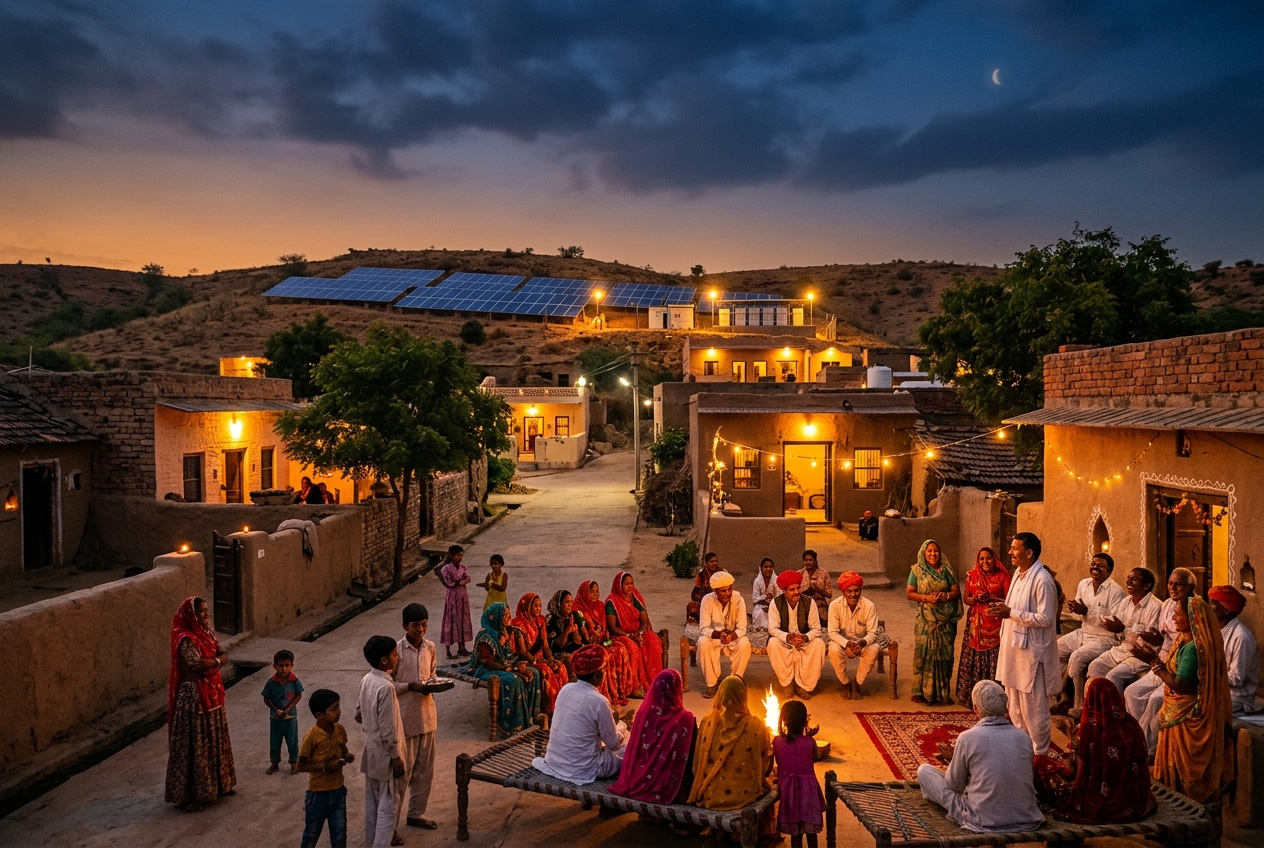
India’s NGO energy-access market is moving beyond basic lighting and household systems. In 2026, one of the most bankable and measurable community-energy pathways is solar for water and water-linked livelihoods: drinking water supply, irrigation, dairy chilling support loads, village enterprises and women-led micro-businesses that depend on reliable daytime power. For NGOs, CSR teams, utilities and funders, this angle offers a different delivery logic from mini-grids or PAYGo retail. It ties energy access directly to water security, income generation and public-service outcomes, making it easier to justify grant support and easier to verify impact.
This article sets out a practitioner framework for structuring NGO-led solar water and livelihood-load programmes in India in 2026: where the economics work, which policy windows matter, what CAPEX and tariff assumptions to use, how to build a credible MRV stack and how to avoid the common failure modes that weaken scale-up.
Why solar water and livelihood loads are a strong NGO energy-access theme in 2026
The strongest NGO energy-access interventions are those that create visible public value within 6 to 18 months while keeping recurring subsidies low. Solar water systems meet that test for five reasons.
- They solve a high-salience local problem: drinking water reliability, irrigation cost or diesel dependence.
- They convert directly into measurable social outcomes: hours of service, litres supplied, acres irrigated, diesel displaced, women’s time saved and enterprise income created.
- They operate largely in daytime, which fits solar generation and reduces storage dependence.
- They can be owned by panchayats, user committees, FPOs, SHGs, schools, health facilities or NGOs under clear governance arrangements.
- They attract multiple funding pools at once: CSR, district convergence, philanthropic grants, climate-focused donors and, in some cases, carbon-linked clean-cooking or diesel-displacement programmes as adjacent layers.
In many districts, the actual village pain point is not first-mile generation alone but the cost and unreliability of pumping, treating, storing and distributing water. Diesel irrigation can still cost farmers roughly Rs 18-25 per kWh equivalent when fuel, transport, maintenance and low engine efficiency are considered. Even grid-connected rural pumping is often constrained by feeder timing, low voltage and seasonal outages. By contrast, well-designed solar pumping and water-service systems can produce delivered energy at a levelised cost often below Rs 3.0-4.5 per kWh over asset life for grant-supported community installations, depending on utilisation, O&M discipline and pump sizing.
For CSR decision-makers under Schedule VII-eligible themes such as rural development, environment sustainability, health and livelihoods, solar-water projects are easier to position than generic “renewable energy awareness” initiatives. They also create stronger audit trails because output metrics are physical and observable.
Use cases that work best for NGO-led deployment
Not every rural load is suited to NGO delivery. The best use cases are those with shared benefit, measurable usage and clear local custodianship.
First is community drinking water supply. Typical systems combine solar pumping, elevated storage, treatment where required and distribution through standposts or local piped networks. In fluoride, iron or salinity-affected geographies, solarisation can be paired with treatment skids, though treatment OPEX must be ring-fenced. Typical solar capacities may range from 3 kWp for small habitation systems to 15-30 kWp for larger multi-hamlet assets, depending on source depth, head and daily demand.
Second is irrigation for group farming or FPO-linked clusters. Individual solar pumps have scale through government schemes, but NGO interventions are often stronger when focused on shared irrigation, water-user groups and crop planning. Shared assets reduce per-farmer CAPEX and improve utilisation, especially in horticulture, vegetable belts and tribal livelihoods programmes.
Third is water-linked livelihood infrastructure. Examples include milk collection points, community washing and processing equipment, small food-processing units, seed cleaning, spice grinding, flour milling and rural cooling loads that can operate around water access points or agriculture centres. These are not large industrial loads, but they matter because they monetise energy access and support user-fee collection.
Fourth is institutions with water-energy needs. Hostels, ashram schools, health sub-centres and skill centres often need pumping, filtration, refrigeration support and backup for digital services. These are especially relevant in aspirational districts and remote blocks where CSR visibility matters.
In practice, the most resilient model is not a single-asset intervention. It is a village or cluster package with one core social service load and one or two livelihood loads attached. That improves utilisation, spreads fixed O&M costs and creates stronger local willingness to pay.
2026 cost benchmarks, tariffs and commercial structures
For practitioners, vague claims about affordability are not enough. The following 2026 working benchmarks are useful for programme screening in India, though district-level bids vary by geology, civil scope and BOS quality.
- Community solar pumping systems: around Rs 55,000-75,000 per kWp for basic pumping-only systems at modest scale, excluding major civil works and distribution.
- Drinking water systems with storage, controller, mounting and basic treatment integration: often Rs 6 lakh to Rs 25 lakh per site depending on bore depth, daily demand, treatment complexity and pipeline length.
- Solar irrigation pumps for shared use: broadly Rs 2.5 lakh to Rs 6 lakh per asset for common capacity bands, before site-specific civil and water-distribution additions.
- Small livelihood-load systems co-located with solar water assets: Rs 1.5 lakh to Rs 10 lakh depending on machinery, cooling and wiring.
- Annual O&M budgets: typically 1.5% to 3.0% of installed project cost for basic systems; higher where water treatment membranes, remote telemetry or intensive field support are included.
The biggest commercial mistake NGOs make is treating CSR as one-time CAPEX and underfunding service continuity. In 2026, credible projects are being structured in three financial layers.
Layer 1 is anchor grant capital. CSR funds, philanthropic grants or district convergence cover 40% to 90% of initial CAPEX depending on the poverty profile and public-good component.
Layer 2 is local contribution. This may be cash, labour, land, civil support, panchayat contribution or beneficiary deposit. Even a 5% to 10% community stake improves asset care and dispute resolution.
Layer 3 is recurring revenue. User fees, irrigation service charges, institutional payments, FPO levies or enterprise rent support O&M and future replacements. Purely free-service models tend to degrade after 18-30 months unless the panchayat has a committed maintenance budget.
For drinking water, user-fee structures often work better when expressed per household per month rather than volumetric tariffs in small villages. Rs 30-80 per month per household is common for basic service acceptance in many locations, though this depends on service quality, source reliability and willingness to pay. For irrigation, hourly pump rental or acre-based seasonal charging is easier to administer. Charges need not recover full CAPEX if grants cover social value, but they should at least cover operator wages, routine maintenance and a replacement reserve.
Where grid power is available but erratic, hybrid systems can be evaluated. However, adding batteries to water-dominant daytime loads should be justified carefully. In many cases, bigger storage tanks are cheaper than electrochemical storage. Community-energy planners should compare the cost of water storage against battery backup before specifying system architecture.
Policy and institutional fit in India
The most scalable NGO programmes in 2026 align with public schemes rather than duplicate them. That means understanding where solar-water projects sit within central and state policy ecosystems.
PM-KUSUM remains relevant for agricultural solarisation, especially where feeder issues and diesel displacement are material. However, NGOs should not assume that individual-farmer pump subsidy pathways solve community-access needs. Shared irrigation, women’s collectives and tribal village water assets often require custom aggregation and local governance support beyond scheme mechanics.
The Jal Jeevan Mission context is also important. Where piped water infrastructure exists but suffers from unreliable pumping or energy costs, solarisation can improve service uptime. But NGOs must map scheme ownership carefully; retrofits need approval from the relevant water authority, gram panchayat and implementing agency.
State renewable-energy agencies, rural livelihood missions and tribal development departments can all be part of convergence. In many states, SHG federations and producer collectives are stronger long-term custodians than informal committees. For corporate funders, this matters because asset ownership and post-installation governance are now a bigger diligence item than ribbon-cutting visibility.
This is where Growthifye capabilities such as Program design & theory of change and Compliance & governance become central. A water-energy intervention that lacks clear ownership, O&M responsibility, procurement discipline and reporting design will struggle to survive annual CSR scrutiny, no matter how strong the first-year photos look.
Designing MRV that lenders, CSR teams and policymakers will trust
MRV for NGO energy access is often too soft. Counting “beneficiaries reached” is not enough in 2026. If solar-water and livelihood-load programmes are to attract repeat capital, they need an evidence layer that is operationally useful, audit-friendly and proportionate in cost.
A practical MRV stack should include five metric families.
- Energy metrics: kWh generated, pump run-hours, downtime, inverter alerts and specific energy per litre pumped.
- Water-service metrics: litres delivered, storage utilisation, pressure or hours of supply, treatment uptime and water-quality test compliance where relevant.
- Economic metrics: diesel litres displaced, irrigation cost reduction, incremental enterprise revenue, user-fee collection efficiency and O&M coverage ratio.
- Social metrics: households served, school or health-centre service continuity, time saved in water collection and share of women users or women-led governance roles.
- Governance metrics: asset ownership records, complaint closure time, operator attendance, preventive maintenance completion and spare-part lead times.
Remote monitoring need not be expensive. Basic telemetry integrated with pump controllers and flow meters can cover a large share of operational MRV. The challenge is less hardware than process discipline: baseline creation, beneficiary registry, usage protocol, monthly exception review and third-party validation for a sample of sites.
For NGO portfolios above roughly Rs 3 crore to Rs 5 crore, it is usually worth creating a standardised portfolio dashboard. This helps compare villages, identify underperformance and support future fundraising. Growthifye’s Impact measurement & MRV approach becomes particularly valuable where corporates need site-level evidence for board reporting and where multiple implementation partners are involved.
MRV should also capture negative signals. For example, groundwater stress, elite capture of irrigation hours, treatment downtime due to consumables and unpaid operator wages can destroy long-term impact even when generation figures look good. Good MRV is not promotional; it is corrective.
Key risks and how to mitigate them
The most common failure in community-energy water projects is poor demand and source assessment. A pump sized on optimistic assumptions can underdeliver in summer or overspend on CAPEX where a smaller system and better storage would suffice. Hydrogeology, source sustainability and seasonal drawdown must be part of feasibility.
Second is governance ambiguity. If the panchayat, NGO, SHG and line department all think someone else is responsible for maintenance, the asset will drift. Every project needs a signed responsibility matrix covering ownership, operator selection, fee collection, spare procurement and escalation paths.
Third is weak O&M provisioning. In practice, the difference between a functioning year-three system and a failed one is often a modest annual maintenance reserve. This is why recurring revenue design matters even in grant-funded projects.
Fourth is tariff or fee politics. Community projects often undercharge because implementers fear resistance. But token pricing can be counterproductive if it starves maintenance. Better to define transparent fee logic linked to service standards and exemptions for the most vulnerable households where needed.
Fifth is overengineering. Adding batteries, IoT layers, treatment complexity or oversized distribution can push CAPEX beyond what the local governance model can sustain. The simplest serviceable design is often the best design.
Finally, livelihood loads should not be added as an afterthought. If a milling unit, dairy support load or food-processing machine is included, there must be a market pathway, operator capability and basic business plan. Otherwise the “productive use” claim stays cosmetic.
What a scalable 2026 NGO programme should look like
A strong district-scale programme in 2026 would typically include 20 to 100 sites, a common technical design library, one MRV protocol, one governance template and a blended funding structure. Site archetypes might include drinking water systems for remote habitations, shared irrigation for SHG or FPO clusters and one or two livelihood-energy modules per cluster.
Project preparation should include baseline surveys, source checks, load estimation, community consultations, local-entity onboarding and fee-design workshops. Procurement should favour bankable OEMs, local service capability and standard spare inventories. Commissioning should include user training, operator SOPs and dashboard activation from day one.
For funders, the aim should be repeatability rather than one-off philanthropy. That means creating CSR funding pipelines that can absorb additional districts, co-funders and implementation partners without redesigning the programme every quarter. Portfolio standardisation also helps lenders and policymakers evaluate whether community-energy assets are producing durable public value.
The strategic advantage of the solar-water and livelihood-load model is simple: it makes energy access tangible. Instead of abstract electrification claims, stakeholders can see water flowing, diesel bills falling and village enterprises operating in daylight hours. In a constrained capital environment, interventions that demonstrate operational outputs and social outcomes with low recurring subsidy will continue to attract attention.
For Indian corporates, RE developers and public institutions seeking high-integrity rural impact, this is one of the clearest 2026 opportunities in NGO energy access. The combination of solar pumping, water service, productive use and disciplined MRV can deliver measurable returns in resilience, livelihoods and rural service quality.
If you are planning an NGO energy-access portfolio around water, livelihoods or community infrastructure, contact Growthifye’s advisory desk to structure the right technical design, funding approach and delivery model for your district or state pipeline.
Explore Growthifye's related capabilities
This analysis connects directly to our advisory practice: Program design & theory of change · CSR funding pipelines · Grant & philanthropic fundraising · Compliance & governance.
About the author

Chief Executive Officer, Growthifye — With over 23 years in management consulting, Sudarshan has taken businesses from concept to scale — building and scaling new-age digital and energy businesses.
- 23+ years in management consulting
- EY alumnus
- Led large-scale BESS programmes, capital raises and advisory mandates
Want this analysis applied to your project?
Talk to our team