India 2026 NGO Energy Access: Solar Water, Livelihood Loads and CSR Grant Design
By Sudarshan Karweer · sudarshan@growthifye.com · +91 84510 99371 (Call / WhatsApp) · 2026-08-29
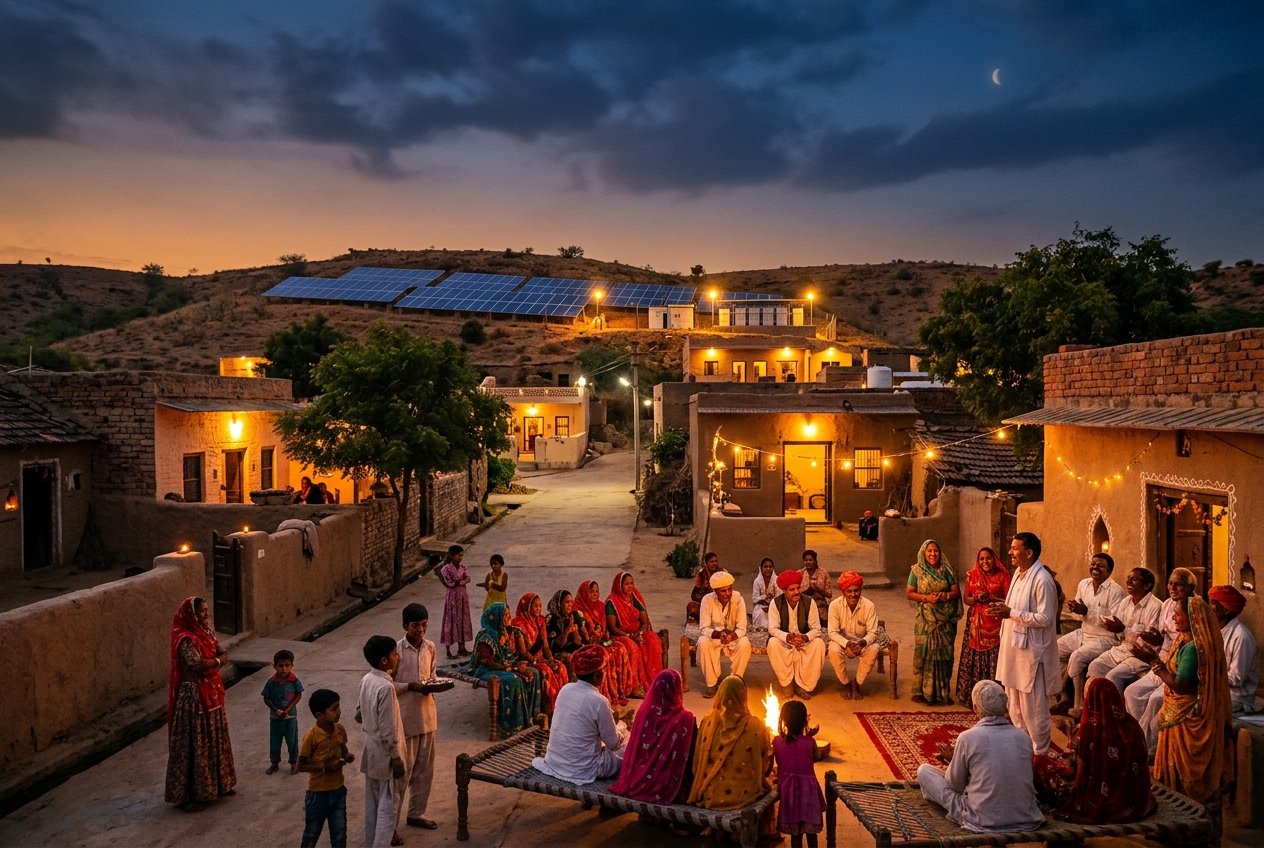
India’s NGO energy-access market is maturing in 2026. The most bankable projects are no longer basic solar-home-system deployments or one-off village electrification pilots. Instead, funders are asking a tougher question: can energy access create durable livelihood gains, measurable social outcomes and a pathway to partial cost recovery? For many districts, the answer lies in solar water systems and livelihood-linked loads: drinking-water pumping, irrigation, micro-enterprise equipment, dairy chilling, rice hulling, flour milling, sewing clusters, and women-led processing units.
For NGOs, CSR teams, utilities and decentralised renewable-energy developers, this is a distinct opportunity area from mini-grids, PAYGo solar or clean-cooking programs. It requires a different theory of demand, a different operating model and sharper measurement of outcomes. The commercial logic is also different. Household willingness to pay for basic energy remains price-sensitive, but farmers, women’s collectives, producer organisations and village enterprises will pay for energy when it directly reduces diesel cost, water scarcity, downtime or post-harvest losses.
This article looks at how NGO-led energy-access programs in India can structure solar water and livelihood-load projects in 2026 using CSR, grants and blended operating models. It focuses on practical design choices, realistic cost ranges, tariff structures, policy fit and bankability considerations.
Why solar water and livelihood loads are gaining traction in 2026
Three on-ground shifts are making this segment more investable.
First, rural demand is becoming more appliance- and income-linked. In many villages, basic lighting penetration is already high due to grid expansion, PM-KUSUM spillovers, solar-home-system legacy fleets and lower-cost DC appliances. What remains under-served is reliable daytime power for productive use.
Second, corporates are under pressure to show measurable and attributable social impact from CSR allocations. A solar water system serving a school, anganwadi, health sub-centre or drinking-water point offers clearer outcome metrics than generic awareness programs. Likewise, a livelihood-energy system linked to women’s self-help groups or farmer producer organisations can report on income, output, operating hours, avoided diesel and beneficiary counts.
Third, state and district institutions are more open to convergence. NGOs are increasingly combining CSR funds with Jal Jeevan Mission implementation gaps, NRLM-linked women’s enterprises, PMFME-supported food processing, and agriculture department schemes for irrigation and allied activities. This lowers pure-donation dependence and improves local ownership.
The strongest use cases in 2026 are:
- Solar drinking-water pumping for schools, hostels, health centres and community standposts
- Small irrigation systems for FPOs, water-user groups and common-service farming clusters
- Solar-powered rural livelihood centres with milling, stitching, food processing or cooling loads
- Community dairy and fishery applications where daytime power quality is poor
- Women-led enterprise hubs where energy is a constraint to machine utilisation
Project economics: what works and what does not
Practitioners should avoid treating all energy-access assets as interchangeable. A solar drinking-water pump and a rural processing hub have different utilisation, storage needs, tariff logic and O&M risks.
In 2026, indicative installed costs for NGO-scale projects in India commonly fall in the following ranges, varying by state, module structure, BOS quality, civil works and remote-site logistics:
- 2–3 HP solar water pumping system: Rs 2.2 lakh to Rs 3.6 lakh
- 5 HP solar water pumping system: Rs 3.8 lakh to Rs 5.8 lakh
- 7.5–10 HP community irrigation system with elevated storage and distribution add-ons: Rs 6.5 lakh to Rs 11 lakh
- 10–25 kW livelihood-energy hub with three-phase distribution, basic controls and limited storage: Rs 9 lakh to Rs 24 lakh
- Battery-backed village enterprise centre, depending on autonomy and load mix: add roughly Rs 12,000 to Rs 20,000 per usable kWh for LFP-based storage in delivered project terms
For water systems, the economics depend on avoided diesel, reduced manual hauling, service reliability and beneficiary density. If a 5 HP diesel pump would otherwise consume roughly 0.8 to 1.2 litres per operating hour, then at diesel prices of around Rs 88 to Rs 98 per litre in many markets, avoided fuel expenditure becomes a compelling anchor for cost justification. Even when actual operating hours are modest, the value of predictable daytime pumping for drinking water or irrigation can support local contribution models.
For livelihood hubs, utilisation is everything. A 15 kW solar system serving a sewing cluster for only three hours a day will struggle to justify storage and maintenance. The same system serving six to eight hours of milling, grading, packing, refrigeration support or machine-tool use can produce viable social returns and partial revenue recovery.
A common mistake is overbuilding generation without securing anchor demand. Another is underpricing maintenance. NGO projects often succeed in capex mobilisation but fail in year-3 inverter replacement, pump servicing, water-quality monitoring or operator retention. In practice, annual O&M budgets of 1.5% to 3% of project cost should be ring-fenced for simple water systems, while more complex livelihood-energy sites may require 3% to 5%, especially where batteries or productive-use machinery are involved.
Delivery models NGOs can use with CSR and grants
There is no single template. In 2026, four delivery models are proving practical.
1) Full-grant community infrastructure model
This works best for drinking water in schools, health centres, hostels, tribal hamlets and public-service sites where the primary objective is access, health or resilience rather than commercial return.
Typical structure:
- CSR or philanthropy funds 80% to 100% of capex
- Panchayat, school management committee or local institution provides site access and basic security
- NGO or EPC partner handles design, procurement and commissioning
- Annual O&M is either prepaid for 3–5 years or shared with the local institution
This model is suitable where tariff collection would be socially or administratively inefficient. However, funders should insist on service-level definitions: litres per day, downtime tolerance, pump availability, seasonal performance and water-quality testing protocol.
2) Community contribution plus CSR capex model
This is effective where users derive direct economic benefit, such as irrigation or enterprise machinery. Community contribution can be cash, labour, civil works or membership fees.
Typical structure:
- CSR covers 50% to 80% of capex
- User group contributes 10% to 25% upfront or through phased deposits
- NGO supports governance, operating rules and conflict resolution
- A local operator or SHG federation collects user fees
This creates better ownership than full-grant models. In several districts, even a modest contribution of Rs 5,000 to Rs 20,000 per member materially improves payment discipline and asset care.
3) Grant-funded viability support with service-fee operations
This resembles a light-touch utility model. It suits water kiosks, irrigation services and rural processing centres.
Typical structure:
- Grant or CSR finances initial capex gap
- A local enterprise, FPO, social enterprise or cooperative operates the asset
- Users pay per litre, per hour, per acre or per kg processed
- The operator funds routine O&M and minor replacements from collections
Illustrative tariffs seen in practice can include:
- Drinking water service fees equivalent to Rs 2 to Rs 6 per 20 litres in areas with treatment and distribution components
- Community irrigation charges from roughly Rs 70 to Rs 180 per operating hour for smaller systems, or acreage-based pricing depending on crop and season
- Rural processing service fees priced per kg of grain, spice, flour or produce handled
Tariffs need to be set against local diesel alternatives, labour substitution and agricultural margins. If pricing is lower than diesel but sufficient to cover operator cost and maintenance reserve, the model has a stronger survival rate after grant support ends.
4) Convergence-led infrastructure model
This is often the most scalable but operationally complex. NGOs combine multiple schemes and institutions.
Examples include:
- CSR funds energy system capex while a line department supports water infrastructure or beneficiary mobilisation
- NRLM institutions manage women-led livelihood centres while philanthropic grants cover training and enterprise incubation
- District mineral foundation or local-area development funds support civil works in remote blocks, while corporate CSR backs solarisation and monitoring
Here, Program design & theory of change matters because each stakeholder is solving a different problem: access, health, livelihoods, resilience, or ESG visibility. Without a coherent design logic, convergence becomes a stack of disconnected approvals.
Tariff design, governance and payment discipline
The strongest NGO energy-access projects in 2026 are treating tariff design as a governance issue, not just a finance issue.
For drinking-water infrastructure, fully free access can be justified at institutions such as schools or health facilities, but community systems generally perform better when there is at least a nominal user contribution. Even small monthly household subscriptions or prepaid water-card mechanisms can improve accountability, provided inclusion safeguards exist for low-income households.
For irrigation, three principles matter:
- Price below diesel-equivalent service cost, not necessarily below grid tariff
- Prioritise daytime scheduling to minimise storage cost
- Align collection with crop cycles or farmer cash-flow timing
For livelihood hubs, blended pricing often works best:
- Fixed membership fee for participating SHGs or producer groups
- Variable machine-use fee by hour or output
- Reserve margin for maintenance and eventual component replacement
Governance design should specify:
- Who owns the asset
- n- Who can authorise repairs
- What happens if collections fall below O&M requirement
- How disputes over water allocation or machine time are resolved
- Whether there is a service guarantee from the NGO or EPC contractor
This is where Compliance & governance becomes central. Funders increasingly want auditable asset registers, beneficiary lists, committee resolutions, procurement trail, related-party checks and escalation protocols. These are not bureaucratic extras. They reduce reputational and operational risk, especially in multi-village portfolios.
MRV that matters to funders, utilities and policymakers
In 2026, impact reporting is shifting from output counting to service verification and outcome attribution. Donors no longer want to hear only that 50 pumps were installed or 10 enterprise centres were inaugurated. They want to know whether assets are functioning, whether users are paying, and whether livelihoods or public services improved.
A credible MRV stack for solar water and livelihood-load projects should capture five layers:
Technical performance
- Daily energy generation
- Pump or machine operating hours
- Downtime and fault events
- Water output or throughput metrics where relevant
- Battery health, if storage is included
Service delivery
- Households, institutions or enterprises served
- Hours of water availability or machine access
- Seasonal continuity during summer and monsoon periods
- Number of days asset remained non-functional
Financial viability
- Collections vs expected collections
- O&M spend vs budget
- Reserve account adequacy
- Cost recovery ratio by site
Social outcomes
- Time saved in water collection
- Increase in cropped area or irrigation reliability
- Reduction in diesel consumption
- Increase in enterprise operating hours
- Women’s participation and leadership in governance
Institutional durability
- Committee meeting frequency
- Operator retention
- Timeliness of repairs
- Spare-parts availability and service response time
This is where Impact measurement & MRV can materially improve funding confidence. For corporates, outcome-linked reporting strengthens internal CSR committee approvals. For lenders and catalytic capital providers, site-level operating data supports replication. For state agencies and utilities, reliable evidence helps justify convergence with public programs.
Policy fit and state-level considerations in India
While there is no single national policy for NGO-led community energy, several 2026 policy interfaces are relevant.
PM-KUSUM remains important as a market-shaping benchmark for solar pumping, even when NGO projects are outside direct subsidy channels. It influences vendor networks, local expectations and reference pricing.
Jal Jeevan Mission continues to create water-infrastructure demand, especially where electricity reliability remains poor or new habitations need decentralised support. Solarisation can reduce outages and diesel dependence for community water assets, though institutional alignment with local implementing agencies is essential.
NRLM and state rural livelihoods missions are highly relevant for women-led enterprise centres, SHG governance and community contribution mechanisms. Where NGOs can embed energy assets inside existing SHG or federation structures, repayment discipline and asset use tend to improve.
PMFME, ODOP-linked value chains and state agro-processing incentives can also support productive-use loads. If an energy asset enables turmeric grinding, millet processing, oil expelling, flour milling or packaging linked to an identified local value chain, livelihood outcomes become easier to evidence.
State DISCOM conditions also matter. In some geographies, weak rural daytime supply improves the value proposition for standalone or hybrid systems. In others, agricultural feeder improvements can reduce willingness to pay for privately managed irrigation energy. Project design must be district-specific, not generic.
Practitioners should also account for groundwater and water-governance risk. A technically sound solar pumping project can still fail if aquifer stress, source sustainability or local allocation conflict is ignored. Water-energy-livelihood projects need hydrogeological screening, seasonal planning and demand management, not just solar sizing.
What developers, corporates and lenders should look for
For RE developers and EPC firms, NGO-led projects can be attractive portfolio opportunities if they are standardised and bundled. A scattered set of tiny installations with weak contracts is expensive to service. A district-level or state-level pipeline with common technical specifications, remote monitoring and consolidated O&M is much more viable.
For corporates deploying CSR capital, the key diligence questions are:
- Is the demand anchor real and measurable?
- Who will operate the asset after commissioning?
- Is there a three- to five-year O&M plan with budget?
- Are tariffs or user contributions socially viable?
- Can the NGO demonstrate field governance and issue resolution capacity?
For lenders and catalytic capital providers, full commercial debt may not fit early-stage community portfolios. But recoverable grants, first-loss structures, revenue-linked support or pooled reserve accounts can improve scale-up prospects where revenue streams are visible.
For utilities and policymakers, these projects should not be viewed as off-grid charity alone. They can reduce diesel use, improve daytime service reliability for public infrastructure, enable water access in weak-grid locations and create productive demand ecosystems that complement rather than compete with the main grid.
The central lesson from 2026 is simple: NGO energy access works better when energy is tied to water security and livelihoods, not treated as an isolated hardware intervention. Solar water systems and livelihood-linked loads produce stronger user demand, clearer social outcomes and more credible CSR narratives than many legacy access models. But they only scale when project design, governance, tariffs and monitoring are handled with the same discipline that commercial energy projects require.
Growthifye supports NGOs, corporates and implementation partners with CSR funding pipelines, Program design & theory of change, and Impact measurement & MRV for energy-access portfolios across India. If you are planning a solar water, irrigation or community livelihood-energy program, contact Growthifye’s advisory desk to structure the model, de-risk delivery and build a financeable pipeline.
Explore Growthifye's related capabilities
This analysis connects directly to our advisory practice: Program design & theory of change · CSR funding pipelines · Grant & philanthropic fundraising · Compliance & governance.
About the author

Chief Executive Officer, Growthifye — With over 23 years in management consulting, Sudarshan has taken businesses from concept to scale — building and scaling new-age digital and energy businesses.
- 23+ years in management consulting
- EY alumnus
- Led large-scale BESS programmes, capital raises and advisory mandates
Want this analysis applied to your project?
Talk to our team