India 2026 NGO Energy Access: Solar Telecom Towers, Village Loads and CSR MRV
By Sudarshan Karweer · sudarshan@growthifye.com · +91 84510 99371 (Call / WhatsApp) · 2026-09-01
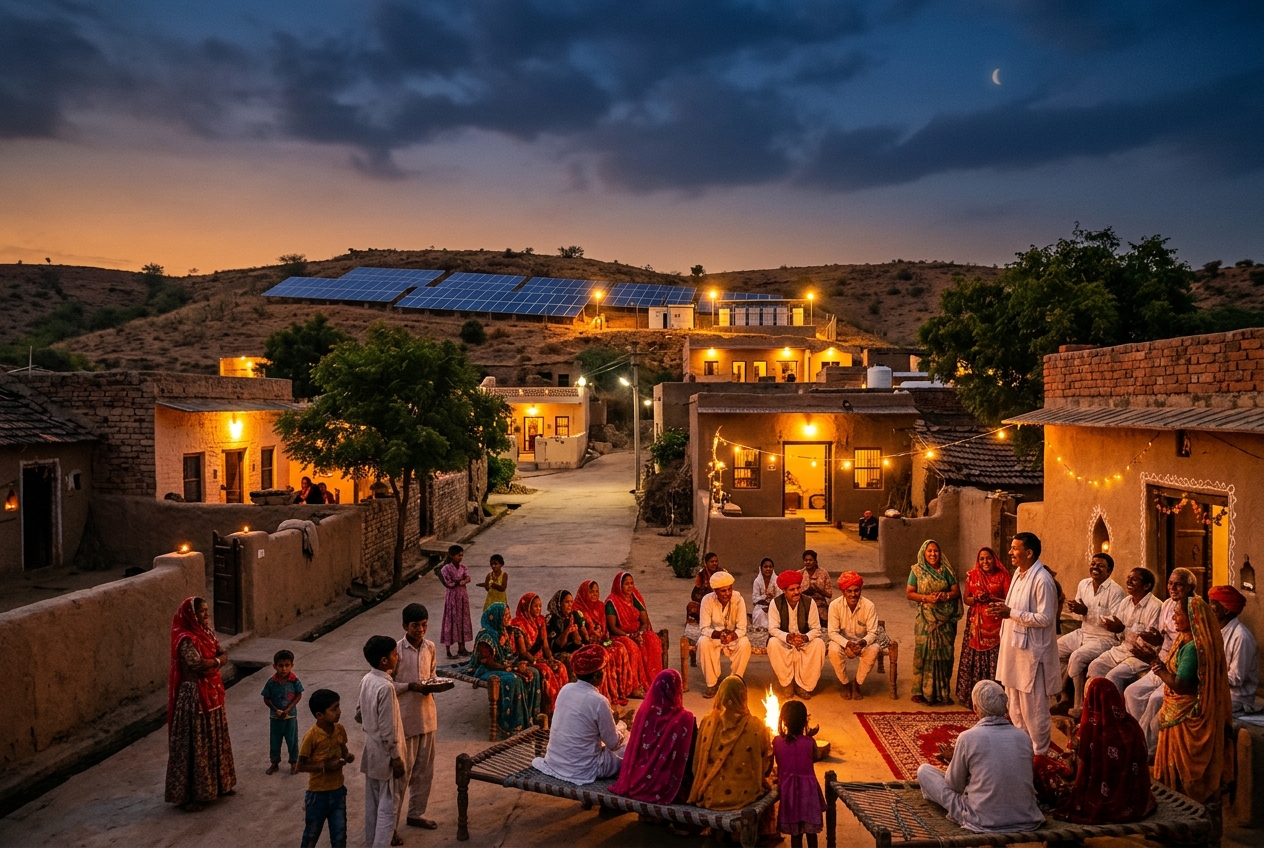
India’s rural energy-access conversation often starts with households, schools, health centres or irrigation. A less discussed but commercially important entry point is the rural telecom tower. In thousands of low-reliability grid locations, towers still depend on diesel gensets, undersized battery banks or expensive hybrid OPEX contracts. For NGOs, CSR teams, telecom infrastructure firms and distributed renewable-energy developers, these sites can become anchor loads that improve project bankability while extending electricity services to nearby community facilities and livelihood users.
In 2026, this model matters for three reasons. First, telecom connectivity is now treated as essential infrastructure for payments, telemedicine, education, farm-market access and emergency communications. Second, diesel costs remain volatile and operationally painful in remote areas. Third, corporate CSR and philanthropic capital increasingly prefer measurable, service-linked interventions rather than one-time asset donation. A telecom-tower-led community energy model can meet these preferences if it is designed with hard baselines, contractual clarity and verifiable outcomes.
This article examines how NGO-led and CSR-backed programs can structure solarisation of rural telecom towers as an anchor-load energy-access strategy in India, with practical numbers, policy touchpoints, risk allocation and MRV requirements.
Why rural telecom towers are an energy-access opportunity
India has a very large telecom footprint, and a meaningful share of towers in difficult geographies still suffer from weak grid quality, long outage hours or costly diesel dependence. A typical rural ground-based tower may carry a continuous load of around 2 kW to 6 kW depending on tenancy, radio equipment mix, cooling design and backhaul configuration. In many unreliable-grid districts, the practical annual energy need can range from roughly 20,000 kWh to 50,000 kWh.
That matters because anchor loads help solve the biggest problem in community-energy projects: demand uncertainty. A school or health sub-centre alone may not support viable sizing and operations. But a telecom tower with round-the-clock demand can justify solar PV, batteries, controls and maintenance systems that also serve adjacent social or productive loads under a controlled feeder architecture.
For NGOs and CSR sponsors, the development logic is straightforward:
- Telecom uptime supports digital inclusion.
- Replacing diesel reduces local pollution, noise and fuel logistics risk.
- A stable anchor load improves technical utilisation of the energy system.
- Surplus daytime power can support community services such as water pumping, digital classrooms, cold storage pre-cooling, SHG enterprises or public lighting.
- Outcomes are measurable in kWh served, diesel avoided, outage reduction, tower uptime and community-beneficiary metrics.
This is where Program design & theory of change becomes critical. The project should not be framed merely as a tower retrofit. It should be framed as a resilience and service-delivery platform where telecom reliability enables broader rural development outcomes.
The 2026 commercial case: diesel savings, OPEX reduction and uptime
The basic economics depend on existing tower-energy arrangements. In weak-grid areas, a telecom tower may currently rely on one of three patterns:
- Grid plus diesel backup with poor battery autonomy
- Managed energy service contract with diesel pass-through or indexed pricing
- Partial hybrid setup with legacy lead-acid batteries and underperforming solar assets
In 2026, delivered diesel cost to remote sites can easily land in the Rs 95 to Rs 110 per litre range once transport, pilferage, handling and downtime costs are considered. A conventional genset may generate effective electricity at Rs 24 to Rs 32 per kWh for small remote loads, and even higher in operationally difficult areas.
By contrast, a well-engineered solar-hybrid retrofit with lithium battery storage can bring blended effective cost significantly lower over a 7 to 10 year operating window, especially where solar resource is good and diesel runtime is materially reduced. Depending on site conditions, the practical target is often:
- 50% to 80% reduction in diesel consumption
- 20% to 40% reduction in energy OPEX over baseline contracts
- Tower uptime above 99% for critical loads
- Battery autonomy of 4 to 8 hours for telecom-critical load segments
A simple example helps. Assume a 3 kW average tower load, implying annual consumption of around 26,280 kWh. If baseline supply is a weak-grid plus diesel system with 35% of annual energy effectively supplied by genset, diesel-generated electricity could be about 9,200 kWh. At an effective diesel power cost of Rs 28 per kWh, that diesel component alone costs about Rs 2.58 lakh annually. If a solar-battery retrofit cuts diesel generation by 70%, annual savings on that component approach Rs 1.8 lakh before adding reduced maintenance visits and lower battery replacement frequency.
For larger multi-tenant towers or clusters, the economics improve further because controls, remote monitoring and O&M can be centralised.
Delivery models NGOs can back with CSR and grants
The most bankable structure is not always pure asset donation. In 2026, better-performing NGO energy-access programs are mixing grant support with service contracts and performance-linked disbursement. For telecom-tower-linked projects, four practical models stand out.
1. CSR-funded viability support for ESCO delivery
A renewable-energy developer or energy-service company finances, installs and operates the solar-hybrid system under a multi-year service agreement with the tower company or telecom tenant. CSR funds cover part of the capital gap for sites that are socially valuable but commercially marginal.
This model works well where:
- Site-level economics are close to viable but not fully financeable
- There is a credible offtake contract with uptime obligations
- NGO partners can justify community co-benefits beyond the tower itself
Typical CSR support may cover 20% to 50% of capex for the community-serving component or the incremental resilience layer required to add nearby social loads.
2. Grant-funded demonstration clusters in aspirational districts
A 20 to 100 tower cluster in a high-outage district can demonstrate standardised technical design, remote diagnostics and shared MRV. Philanthropic grants fund the first-loss tranche of learning costs, training, baseline studies and beneficiary integration.
This is useful where state rural-development priorities, telecom connectivity gaps and weak public-service delivery overlap.
3. NGO-owned community spur with private anchor contract
The telecom tower remains on a commercial power arrangement, but grant capital funds a ring-fenced daytime feeder to nearby community loads from the same solar asset or from a co-located distributed system. Metering must clearly separate telecom and community consumption. This model needs careful legal and technical design to avoid unauthorised distribution issues.
4. Results-based disbursement with verified service outcomes
Part of donor or CSR funding is released only after pre-agreed metrics are met, such as:
- Tower uptime improvement
- Diesel litres avoided
- kWh delivered to named community loads
- Functional hours for digital or health services
- Number of women-led enterprises connected
This pushes all parties toward robust Impact measurement & MRV rather than capex deployment alone.
Technical design choices that determine project success
Many decentralised-energy projects underperform not because solar resource is weak, but because load assessment, battery design and controls are poor. Telecom-tower applications are unforgiving. If uptime drops, the social argument collapses quickly.
Key technical design considerations include:
- Load segregation: Separate critical telecom loads from optional or schedulable community loads.
- Cooling efficiency: Passive or free-cooling retrofits can materially reduce consumption before solar sizing.
- Battery chemistry: Lithium iron phosphate is increasingly preferred over lead-acid for lifecycle, temperature tolerance and remote monitoring.
- Smart EMS: Energy-management systems should prioritise tower reliability while enabling controlled community dispatch.
- Theft and tamper protection: Rural sites need robust enclosure, CCTV where feasible, geofencing and alarm integration.
- O&M access: Design for sparse field visits with predictive maintenance and reliable telemetry.
Indicative 2026 capex ranges for a rural telecom-tower hybridisation package can vary significantly by load and battery autonomy, but a rough order of magnitude for a single-site retrofit may be:
- 5 kWp to 12 kWp solar PV: Rs 3 lakh to Rs 7 lakh
- 15 kWh to 40 kWh lithium storage: Rs 3.5 lakh to Rs 10 lakh
- Inverters, controllers, structure, BOS, remote monitoring and integration: Rs 2 lakh to Rs 5 lakh
- Civil and security enhancements: Rs 0.5 lakh to Rs 2 lakh
A practical total can therefore sit between Rs 9 lakh and Rs 24 lakh per site, depending on load, autonomy, legacy asset reuse and civil complexity. Cluster procurement can reduce unit costs.
Policy and regulatory fit in India in 2026
The policy case should be framed carefully. Telecom towers are commercial infrastructure, while NGOs and CSR programs must demonstrate public purpose. The strongest projects do this by explicitly linking digital connectivity and shared local-energy benefits.
Relevant 2026 policy and institutional touchpoints include:
- Companies Act CSR framework and Schedule VII categories related to rural development, education, health, environment sustainability and livelihoods
- State renewable-energy policies enabling decentralised systems and public-institution solarisation
- Ministry-level digital inclusion and rural connectivity priorities, especially in difficult geographies
- Aspirational districts and tribal-area development programs where service reliability is a development bottleneck
- Panchayat-level and district-level convergence for community assets co-served by the system
Developers should also assess electricity-regulatory boundaries carefully. If power from a tower-linked system is extended to third-party users, distribution and sale structures must be compliant with local regulations, franchise models or captive-service interpretations. In some cases, the cleaner path is to define the community connection as a donor-funded service to identified public or community assets rather than an open retail supply model.
This is where Compliance & governance and Corporate & utility partnerships can materially reduce execution risk. Projects should map permissions, safety standards, asset ownership and data-sharing obligations from day one.
Designing MRV that lenders, CSR boards and auditors will accept
MRV in telecom-anchor projects must go beyond counting installed kilowatts. Decision-makers increasingly want service-level evidence. A serious MRV architecture should include five layers.
1. Baseline energy and service audit
Capture at least 3 to 12 months of historical data where available:
- Grid outage hours
- n- Diesel litres consumed
- Maintenance visits
- Tower downtime incidents
- Fuel pilferage or delivery failures
- Existing community service constraints tied to poor power quality
2. Asset-level telemetry
Use remote monitoring for:
- Solar generation
- Battery SOC and cycling
- Load served by segment
- Genset runtime
- Grid availability
- Fault alerts and response times
3. Community-outcome indicators
Depending on project scope, track:
- Hours of operation gained for schools, digital centres or health points
- Number of households or enterprises receiving defined services
- Additional income days for connected microenterprises
- Women beneficiary participation in energy-linked livelihoods
4. Environmental metrics
Calculate:
- Diesel litres avoided
- tCO2e avoided using transparent emission factors
- Reduced local particulate and noise exposure where relevant
5. Financial-performance metrics
Measure:
- OPEX savings versus baseline
- Collection or service-fee performance where applicable
- Downtime penalties avoided
- Payback sensitivity to fuel cost and battery replacement assumptions
A lender or CSR committee is far more likely to support scale-up if the project can show not just emissions reduction, but lower downtime, verified diesel displacement and documented social-use hours.
Risks, failure points and what to do differently
The biggest execution mistake is forcing a community-energy add-on onto a site where the telecom anchor itself is unstable contractually. If tenancy is uncertain, if lease renewal is weak, or if tower ownership and energy responsibility are contested, the project can unravel.
Key risks include:
- Telecom contract changes reducing load unexpectedly
- Battery theft or vandalism
- Grid improvement arriving sooner than expected and altering economics
- Community-load creep that compromises anchor reliability
- Weak local O&M capacity and slow fault response
- Poorly documented CSR purpose leading to audit issues
Mitigation measures should include:
- Only selecting towers with strong tenure visibility and clear energy responsibility
- Ring-fencing critical loads with hard dispatch priority
- Installing advanced remote diagnostics and response SLAs
- Standardising technical packages across clusters
- Structuring CSR around measurable public-purpose outcomes, not simply private asset enhancement
- Using CSR funding pipelines and Grant & philanthropic fundraising strategically for early-stage de-risking, not perpetual operating subsidy
The strongest projects are usually cluster-based rather than one-off. A 30-site or 50-site district portfolio allows better procurement, monitoring and service logistics. It also creates a more credible evidence base for replication across states.
What a scalable 2026 program should look like
A mature NGO energy-access program around telecom towers should combine commercial realism with development intent. In practice, that means:
- District selection based on outage intensity, telecom importance and community-service gaps
- Site screening for anchor-load quality and contractual stability
- Standard technical package with modular battery and community-load options
- CSR or grant support targeted to viability gaps and social-load integration
- Robust MRV from baseline to year-3 outcomes
- Clear governance on ownership, operations, data and maintenance
For Indian C&I stakeholders, utilities and financiers, the value is broader than one niche use case. Telecom towers demonstrate how anchor loads can make decentralised energy more reliable and investable in rural India. For policymakers, they offer a way to connect digital infrastructure with village-level service outcomes. For NGOs, they provide a measurable platform where energy access is tied directly to connectivity, resilience and local economic activity.
The next wave of energy-access scale in India will not come only from standalone household systems or isolated grants. It will come from better integration of anchor demand, public-purpose loads and performance-linked funding. Rural telecom towers are one of the clearest opportunities to do that in 2026.
If your organisation is evaluating NGO energy-access programs around telecom infrastructure, village loads, CSR structuring or MRV systems, contact Growthifye’s advisory desk to design a bankable, compliant and scalable delivery model.
Explore Growthifye's related capabilities
This analysis connects directly to our advisory practice: Program design & theory of change · CSR funding pipelines · Grant & philanthropic fundraising · Compliance & governance.
About the author

Chief Executive Officer, Growthifye — With over 23 years in management consulting, Sudarshan has taken businesses from concept to scale — building and scaling new-age digital and energy businesses.
- 23+ years in management consulting
- EY alumnus
- Led large-scale BESS programmes, capital raises and advisory mandates
Want this analysis applied to your project?
Talk to our team