India 2026 NGO Energy Access: Solar-Powered Rural Livelihood Microenterprises
By Sudarshan Karweer · sudarshan@growthifye.com · +91 84510 99371 (Call / WhatsApp) · 2026-09-01
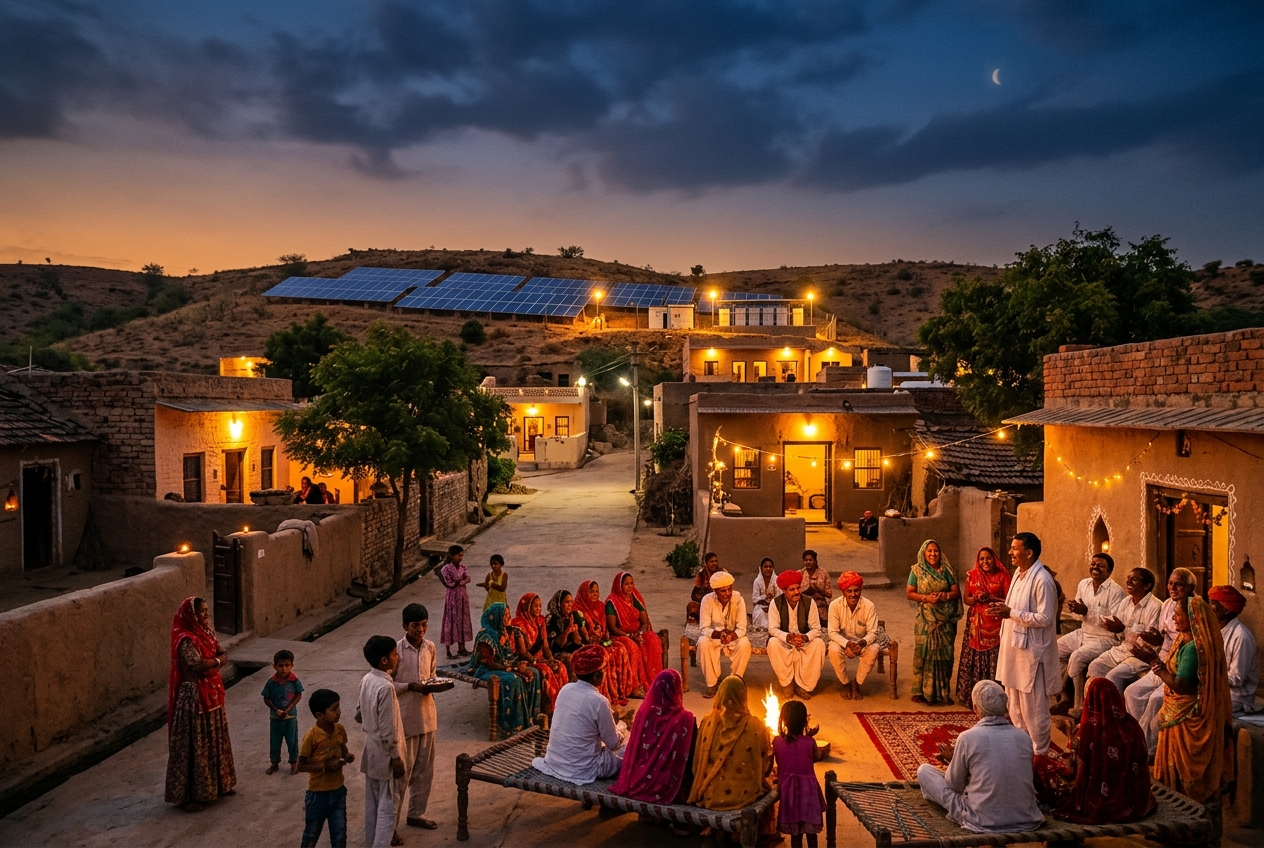
India’s decentralised renewable energy conversation has matured. In 2026, the harder question is no longer whether rural communities need electricity access, but how to convert reliable clean power into stable cash flows for households, women’s groups and village enterprises. For NGOs, CSR teams, EPC firms, social lenders and state agencies, solar-powered rural microenterprises are now one of the most bankable ways to connect energy access with livelihoods, resilience and measurable development outcomes.
This article looks at a practical programme design for NGO-led rural solar microenterprise initiatives in India: what loads to target, what project sizes work, how to structure capital and operating support, what MRV metrics matter, and where policy and utility coordination can reduce risk. The focus is on productive-use energy for income generation, not institutional electrification, clean cooking in campuses or mini-grid anchor models.
Why rural solar microenterprises matter in 2026
A village-level livelihood load is more financeable than a pure household lighting intervention because the end use generates revenue. Across India, NGOs and implementation partners are now prioritising enterprises such as:
- tailoring and stitching units
- flour mills and mini rice hullers
- spice grinding and oil expelling
- milk chilling and dairy collection points
- rural e-mobility charging for cargo and passenger three-wheelers
- mobile repair, digital service and printing kiosks
- carpentry, welding and fabrication where grid quality is weak
- women-led food processing units for millet, pulses and spices
- fish vending and cold storage carts in coastal and inland districts
In many districts, these businesses already exist but are constrained by diesel, poor grid reliability or expensive captive backup. A diesel-powered 5 kVA setup serving milling, sewing or food processing can easily cost Rs 22-30 per kWh equivalent once fuel, transport, maintenance and underloading are accounted for. By comparison, a well-sized behind-the-meter solar-plus-battery livelihood system can deliver effective energy cost in the Rs 8-14 per kWh range over the asset life, depending on utilisation, battery chemistry, grant support and O&M structure.
The economics improve further where daytime productive loads dominate. A 3 kW to 10 kW rooftop or ground-mounted solar system serving a village enterprise cluster can offset expensive diesel and reduce dependence on low-voltage, outage-prone feeders. For NGOs, the intervention is attractive because impact can be tracked through income uplift, women’s labour productivity, enterprise survival and reduced fossil-fuel expenditure.
Which enterprise archetypes are most viable
Not every livelihood load is suitable for an NGO energy-access programme. In 2026, the strongest candidates tend to share three features: predictable use, direct revenue linkage and manageable appliance quality control.
A practical shortlist includes the following.
- Solar tailoring hubs: 1-3 kW systems with efficient motors, lighting and fans for 5-15 machines. Typical capex in 2026 may range from Rs 1.2 lakh to Rs 3.8 lakh depending on battery backup and building condition.
- Food processing units: 3-10 kW systems serving grinders, sealers, mixers, dryers or pulverisers. These often need hybrid architecture because motor starting currents are high. Capex can range from Rs 3 lakh to Rs 12 lakh.
- Dairy and cooling applications: 2-8 kW solar integrated with efficient refrigeration, milk analysers and collection systems. Battery sizing is critical if evening collection is significant.
- Rural digital service centres: 1-2 kW systems for computers, routers, printers, biometric devices and phone charging, often with very attractive utilisation because downtime has direct service loss.
- SHG-led agro-processing clusters: 5-20 kW common facilities with staggered machine use. These can support turmeric, chilli, millet and pulse value chains and are often well suited for CSR-supported common infrastructure.
The least viable cases are usually those with poor load discipline, oversized expectations, weak appliance sourcing or no market linkage for the product being produced. An NGO energy programme should never treat solar hardware as the primary objective. The energy system is only a delivery mechanism for enterprise performance.
What a bankable programme structure looks like
A scalable NGO-led microenterprise energy programme in India generally needs four layers: beneficiary selection, technical design, blended capital stack and post-installation business support.
At the beneficiary level, project developers should screen for:
- minimum existing monthly enterprise turnover, for example Rs 15,000-Rs 40,000 depending on sector
- evidence of demand, such as existing order books or buyer linkage
- willingness to co-pay 10%-30% of capex or commit to monthly service fees
- suitable site ownership or long-tenure occupancy
- local technician access within 25-50 km
At the technical level, avoid one-size-fits-all packages. A tailoring centre with daytime use may need only 2-4 hours of backup, while a milling or cooling application may need inverter oversizing and limited battery autonomy. In many cases, DC appliances are less practical than standard AC productive-use equipment because local repair ecosystems are AC-centric.
At the financing level, 2026 programmes are increasingly using layered support:
- 30%-60% first-loss grant or CSR capex support
- 10%-25% beneficiary contribution, cash or in-kind
- balance financed via NBFC, MFI, SHG federation, producer company or revolving livelihood fund
- annual O&M reserve built into programme economics, often 1.5%-3% of capex
For a women-led processing unit costing Rs 6 lakh, one workable structure could be:
- Rs 2.7 lakh CSR grant
- Rs 60,000 community contribution
- Rs 2.7 lakh low-interest livelihood loan over 36-48 months
If the unit saves Rs 12,000-Rs 18,000 per month in diesel and improves output quality or volume enough to lift margin by Rs 8,000-Rs 20,000 per month, debt service is manageable. However, this only works if utilisation is real. Load and business due diligence matter more than hardware discounts.
This is where Program design & theory of change becomes critical. The programme must map how energy input leads to machine uptime, how uptime leads to output and quality, and how that translates into revenue, jobs and resilience outcomes. Without that chain, MRV becomes superficial and funding committees become sceptical.
Policy and regulatory context in India
In 2026, several policy signals support productive-use DRE, even if implementation varies across states.
First, CSR under Schedule VII continues to support rural development, livelihoods, women’s empowerment, environment sustainability and healthcare-linked access interventions where programmes are structured credibly. Energy access for livelihoods is often easier to justify when bundled with skilling, income enhancement, tribal development or climate resilience outcomes.
Second, state livelihood missions, NRLM-linked SHG ecosystems and producer collectives provide delivery rails. For NGO programmes, convergence with SHG federations, FPOs and district administrations reduces mobilisation cost and improves repayment behaviour.
Third, PM-KUSUM has deepened market familiarity with solar for productive use, though its main focus is irrigation. The spillover effect is that rural users, local installers and banks now understand solar cash-flow logic better than they did five years ago.
Fourth, DISCOM coordination is becoming more important. In weak-grid rural zones, NGOs should not assume that a stand-alone system is the only answer. In some cases, a grid-connected rooftop system with limited battery backup is more cost-effective than a fully islanded design. Where net metering or gross metering thresholds and procedures are workable, hybridisation can materially improve project economics. State regulations differ, and feeder-level reliability data should inform system design.
Finally, carbon-market interest has increased, but small distributed systems still face aggregation and transaction-cost challenges. For most NGO portfolios under 5 MW aggregated capacity, carbon revenue should be treated as upside rather than base-case viability.
Numbers that decision-makers should actually track
Indian stakeholders often ask for installed capacity, number of beneficiaries and annual generation. Those metrics are necessary but insufficient. In 2026, a serious rural microenterprise energy programme should track commercial and developmental indicators together.
Recommended technical metrics:
- kW installed and usable battery capacity in kWh
- monthly generation in kWh and solar fraction
- system uptime and outage hours
- load factor and seasonal utilisation
- diesel litres avoided, where applicable
- appliance downtime and service response time
Recommended enterprise metrics:
- baseline and post-installation turnover
- net monthly savings on fuel and electricity
- production volume and rejection rate
- enterprise operating days per month
- number of paid workers, especially women
- monthly loan repayment performance
Recommended impact metrics:
- household income uplift attributable to the enterprise
- time saved, especially for women operators
- local jobs created or formalised
- tCO2e emissions avoided using conservative methodology
- continuity of service after 12 and 24 months
The central failure mode in this sector is overclaiming impact without causal evidence. Impact measurement & MRV should therefore combine remote monitoring with periodic field verification. If a 5 kW system generates 550-700 kWh a month but the enterprise reports no change in output or income, something is wrong with utilisation, equipment choice or business support.
A robust 2026 MRV stack typically includes inverter telemetry, appliance-level sampling where possible, geotagged commissioning records, beneficiary KYC, baseline business surveys and quarterly outcome validation. For CSR-funded portfolios, this improves audit readiness and repeat funding probability.
Common design mistakes and how to avoid them
Many NGO energy access programmes underperform for reasons that are avoidable.
The first mistake is technology-first procurement. Lowest-capex selection often leads to weak batteries, undersized inverters or poor local serviceability. Productive-use systems should be procured against lifecycle performance, not module price alone.
The second mistake is ignoring load growth. A stitching centre that starts with six machines may expand to twelve within a year if orders improve. A system designed with zero headroom forces costly retrofit. In most cases, 15%-25% future load margin is prudent if roof area and inverter design allow.
The third mistake is weak appliance efficiency. Solar cannot rescue inefficient motors and resistive loads. Enterprise support should include appliance audits and replacement planning.
The fourth mistake is poor ownership architecture. If no single entity is accountable for O&M payments, battery replacement and theft prevention, assets degrade quickly. Clear asset registers, user agreements and escrow or reserve mechanisms are essential.
The fifth mistake is separating energy intervention from market linkage. A spice grinder without buyer aggregation, packaging support and quality control may not produce enough margin to sustain financing. Energy access should be bundled with enterprise development.
This is where Corporate & utility partnerships can add value. Corporate offtakers, distributors, dairy federations, textile buyers and utilities can help standardise demand, payments and service networks. Stronger demand-side architecture reduces the risk that the solar asset becomes underused infrastructure.
A practical implementation roadmap for NGOs, CSR teams and developers
For stakeholders looking to launch a 2026 pilot or scale-up programme, the sequence matters.
Phase 1: district and cluster selection - focus on districts with weak supply quality, active SHG or FPO networks and proven livelihood activity - identify 2-3 enterprise archetypes rather than trying to cover ten sectors at once
Phase 2: baseline assessment - map energy spend, outages, fuel dependence, appliance profile and existing enterprise cash flows - capture seasonality in raw material availability and demand
Phase 3: technical-commercial design - size systems against real operating hours and motor loads - compare grid-tied, hybrid and off-grid configurations - set beneficiary contribution and financing terms based on enterprise margins
Phase 4: procurement and installation - standardise components where possible for easier O&M - include commissioning checks, training and safety sign-off
Phase 5: post-installation support - monitor generation and enterprise outcomes monthly for at least 12 months - integrate bookkeeping, market linkage and maintenance support
Phase 6: scale and portfolio finance - aggregate data from 50-200 installations to build lender comfort - use verified performance to unlock larger CSR funding pipelines and philanthropic support
A portfolio approach is especially important. A single rural microenterprise project may be too small for serious financial attention, but a 1-3 MW equivalent aggregated livelihood portfolio across districts can attract structured debt, development capital and larger corporate participation, provided default risk and O&M quality are well managed.
The strategic takeaway for 2026
India’s rural energy-access market is entering a more disciplined phase. Donors and corporates are asking harder questions. Lenders want data. Communities want systems that power income, not just aspiration. Solar-powered rural microenterprises sit at the intersection of all three demands.
For NGOs and their implementation partners, the opportunity is to move from asset donation to outcome-linked energy infrastructure. That means selecting viable enterprises, designing around real load curves, blending CSR and livelihood finance intelligently, and verifying income and resilience outcomes with credible MRV.
The organisations that succeed in this space will be those that treat energy, enterprise and governance as one integrated programme rather than three separate workstreams.
If your team is designing an NGO energy-access portfolio around rural livelihoods, community solar or CSR-backed productive loads, contact Growthifye’s advisory desk for support on programme structuring, funding strategy, technical design and MRV.
Explore Growthifye's related capabilities
This analysis connects directly to our advisory practice: Program design & theory of change · CSR funding pipelines · Grant & philanthropic fundraising · Compliance & governance.
About the author

Chief Executive Officer, Growthifye — With over 23 years in management consulting, Sudarshan has taken businesses from concept to scale — building and scaling new-age digital and energy businesses.
- 23+ years in management consulting
- EY alumnus
- Led large-scale BESS programmes, capital raises and advisory mandates
Want this analysis applied to your project?
Talk to our team