India 2026 NGO Energy Access: Solar-Powered Clean Cooking for Institutions
By Sudarshan Karweer · sudarshan@growthifye.com · +91 84510 99371 (Call / WhatsApp) · 2026-08-31
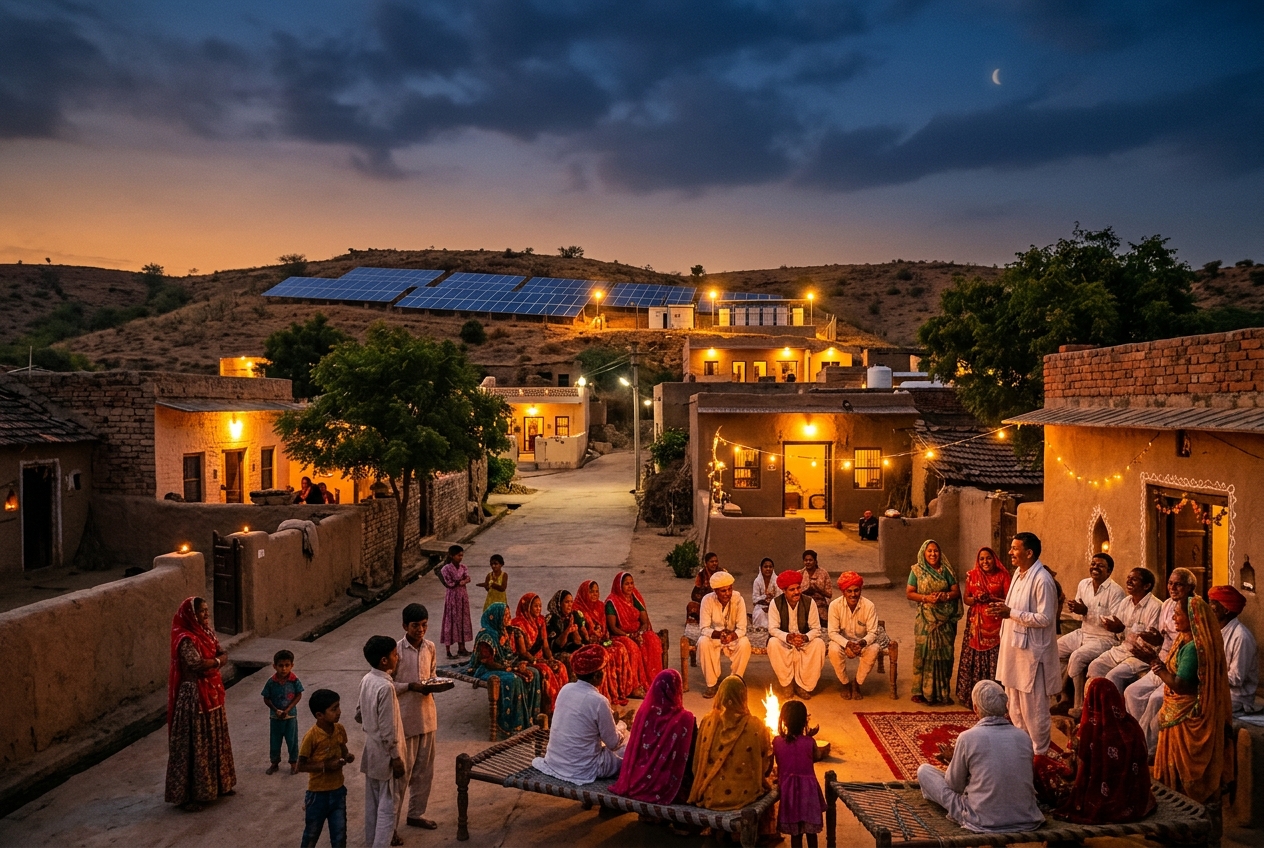
India’s NGO energy-access market has spent the last few years focusing on lights, pumps, drinking water and livelihood loads. In 2026, a different category deserves sharper attention: solar-powered clean cooking for institutional and community kitchens. This is not the same as household improved cookstoves, and it is not merely an equipment donation exercise. For India’s anganwadi clusters, residential schools, hostels, tribal welfare facilities, old-age homes, community kitchens, religious kitchens and health-linked nutrition centres, cooking energy is a large, recurring operating cost and a major source of indoor pollution, logistics risk and carbon emissions.
For NGOs, CSR teams, RE developers and project financiers, the opportunity lies in designing institutional clean-cooking systems that actually match meal volumes, kitchen schedules, fuel back-up requirements, staff capability and measurable impact outcomes. In many cases, the right answer is not “all-solar”. It is a hybrid architecture that combines solar thermal, rooftop solar PV, efficient electric cooking, heat storage, insulated vessels and retained LPG backup. The commercial case depends on fuel displacement, tariff design, utilisation rates and maintenance discipline.
This article sets out the 2026 India practitioner view: where the use cases are, what technologies fit, what capex ranges to expect, how CSR and grant structures can be built, and what lenders and policymakers should watch in procurement and MRV.
Why institutional clean cooking is now a serious 2026 NGO energy-access theme
Institutional kitchens are structurally different from household cooking programmes.
- Energy demand is concentrated and easier to meter
- n- Beneficiaries are grouped, which lowers delivery and training costs
- Procurement is centralised through trusts, societies, district authorities or NGO networks
- Fuel replacement can produce visible OPEX savings within one budget cycle
- Health, gender and climate outcomes can be monitored with fewer data points than household-scale programmes
In India, many NGO-supported facilities still rely on LPG cylinders, firewood, agricultural residue or a mix of all three. In remote districts, LPG refill logistics remain unreliable. Biomass use often persists because it is perceived as low-cost, even where collection time, smoke exposure, kitchen blackening and cooking inefficiency are high. Meanwhile, several institutions now have daytime electricity access that is adequate for auxiliary loads but not optimised for thermal demand.
The 2026 trigger is convergence. CSR budgets are under pressure to show measurable outcomes. Carbon methodologies for clean cooking and fuel-switching have matured, though they still require careful baselining. Solar module and storage economics remain more favourable than they were three to five years ago. State-level interest in reducing biomass dependence around public and community facilities is also increasing, especially where tribal development, nutrition, women’s empowerment and rural livelihoods overlap.
For advisory firms like Growthifye, the key is to treat institutional clean cooking as a systems programme, not an appliance campaign. That means load estimation, menu mapping, thermal profile assessment, site layout, OPEX comparison, safety planning and Impact measurement & MRV from day one.
Which sites make the best project pipeline in India
Not every kitchen is suitable. The strongest pipeline typically comes from repeatable site typologies with stable meal demand and day-time cooking windows.
Promising NGO and CSR site categories in 2026 include:
- Ashramshalas and tribal residential schools serving 100 to 1,000 meals per day
- Hostels for girls, working women or students with predictable breakfast-lunch-dinner cycles
- Community nutrition kitchens linked to maternal and child welfare programmes
- Faith-based or charitable kitchens with daily bulk cooking and strong local governance
- NGO-run old-age homes and residential care centres
- Training centres and campus kitchens in semi-urban and peri-urban locations
- Disaster-resilient community kitchens in climate-vulnerable districts
Sites are strongest when they have:
- Minimum 150 to 200 meals per day on a recurring basis
- Adequate roof or adjacent land area for solar thermal collectors or PV
- Existing kitchen staff who can be trained on SOPs
- At least 3 to 5 years of expected operating continuity
- A reliable local implementing partner for maintenance and reporting
Weak candidates include highly seasonal facilities, kitchens with erratic occupancy, sites with severe shading, and locations where management turnover is so high that process continuity is doubtful.
From a state perspective, Rajasthan, Gujarat, महाराष्ट्र, Karnataka, Telangana, Odisha, Chhattisgarh, Jharkhand and parts of the Northeast can each support different models depending on irradiation, grid quality, cultural cooking practices and access to service networks.
Technology choices: solar thermal, electric cooking and hybrid models
The market often over-simplifies institutional clean cooking into one technology. In practice, the right design depends on what is being cooked, when, and in what quantity.
Three broad configurations dominate in 2026:
- Solar thermal with insulated hot-water or steam systems for bulk daytime cooking
- Rooftop solar PV paired with efficient electric cooking appliances where tariffs and wiring allow
- Hybrid systems with solar contribution plus LPG or electric backup for reliability
Solar thermal is usually best where the kitchen has large daytime batch cooking, available collector area and a trained operator. It can support steam-based cooking, pre-heating and hot-water demand. However, performance falls if cooking shifts to cloudy early mornings or late evenings, if collector cleaning is poor, or if steam systems are oversized relative to actual meal throughput.
Solar PV plus electric cooking works well where institutions already have stable low-voltage infrastructure and where menu items suit induction, rice boilers, electric steamers or pressure systems. This model is increasingly relevant as commercial and institutional rooftop systems in India often deliver levelised daytime power in the range of roughly Rs 3.2 to Rs 5.0 per kWh depending on scale, financing and utilisation. But the economics change if imported electricity during peak cooking hours costs Rs 6 to Rs 9 per kWh and the kitchen needs significant battery backup. Battery-supported cooking can become expensive unless the use case is operationally critical or grant-supported.
Hybrid systems are therefore the most bankable. A typical example might include:
- Solar thermal for pre-heating or bulk steam generation
- Rooftop PV to run auxiliaries and selected electric cooking loads
- High-efficiency insulated vessels to reduce thermal losses
- LPG retained for monsoon backup, peak events or early-morning cooking
This kind of architecture protects service continuity while still reducing annual LPG or biomass use materially.
Indicative 2026 capex ranges for institutional systems vary widely by size and integration level:
- Basic efficient electric cooking retrofit for a small institutional kitchen: Rs 3 lakh to Rs 8 lakh
- Mid-sized rooftop PV plus electric cooking integration: Rs 8 lakh to Rs 25 lakh
- Solar thermal for medium institutional kitchens: Rs 10 lakh to Rs 35 lakh
- Larger integrated steam or hybrid systems for high meal volumes: Rs 25 lakh to Rs 75 lakh or more
These are broad practitioner ranges only. Civil works, piping, kitchen redesign, electrical upgrades, thermal storage, AMC and district logistics can move totals significantly.
The business case: fuel savings, tariffs and grantability
For NGO-backed projects, the investment case is rarely a pure commercial payback story. It is usually a blended value case combining avoided fuel costs, health and gender co-benefits, resilience and measurable impact.
Still, hard numbers matter.
If an institutional kitchen uses 20 to 40 domestic-equivalent LPG cylinders per month, or its commercial LPG spend runs into Rs 25,000 to Rs 1.5 lakh monthly depending on scale, then partial fuel displacement can be meaningful. Where biomass is the baseline, direct cash savings may appear lower, but time savings, labour reduction, reduced smoke exposure and lower soot-related cleaning costs can still justify intervention.
In 2026, practitioners should evaluate at least five financial variables:
- Baseline monthly cooking energy spend by fuel type
- Number of meals served and seasonal occupancy swings
- Share of cooking load that can realistically be shifted to solar-assisted daytime operations
- Electricity tariff slab and sanctioned load constraints
- O&M capability and replacement reserve requirements
Simple payback can range from 3 to 8 years in stronger LPG-displacement cases, but can stretch beyond that if utilisation is weak or systems are poorly matched to kitchen operations. This is why CSR and philanthropic capital remain highly relevant. Clean cooking in institutional settings fits well within CSR themes around health, women, tribal development, nutrition, education and climate resilience.
A robust funding stack may combine:
- CSR capex support for system procurement and installation
- Philanthropic grants for early-stage site assessments and community mobilisation
- NGO contribution for local supervision and behavioural adoption
- Beneficiary institution contribution, even if modest, to improve ownership
- Performance-linked disbursement tied to operating days, meals served or verified fuel displacement
This is where disciplined CSR funding pipelines and Grant & philanthropic fundraising become valuable. Donors increasingly want district-level replication rather than isolated pilots. A 20-site or 50-site programme with standardised technical specifications, training modules and MRV can attract far stronger interest than one-off installations.
Policy and compliance context in 2026
Institutional clean cooking sits at the intersection of multiple policy domains rather than one single scheme.
Relevant policy and market signals in India in 2026 include:
- CSR spending under Schedule VII themes linked to health, education, environment, rural development and gender outcomes
- Renewable-energy adoption incentives at state and utility level for institutional rooftop systems, where applicable
- Clean air and public health priorities that strengthen the case for reduced biomass smoke exposure
- Energy-efficiency standards and electrical safety norms for institutional retrofits
- Carbon market interest in verifiable fuel-switching and avoided emissions pathways
The practical point is that developers and NGOs should not assume one central subsidy will make projects work. Most viable programmes will be assembled through converged funding and careful contracting.
Compliance matters as much as engineering. Kitchen retrofits in schools, hostels and community facilities require attention to fire safety, pressure systems, electrical protection, food-service workflow, operator training and AMC accountability. Procurement documents should specify not just installed capacity but usable cooking outcomes: litres of water heated, kilograms of rice cooked, batch duration, backup arrangements, and uptime commitments.
For trusts and NGOs, governance failures often arise from missing handover protocols, unclear ownership of spare parts, and no budget line for O&M after year one. These failures are avoidable with proper Compliance & governance frameworks embedded into programme design.
MRV: what lenders, CSR teams and policymakers should insist on
Institutional clean cooking is highly suitable for measurable impact, but only if baseline and operating data are structured correctly.
A practical 2026 MRV framework should track:
- Number and type of institutions served
- Average meals cooked per day and occupancy rates
- Baseline fuel mix by LPG, biomass and electricity
- Post-installation fuel consumption by month
- Solar generation or thermal output, depending on technology
- Kitchen operating days and downtime events
- Indoor air quality proxies or exposure-reduction indicators where feasible
- Estimated emissions reductions using transparent assumptions
- OPEX savings and maintenance spending
- User satisfaction among cooks, wardens and facility managers
For example, if a 500-meal-per-day hostel kitchen reduces LPG use by 35% to 60% after a solar-assisted retrofit, that reduction should be backed by cylinder purchase records, runtime logs, smart meters or thermal-output records rather than anecdotal claims. Biomass displacement is even more sensitive and should be validated through procurement logs, stock registers, periodic site checks and use-pattern verification.
Developers seeking lender confidence should also track technical KPIs:
- Specific energy use per 100 meals
- Collector or PV utilisation rate
- Backup fuel activation frequency
- System availability percentage
- Response time for maintenance calls
For portfolios above 20 sites, digital dashboards are now practical and affordable. IoT-enabled metering for power, temperature, steam pressure or runtime can materially improve programme credibility, especially when multiple CSR sponsors are involved.
Delivery models that work on the ground
The strongest implementation structures in 2026 are those that match technical complexity to local operating capacity.
Three delivery models are emerging:
- Capex grant plus AMC: donor funds installation, implementing partner manages training and annual maintenance
- Cluster service model: one district-level service partner supports 10 to 50 kitchens under standard SOPs
- Outcome-linked programme: staged disbursement based on commissioning, training completion and verified operating performance
For most NGO-led portfolios, the cluster model is the most scalable. It reduces technician travel cost, standardises spare inventory and makes refresher training feasible. It also helps aggregate procurement, which can reduce equipment cost by 8% to 15% versus fragmented buying in some categories.
Developers should resist over-customisation. A limited menu of standard system designs by meal-volume band is usually better:
- 100 to 250 meals/day
- 250 to 500 meals/day
- 500 to 1,000 meals/day
- 1,000+ meals/day
Within each band, only a few variables should change: roof area, backup fuel profile, cooking vessel mix and electrical infrastructure.
This is where Program design & theory of change becomes commercially relevant, not just donor language. If the theory of change is explicit from the start—reliable clean cooking leads to lower recurring fuel burden, reduced smoke exposure, improved nutrition-service continuity and better institutional resilience—then technical design, training, funding and MRV can all be aligned around the same outcome chain.
What the market should do next
For policymakers, the immediate task is to recognise institutional clean cooking as a distinct DRE and social-infrastructure segment, not a subset of generic rooftop solar.
For CSR heads, the opportunity is to move from isolated kitchen donations to district or state-level portfolios with common MRV rules.
For lenders and impact investors, the next frontier is not unsecured household appliance scale-up alone, but aggregated institutional portfolios with visible offtake, governance and measurable fuel displacement.
For RE developers, success will come from interdisciplinary capability: thermal engineering, electrical integration, kitchen operations, field training and grant-compatible reporting.
And for NGOs, the best projects will be those where energy access is tied directly to service delivery outcomes—more reliable meals, lower fuel logistics stress, safer kitchens and stronger programme continuity in underserved regions.
India’s 2026 energy-access conversation needs to expand beyond electrons and include useful heat. Institutional clean cooking is one of the most practical ways to do that at measurable scale.
If your organisation is evaluating a portfolio of community kitchens, hostels, tribal institutions or social facilities, contact Growthifye’s advisory desk for programme structuring, technical diligence, funding strategy and implementation support.
Explore Growthifye's related capabilities
This analysis connects directly to our advisory practice: Program design & theory of change · CSR funding pipelines · Grant & philanthropic fundraising · Compliance & governance.
About the author

Chief Executive Officer, Growthifye — With over 23 years in management consulting, Sudarshan has taken businesses from concept to scale — building and scaling new-age digital and energy businesses.
- 23+ years in management consulting
- EY alumnus
- Led large-scale BESS programmes, capital raises and advisory mandates
Want this analysis applied to your project?
Talk to our team