
India 2026 NGO Energy Access: Solar Irrigation, FPOs, CSR and MRV
By Sudarshan Karweer · sudarshan@growthifye.com · +91 84510 99371 (Call / WhatsApp) · 2026-08-30
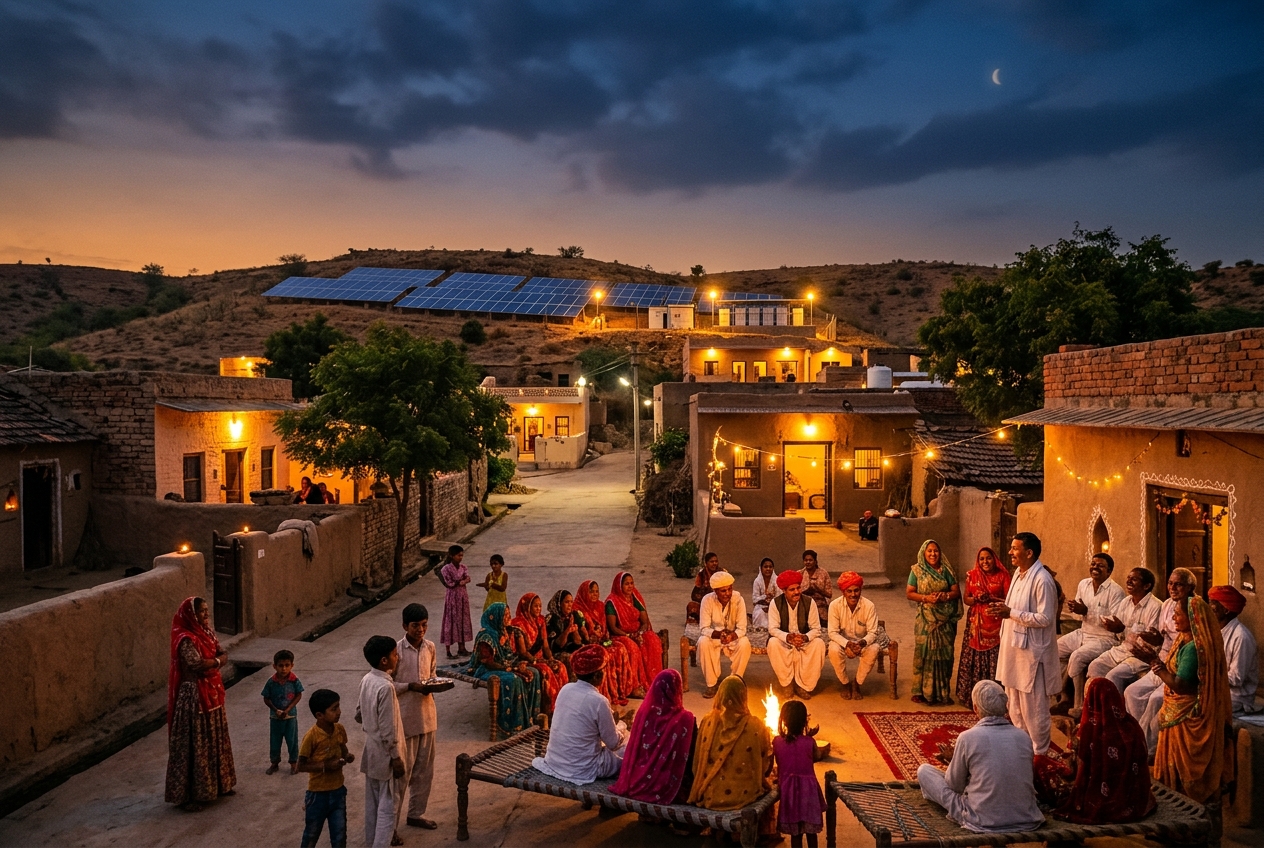
India’s NGO energy-access market is moving beyond lanterns, home systems and institutional rooftop projects. In 2026, one of the strongest yet under-structured opportunities is solar irrigation delivered through farmer institutions, NGOs and CSR-backed rural programmes. For advisory firms, developers, lenders and public agencies, this is not only an agriculture decarbonisation story. It is a community energy-access model with measurable livelihood outcomes, diesel displacement, groundwater governance implications and scalable blended-capital use cases.
This matters because irrigation remains one of the largest rural energy loads in India. Grid-connected pump sets face poor supply quality, night-time feeder access and voltage fluctuations. Diesel pumps still impose high operating costs on smallholders, especially in eastern India, tribal geographies and fragmented landholding clusters. Meanwhile, PM-KUSUM has expanded market familiarity with solar pumps, but implementation quality, beneficiary selection, after-sales support and water-use safeguards remain inconsistent across states. That gap creates a practical role for NGOs and CSR funders: not to duplicate subsidy schemes, but to improve aggregation, co-funding, inclusion, governance and impact verification.
For stakeholders in renewable energy, the investable question is straightforward: how do you structure community-oriented solar irrigation so that it delivers reliable farm energy, protects water resources, creates bankable payment behaviour and generates auditable impact data?
Why solar irrigation is now an NGO energy-access priority in 2026
The economics have sharpened. A typical 5 HP diesel irrigation pump can consume around 0.8 to 1.2 litres of diesel per hour depending on load and age. At diesel prices commonly around Rs 88-95/litre in many markets during 2026, variable irrigation cost can exceed Rs 80-100 per operating hour. During peak irrigation periods, seasonal expenditure for a small farmer using hired pumping services or owned diesel pumping can run into tens of thousands of rupees.
By comparison, decentralised solar pumping shifts the cost structure from fuel OPEX to upfront CAPEX and maintenance. For NGO-led access programmes, this makes solar irrigation a strong fit where CSR or grant capital can reduce entry barriers while local institutions manage scheduling and collection. Unlike household lighting interventions, irrigation energy is directly tied to income, crop intensity and resilience. That improves the case for co-payment and repayment discipline.
The strongest use cases in 2026 are not one-pump-one-farmer deployments everywhere. They are shared-use and service-oriented models where:
- farmer producer organisations (FPOs) aggregate demand
- self-help group networks support outreach and collections
- NGOs identify vulnerable beneficiaries and mediate inclusion
- developers install and maintain systems under service agreements
- CSR funding covers viability gaps, training and first-loss support
- MRV frameworks measure both energy and livelihood outcomes
This angle is clearly distinct from generic rural solar and clean-cooking narratives because irrigation is a productive load with immediate cash-flow linkage. It can therefore sit between social infrastructure and commercial energy service models.
The 2026 policy landscape: PM-KUSUM, state subsidies and where NGOs fit
Any serious practitioner discussion must start with PM-KUSUM. Across components and state-specific implementations, the scheme has mainstreamed standalone and grid-connected solar pump deployment. However, the practical picture varies by state on subsidy release, empanelment, technical specifications, beneficiary contribution and integration with feeder infrastructure.
In most field situations, NGOs do not replace PM-KUSUM. They improve last-mile execution around it. The most useful intervention points are:
- beneficiary identification in low-income or tribal blocks
- demand aggregation at village, watershed or FPO level
- convergence with CSR grants for margin money or uncovered costs
- training on water budgeting and pump scheduling
- support on land records, application paperwork and local permissions
- post-installation grievance handling and usage monitoring
For standalone DC or AC solar pumps in the 3 HP to 10 HP category, all-in installed costs in 2026 can still vary widely by configuration, quality and state procurement route. As a broad market reference, a 3 HP system may land in the Rs 2.2-3.0 lakh range, while 5 HP systems may sit around Rs 3.0-4.5 lakh. Community systems with elevated storage, distribution piping, smart controllers or higher pumping heads can cost materially more. In many districts, subsidy support may cover a major share, but the residual beneficiary contribution remains a barrier for small and marginal farmers.
That is where CSR design matters. If a company wants measurable rural livelihood impact under Schedule VII-style development priorities, a poorly targeted asset giveaway will underperform. A better structure may combine:
- subsidy convergence through government schemes
- CSR support for beneficiary contribution for vulnerable groups
- grant support for training, institution building and O&M reserve
- metered service models for long-term operational discipline
- mandatory usage and water data capture for auditability
This is exactly where Program design & theory of change becomes critical. Without a clear causal chain from pump installation to irrigated acreage, cropping intensity, diesel displacement, farmer income and water sustainability, many corporate social investments remain anecdotal rather than decision-useful.
Delivery models that work: individual ownership versus irrigation-as-a-service
In 2026, the market is learning that ownership structure determines operational outcomes. Three broad models are visible.
The first is the individual beneficiary model. It is straightforward and politically attractive, but often weak on inclusion and utilisation. Better-off farmers with clearer land titles and easier co-payment capacity are more likely to benefit. NGO participation here is mostly around outreach and documentation support.
The second is the community or group-ownership model. A water-user group, SHG federation or FPO owns the asset, while members book irrigation slots and pay usage charges. This improves utilisation if command area planning is sound. It also creates a more transparent pathway for CSR co-funding because the social benefit extends beyond a single landholder.
The third, and often the most resilient, is irrigation-as-a-service. In this model, a local entrepreneur, FPO or partner NGO operates the pump and sells water or pumping services on an hourly, acreage or volumetric basis. This approach can serve tenant farmers and fragmented land parcels more effectively than owner-only models.
Typical pricing structures in the field during 2026 may include:
- hourly irrigation service rates of roughly Rs 70-150 depending on crop, water depth, state and local alternatives
- per-acre or per-bigha rates for specific irrigation events
- seasonal subscriptions in tightly organised command areas
- prepaid wallet or token models in digitally enabled pilots
These service tariffs are often below diesel-based alternatives while still supporting routine O&M, operator income and a maintenance reserve. For lenders and developers, the key is whether demand is dense enough within a reasonable hydraulic radius. Scattered smallholders with low coordination capacity can make utilisation too thin, which weakens economics even when the social case appears strong.
The best-designed NGO programmes now screen villages based on:
- groundwater status and irrigation need
- crop mix and irrigation frequency
- distance from reliable grid supply
- prevalence of diesel pumping or expensive hired irrigation
- FPO maturity and collection discipline
- women’s participation in farm decision-making
- land fragmentation and command-area feasibility
Economics, tariffs and financing structure for CSR-backed programmes
Solar irrigation is often described as “free sunlight, high impact.” In practice, programme economics depend on who pays for CAPEX, who bears O&M risk and how utilisation is monetised.
For a shared 5 HP solar pump serving a cluster, annual O&M may remain modest in percentage terms but still requires ring-fenced cash. Module cleaning, controller maintenance, pump servicing, borewell repairs and operator travel all matter. If these costs are ignored at inception, system downtime rises after the first 12-24 months.
A pragmatic financing stack in 2026 may look like this:
- 40-70% public subsidy depending on applicable state route or scheme design
- 10-30% CSR or philanthropic grant for viability gap and inclusion support
- 10-20% beneficiary or institution contribution in cash or phased form
- optional working capital or service-enterprise debt for distribution and O&M systems
Where full subsidy convergence is unavailable, NGOs and advisory firms should resist the temptation to fund entire CAPEX through CSR unless the project is explicitly a demonstration or humanitarian deployment. Co-contribution usually improves care, scheduling compliance and social legitimacy.
For lenders, the relevant diligence point is not only asset quality but payment mechanism design. An FPO with strong produce aggregation and regular member settlements can support irrigation charge recovery better than an informal village committee with no cash-flow discipline. In some cases, irrigation fees can be netted against produce payments or input-credit relationships, reducing collection leakage.
This is also where Compliance & governance becomes operational rather than bureaucratic. Asset registers, ownership documentation, usage contracts, operator responsibilities, escalation protocols and spare-part planning are basic requirements if the programme is to survive beyond the first annual CSR report.
MRV that goes beyond pump counts: what funders should actually track
Many NGO energy-access programmes still report outputs rather than outcomes. “Number of pumps installed” is easy to publish and almost useless for serious decision-makers. In solar irrigation, meaningful MRV in 2026 should cover at least five layers.
First, technical performance:
- installed capacity in kWp
- pump HP and rated discharge
- daily and seasonal operating hours
- downtime incidents and response times
- water delivered where metering is feasible
Second, energy and emissions:
- diesel litres displaced or grid electricity offset
- avoided fuel expenditure
- seasonal energy-service availability
- emissions reduction using transparent baseline assumptions
Third, agriculture and livelihood outcomes:
- irrigated acreage added or stabilised
- change in crop intensity
- shift to higher-value crops where relevant
- farmer income change by segment
- irrigation cost reduction per acre or per season
Fourth, inclusion metrics:
- share of small and marginal farmers served
- tenant farmer access where applicable
- women farmers or women-led SHGs participating
- SC/ST or aspirational-district coverage where relevant
Fifth, water sustainability:
- groundwater status category of intervention blocks
- irrigation scheduling adherence
- crop-water alignment
- use of micro-irrigation convergence where possible
- local water governance measures adopted
This is the difference between a donation programme and a credible rural energy platform. Impact measurement & MRV is not a reporting add-on; it is the instrument that tells developers, corporates, donors and public agencies whether the intervention should scale, pivot or stop.
Practically, the best MRV systems in 2026 combine remote pump telemetry with periodic agronomy and household surveys. A telemetry-only system misses inclusion and income effects. A survey-only system misses actual runtime and reliability. Both are needed.
The hidden risk: solar irrigation can worsen water stress if governance is weak
No expert discussion of solar irrigation in India is complete without addressing groundwater. Solar pumps reduce marginal pumping cost. That is economically attractive, but in over-exploited aquifers it can intensify extraction if deployment is unmanaged.
For NGOs and CSR funders, this creates reputational and environmental risk. The right response is not to avoid solar irrigation altogether, but to screen and govern deployment carefully.
Key safeguards include:
- prioritising regions with irrigation deficits rather than already saturated extraction
- linking projects to water budgeting at village or watershed level
- pairing pumps with drip or sprinkler systems where agronomically viable
- avoiding blanket support for water-intensive cropping in stressed blocks
- setting community rules for irrigation scheduling and seasonal usage
- using sensor or manual logs for high-risk geographies
There is also a role for Corporate & utility partnerships where feeder-level reliability improvements, agricultural demand management and local water stewardship can be aligned. In some states, utility engagement may help target villages where solar irrigation complements rather than complicates supply planning.
A practical playbook for developers, NGOs and funders in 2026
If you are structuring a solar-irrigation energy-access programme today, the implementation sequence matters more than the brochure.
A practical playbook is:
- identify districts with high diesel dependence, weak irrigation reliability and active farmer institutions
- map applicable PM-KUSUM or state-subsidy routes before designing grant support
- segment beneficiaries by landholding, water access, crop profile and ability to co-contribute
- choose ownership and tariff models based on demand density, not ideology
- build water-risk filters into site selection from day one
- contract after-sales service with clear uptime obligations
- design a realistic tariff or reserve mechanism for O&M
- establish baseline data before installation, not after
- deploy combined technical and social MRV for at least two crop cycles
- publish outcome metrics that lenders and policy stakeholders can actually use
For RE developers, the lesson is that NGO-linked projects should not be treated as concessionary side business. They require disciplined engineering, service logistics and data systems. For corporates, the lesson is that CSR cheques alone do not create durable access. Institutional design does. For policymakers, the lesson is that subsidy scale needs stronger local aggregation and post-installation accountability.
Solar irrigation sits at the intersection of energy access, agriculture productivity, resilience and rural income. Done poorly, it becomes another underused asset. Done well, it becomes one of the most practical community-energy investments available in India in 2026.
If your organisation is evaluating NGO energy-access opportunities in solar irrigation, FPO-led delivery, CSR co-funding or field-grade MRV, contact Growthifye’s advisory desk to structure a bankable, compliant and impact-focused programme.
Explore Growthifye's related capabilities
This analysis connects directly to our advisory practice: Program design & theory of change · CSR funding pipelines · Grant & philanthropic fundraising · Compliance & governance.
About the author

Chief Executive Officer, Growthifye — With over 23 years in management consulting, Sudarshan has taken businesses from concept to scale — building and scaling new-age digital and energy businesses.
- 23+ years in management consulting
- EY alumnus
- Led large-scale BESS programmes, capital raises and advisory mandates
Want this analysis applied to your project?
Talk to our team