India 2026 NGO Energy Access: Solar Health Clinics, CSR Finance and MRV
By Sudarshan Karweer · sudarshan@growthifye.com · +91 84510 99371 (Call / WhatsApp) · 2026-09-05
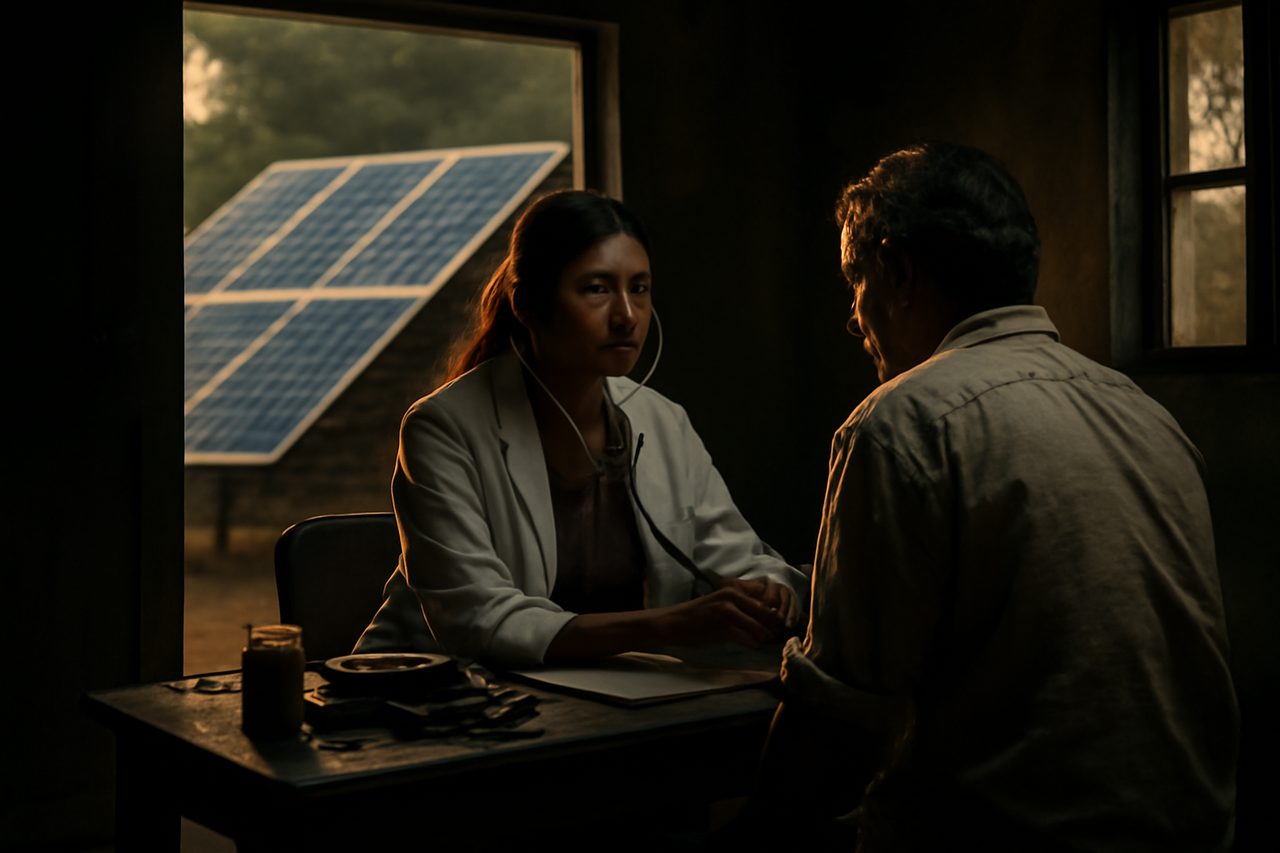
India’s rural health system still has a power-quality problem, not just an energy-access problem. In 2026, many sub-centres, primary health centres, tribal hostels with infirmary loads, maternity facilities, mobile medical units and NGO-run clinics technically have a grid connection, yet continue to face voltage fluctuation, feeder outages, transformer failures and expensive diesel back-up. For healthcare operations, that distinction matters. A clinic can be connected to the grid and still lose vaccine potency, diagnostic throughput and night-time service availability.
For NGOs and CSR teams evaluating community energy interventions, solar health clinics are now one of the strongest use cases in energy access: the social outcome is legible, the energy load is measurable, the avoided diesel economics are tangible, and impact monitoring can be designed with high confidence. This is a distinctly different pathway from mini-grids, clean cooking, irrigation or e-mobility. It sits at the intersection of public health reliability, distributed solar engineering, grant structuring and outcome-based monitoring.
This article sets out what a bankable NGO-led solar health clinic programme looks like in India in 2026: target facilities, sizing logic, capex ranges, operations model, policy context, CSR fit, and MRV architecture.
Why solar health clinics matter in 2026
India’s public and community health facilities have expanded service mandates faster than power infrastructure quality has improved. A typical rural or peri-urban clinic now supports a wider set of loads than it did five years ago:
- vaccine refrigerators and ice-lined refrigerators
- diagnostic devices such as centrifuges, microscopes and analysers
- labour room lighting and suction loads
- fans, lights and IT devices for telemedicine and digital health records
- water purification and small pumping loads
- communications equipment and router back-up
- occasional oxygen concentrators or nebulisation support
These are not always large loads, but they are reliability-sensitive loads. A 3 kW to 15 kW solar-plus-battery system can materially improve service continuity if designed around critical circuits rather than around nameplate connected load.
For NGOs, the case is especially strong in aspirational districts, tribal geographies, forest fringe villages, islands, flood-prone areas and weak-grid blocks where outage duration remains high. From a donor perspective, health is one of the easiest impact narratives to underwrite because the energy intervention maps directly to care delivery indicators: immunisation continuity, reduced referral delays, longer OPD hours, safer deliveries and lower diesel dependence.
Which healthcare facilities are best suited
Not every clinic needs the same architecture. In practice, project developers and CSR sponsors should segment facilities into three buckets.
First, sub-centres, health and wellness centres, and small NGO clinics with daytime operations and limited refrigeration. These often suit 2 kW to 5 kW rooftop solar with 5 kWh to 15 kWh battery support for critical loads.
Second, primary health centres and maternity points with vaccine refrigeration, diagnostics and extended evening service. These usually fit 5 kW to 15 kW systems with 10 kWh to 40 kWh battery storage, depending on outage profile and load diversity.
Third, rural hospitals, mobile medical depots and larger mission facilities with complex loads. These are less suitable for grant-only standardisation and may require hybrid engineering with larger batteries, DG synchronisation, load segregation and more advanced controls.
The most replicable NGO energy access opportunity lies in the first two categories. These sites offer a balance of manageable capex and high public value.
Site-selection criteria should include:
- minimum 12 months of power availability and outage history, ideally feeder-wise if possible
- presence of cold-chain or other critical medical loads
- clear roof rights or campus rights
- willingness of facility management to ring-fence critical circuits
- baseline diesel use or service disruption records
- district health administration consent where public facilities are involved
- basic O&M access within 24 to 72 hours
A common mistake is selecting clinics only on visibility or donor preference. The better approach is to create a technical and social prioritisation matrix: outage severity, patient footfall, maternal-child health relevance, immunisation dependency, diesel intensity, remoteness and ease of post-installation monitoring.
System design: size for critical loads, not total campus demand
In rural healthcare energy access, oversizing is a grant-funded risk and undersizing is an operational risk. The right design principle is simple: protect critical service loads first, then add resilience for secondary loads if budget permits.
A typical critical-load list for a 24x7 or extended-hours rural clinic may include:
- vaccine refrigerator: 0.1 kW to 0.3 kW average, higher cycling peaks
- LED lighting for examination, labour and pharmacy areas: 0.2 kW to 0.8 kW
- fans and ventilation: 0.3 kW to 1.5 kW
- router, desktop, printer and telemedicine devices: 0.2 kW to 0.6 kW
- water purifier or small pump: 0.3 kW to 1.1 kW intermittent
- small diagnostic equipment: 0.5 kW to 2 kW depending on use
For such sites, system design should include:
- dedicated critical-load distribution board
- rooftop solar PV, generally 2 kW to 15 kW
- lithium battery storage sized for outage duration, usually 1.5 to 4 hours of critical load autonomy
- hybrid inverter with remote monitoring
- surge protection, earthing and lightning protection
- refrigeration-compatible wiring priority and temperature-data logging where vaccines are involved
Indicative 2026 all-in capex ranges in India vary by state, logistics and battery hours, but practitioners can broadly expect:
- 2 kW to 3 kW solar with 5 kWh to 8 kWh battery: Rs 4.5 lakh to Rs 7 lakh
- 5 kW solar with 10 kWh to 15 kWh battery: Rs 8 lakh to Rs 13 lakh
- 10 kW solar with 20 kWh to 30 kWh battery: Rs 16 lakh to Rs 26 lakh
- 15 kW solar with 30 kWh to 40 kWh battery: Rs 24 lakh to Rs 38 lakh
These figures can move upward in hilly terrain, island geographies or difficult last-mile logistics. They can move downward where standardised procurement and clustered deployment are used across multiple facilities.
For NGO portfolios, cluster procurement matters. A 20-site deployment can reduce soft costs per clinic through standard design packages, consolidated logistics, common AMC terms and centralised monitoring dashboards.
The financing case: CSR, grants and blended community-health structures
Solar health clinics are rarely financed on a pure commercial-return basis because the host facility is usually public, charitable or low-revenue. But that does not make them weak projects. It simply means the capital stack should match the use case.
In 2026, the most viable financing structures are:
- direct CSR grants for capex and 3-5 years of O&M
- philanthropic grants for hard-to-reach clinics and tribal health assets
- pooled district or thematic programmes combining multiple clinic sites
- outcome-linked donor tranches tied to uptime, vaccine refrigeration continuity or patient service metrics
- co-funding with health foundations, hospital trusts or development agencies
A practical structure is to fund 100% capex through CSR or philanthropy, then escrow 3 years of O&M and remote monitoring at financial close. Too many NGO energy projects fail not on equipment choice but on the absence of funded maintenance. For health facilities, that failure is unacceptable.
Where public-sector clinics are involved, NGOs should define asset ownership, handover conditions, insurance and replacement responsibility upfront. If batteries are expected to require replacement in years 6-8 depending on cycling, this lifecycle cost should be visible in the original programme note.
This is where Growthifye’s Program design & theory of change and CSR funding pipelines capabilities are useful in practice. The technical intervention must be translated into a donor-ready causal chain: improved energy reliability to improved service continuity to measurable health and resilience outcomes, with governance and maintenance clearly assigned.
Tariff and savings logic: what decision-makers should actually compare
The economics of solar health clinics are often misunderstood because analysts compare them only to grid tariffs. That is incomplete. Rural clinics face a blended reliability cost made up of:
- grid energy charges, often in the Rs 6/kWh to Rs 9/kWh range depending on state and consumer category
- effective outage cost from service interruption
- diesel generation cost, often Rs 22/kWh to Rs 34/kWh for small DG sets at 2026 diesel prices and low loading
- equipment damage and replacement risk from poor power quality
- staff overtime or reduced service throughput due to outages
If a clinic uses diesel back-up even intermittently, the case for solar-plus-battery strengthens quickly. Consider a PHC with annual consumption of 18,000 kWh, of which 3,000-4,000 kWh is effectively replaced from diesel or avoided outage losses on critical circuits. A 10 kW solar system in many Indian states can generate roughly 13,500-16,500 kWh per year depending on irradiation, roof orientation and losses. If 60-75% of that solar generation directly offsets grid and diesel-linked consumption on priority loads, the social return and avoided operating stress are significant even if financial payback is not the only objective.
For CSR committees and donors, the right metric is not simple payback alone. It is cost per resilient clinic-year, cost per cold-chain protected day, or cost per incremental service hour enabled. These are more decision-useful for health access programmes.
Policy and implementation context in India
The 2026 policy landscape supports decentralised clean energy in community infrastructure, even where healthcare-specific capital support is uneven across states. Solar deployment at public and institutional buildings can align with broader clean-energy and resilience priorities under state renewable programmes, DISCOM net-metering frameworks where eligible, and district-level development planning.
However, NGOs should be cautious about assuming net metering alone solves the problem. Many rural health installations need back-up and reliability, not just annual energy offset. A rooftop system without storage may reduce bills but still fail the core healthcare objective during outages. For this service area, resilience design outranks headline solar yield.
Compliance considerations include:
- state net-metering or gross-metering rules, where interconnection is pursued
- electrical safety approvals and certified installation practices
- public-facility permissions, especially for government health buildings
- battery disposal and end-of-life handling under applicable waste-management norms
- procurement transparency and AMC enforceability for donor-funded assets
Public-private coordination is often the make-or-break factor. NGOs need district health authorities, local electricians, solar EPC partners and community oversight to align early. One signed CSR sanction letter without local implementation ownership is not enough.
MRV: how to prove health and energy impact credibly
Impact claims in community energy are often too generic. Solar health clinics allow better MRV because both energy and service indicators can be tracked with relatively high frequency.
A robust MRV framework should track four layers.
First, energy performance:
- solar generation in kWh
- battery charge-discharge cycles and state of health
- critical-load uptime during outages
- grid outage hours bridged by the system
- diesel consumption avoided, where baseline DG exists
Second, facility operations:
- hours of lighting and equipment availability in key rooms
- cold-chain continuity and vaccine refrigerator temperature excursions
- telemedicine uptime where relevant
- number of outage-related service interruptions before and after intervention
Third, health-service outcomes:
- immunisation sessions conducted as scheduled
- night-time deliveries handled without power disruption
- patient footfall during evening hours
- sample processing or diagnostic sessions completed
- referrals attributable to power non-availability, before vs after
Fourth, financial and governance indicators:
- O&M ticket closure time
- preventive maintenance completion rate
- asset downtime by cause
- annual operating cost reduction from reduced diesel and repair events
MRV should combine remote monitoring with field validation. A good protocol is monthly equipment data review, quarterly facility surveys and annual third-party verification for larger CSR portfolios. Vaccine sites should integrate temperature logger evidence wherever feasible.
This is precisely where Impact measurement & MRV becomes strategic rather than cosmetic. Donors increasingly want evidence that links asset performance to service outcomes, not just installed capacity photos. For large corporate CSR programmes, audited dashboards showing kWh generated, litres of diesel avoided, cold-chain continuity and service-hour gains can materially improve internal approval for scale-up.
A practical delivery model for NGOs and corporate partners
The most scalable structure in 2026 is a district or state cluster model led by an NGO or foundation, with one technical advisor, one EPC framework, and a common MRV backbone.
A workable sequence is:
- identify 20-100 candidate facilities with health-department consultation
- conduct rapid technical and social feasibility screening
- standardise 3-4 system archetypes by load band
- aggregate procurement and AMC for cost efficiency
- secure CSR and philanthropic commitments for capex plus O&M reserve
- install remote monitoring across all sites
- publish quarterly dashboard reports for funders and district stakeholders
This model reduces per-site transaction cost and produces comparable data across locations. It also creates a scale narrative that individual one-off donations cannot. For corporate sponsors with healthcare, FMCG, telecom, mining, manufacturing or financial-services footprints in rural India, clinic electrification can align strongly with community-health mandates and local-area development obligations.
The key is disciplined execution: do not overpromise total electrification where only critical-load support is funded; do not treat handover as project completion; and do not separate engineering decisions from MRV design.
Solar health clinics are not a symbolic CSR asset. When designed properly, they are a resilient public-service infrastructure intervention with measurable operational and health outcomes. In a 2026 environment of rising diesel cost, tighter donor scrutiny and stronger expectations on evidence, this makes them one of the most practical NGO energy access themes in India.
If your organisation is evaluating solar health clinics, rural healthcare resilience or donor-backed energy access portfolios, contact Growthifye’s advisory desk. We can support programme structuring, technical feasibility, financing strategy and implementation-ready MRV design.
Explore Growthifye's related capabilities
This analysis connects directly to our advisory practice: Program design & theory of change · CSR funding pipelines · Grant & philanthropic fundraising · Compliance & governance.
About the author

Founder & CEO, Growthifye — engineering and financing India's clean-energy transition.
Want this analysis applied to your project?
Talk to our team