India 2026 NGO Energy Access: Community Battery Swapping, SHGs and CSR Delivery
By Sudarshan Karweer · sudarshan@growthifye.com · +91 84510 99371 (Call / WhatsApp) · 2026-08-28
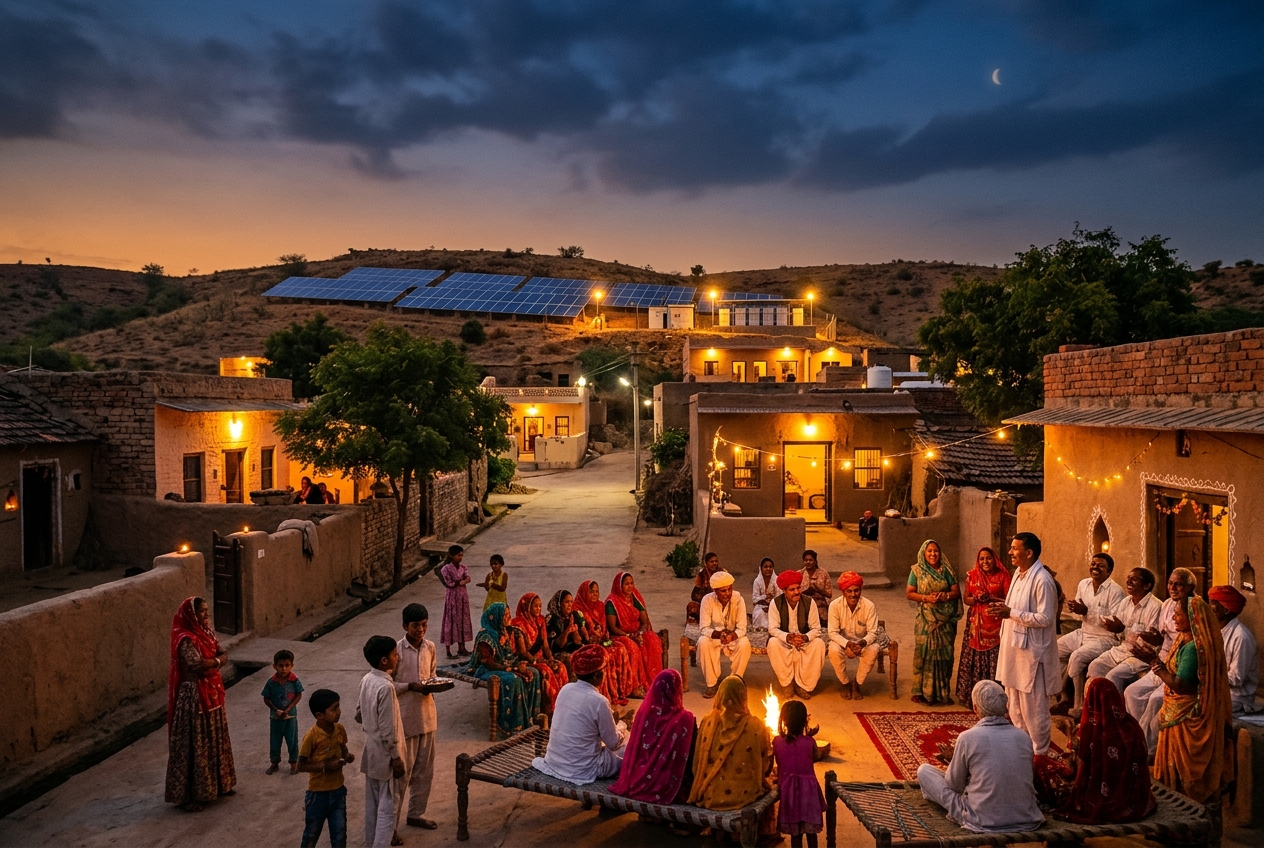
India’s rural energy-access conversation is often dominated by household solar, mini-grids, clean cooking and productive-use appliances. But in 2026, one adjacent model deserves more attention from NGOs, CSR teams, utilities and impact investors: community battery swapping tied to rural livelihoods. For villages and peri-urban growth centres where small electric mobility, micro-enterprises and unreliable grid supply intersect, battery-swapping hubs can become a practical energy-access asset rather than just a transport service.
This matters for Indian stakeholders because the use case sits at the intersection of three hard realities. First, a large share of low-income users still cannot afford vehicle ownership plus battery replacement risk. Second, many NGOs and CSR programmes struggle to fund energy access beyond one-time asset donation. Third, grid quality remains uneven across geographies where livelihoods depend on uptime, especially for early-morning and evening operations. A swapping model, if designed correctly, can convert irregular power access into a managed service with measurable social outcomes.
For Growthifye’s client base, the question is not whether swapping will replace all rural energy-access models. It will not. The real question is where a community battery-swapping architecture can deliver lower user friction, stronger asset utilisation and cleaner MRV than stand-alone subsidy-led deployments.
Why battery swapping belongs in the NGO energy-access toolkit
The most compelling rural and peri-urban applications are not premium EV corridors. They are local ecosystems where a shared battery supports income generation and essential community services.
Examples include:
- e-rickshaws serving first-mile and last-mile connectivity near mandis, railheads and district roads
- cargo three-wheelers for milk collection, agri-input delivery and small parcel movement
- battery-powered sewing, food processing or light workshop loads where DC packs can support modular productive use
- women-led self-help group enterprises that need low-ticket energy services without taking full technology risk
- health outreach or mobile vending services where uptime matters more than ownership of the battery
In these settings, the battery becomes the financed energy unit. Users pay for availability and throughput rather than the full embedded cost of battery ownership. For NGOs and CSR funders, that creates a structure closer to service delivery than a donation programme. It also helps avoid one of the biggest rural electrification problems of the last decade: asset abandonment once maintenance costs emerge.
A community swapping station can also complement weak-grid settlements. Where feeders are available but voltage and outage profiles are poor, operators can charge batteries when supply is stable, use rooftop solar to reduce daytime charging costs, and add limited stationary storage for operational continuity. That layered approach can improve reliability without pretending that one intervention solves all local energy deficits.
The 2026 India business case: unit economics and tariff logic
A useful way to evaluate rural or peri-urban swapping is to separate three cost layers: charging energy, battery depreciation and station operations.
In 2026, many NGO-linked projects will source electricity either from LT commercial supply, dedicated small commercial connections or behind-the-meter rooftop solar integrated with the station. Effective charging energy cost will vary sharply by state and consumer category, but practitioners should assume a grid-supplied range of roughly Rs 7-10/kWh for small commercial rural and peri-urban sites once fixed charges, taxes and demand-related effects are considered. Where rooftop solar is properly sized and used for daytime charging, blended energy cost can come down materially, often into the Rs 4-6/kWh equivalent range depending on capex support, CUF and battery-charging schedule.
Now consider user pricing. For small swappable packs used in e-rickshaws or cargo vehicles, field tariffs in pilot and semi-commercial environments often settle on a per-swap or per-kWh equivalent basis. A practical working range in 2026 can be around:
- Rs 120-180 per swap for smaller low-range packs in low-income geographies
- Rs 180-260 per swap for larger packs or higher-service guarantees
- Rs 11-18/kWh equivalent where digital metering and battery analytics allow energy-based pricing
The viability threshold depends less on energy cost alone and more on battery cycling. If a station owns inventory that turns only 0.4-0.6 cycles per battery per day, economics can fail quickly. But at 1.0-1.5 effective cycles per battery per day, with disciplined maintenance and standardised charging windows, community systems can become financeable in selected clusters.
Indicative capex for a modest rural swapping node in 2026 might include:
- charger and control systems: Rs 2 lakh to Rs 6 lakh
- basic civil and kiosk infrastructure: Rs 1 lakh to Rs 4 lakh
- software, telemetry and user management: Rs 0.5 lakh to Rs 2 lakh initial setup equivalent
- battery inventory: often the largest component, from Rs 4 lakh to Rs 20 lakh depending on chemistry, quantity and pack size
- optional rooftop solar plus limited stationary storage: Rs 3 lakh to Rs 12 lakh for small systems
That means pilot-scale stations can start near Rs 8-12 lakh for narrow use cases, while serious livelihood-oriented hubs may need Rs 20-40 lakh or more. This is precisely why CSR and grant support can be catalytic: not to distort the end-user tariff permanently, but to absorb early-stage standardisation, first-loss battery inventory risk and community mobilisation costs.
Delivery models that are actually workable for NGOs
For NGO energy-access portfolios, the most bankable structure in 2026 is not a fully grant-funded giveaway. It is a layered operating model where community institutions create demand certainty and professional operators maintain technical discipline.
Three workable structures stand out.
First, the NGO-facilitated operator model. Here, an NGO aggregates demand across SHGs, mobility unions, farmer groups or women-led enterprises, while a specialist operator manages battery inventory, charging software and maintenance. CSR capital supports community onboarding, initial station capex and concessional user acquisition.
Second, the franchise-plus-anchor model. A local entrepreneur runs the station under a standard operating framework, but anchor demand comes from school transport, milk routes, municipal sanitation vehicles or institutional mobility. This reduces idle battery inventory and improves daily cycling.
Third, the livelihood-cluster model. Instead of serving only transport, the station also supports modular productive-use loads through compatible battery packs. In areas where tailoring, agri-processing, vending and delivery services are co-located, this diversification improves utilisation and broadens development outcomes.
What usually does not work is an NGO trying to become the long-term technology operator. Battery lifecycle management, safety compliance, software uptime and warranty enforcement require specialised capability. NGOs should focus on mobilisation, inclusion design, subsidy targeting and outcomes management, while partnering for operations.
This is where Growthifye capabilities such as Program design & theory of change and Corporate & utility partnerships become highly relevant. The intervention needs a clear causal chain from energy service to income gain, mobility reliability and emissions benefit, but it also needs commercial and utility interfaces that survive beyond pilot funding.
Policy and regulatory context in 2026
Battery swapping in rural and peri-urban India does not operate in a policy vacuum. Stakeholders should map the intervention against at least five policy layers.
The first is EV and battery-swapping guidance at central and state levels. While India’s policy architecture continues to evolve, state EV policies in 2026 still shape local incentives, electricity-duty treatment, municipal permissions and support for charging or swapping infrastructure. NGOs should not assume that incentives designed for urban fleets automatically fit community energy-access use cases.
The second is CSR compliance under Schedule VII-aligned activities and Rule 135 governance expectations. Energy access, livelihood promotion, women’s empowerment and environmental sustainability can all be relevant, but programme structure matters. A well-designed swapping project must document beneficiary logic, implementing-partner roles, asset ownership and outcome reporting clearly.
The third is electricity regulation. If the station is simply consuming power as an end-user and providing a mobility or battery service, regulatory exposure is generally manageable. But projects should avoid drifting into informal power resale structures without legal review, especially where battery use extends into productive loads beyond mobility.
The fourth is battery safety, transport and waste management compliance. End-of-life handling, reverse logistics and authorised recycling pathways are non-negotiable. CSR funders increasingly ask for full lifecycle responsibility, especially after several years of heightened scrutiny around lithium-ion safety and disposal.
The fifth is financial-inclusion architecture. SHG-bank linkage, NRLM-related community networks, MUDRA-linked entrepreneurship and state livelihood missions can all help de-risk user acquisition. These channels often matter more than technology incentives because they determine whether users can shift from daily informal fuel and rental expenses to predictable service payments.
Designing for SHGs, women-led enterprises and community institutions
A major reason to explore swapping under NGO energy-access is that it can be tailored for women-led and community-owned livelihood systems. However, this only works if the product and repayment logic fit the cash flows of rural users.
In many villages, women’s collectives are less interested in owning a battery asset than in controlling service access and local franchise economics. A practical design could involve:
- NGO and CSR support for mobilisation and digital literacy
- SHG federation participation in customer enrolment and payment discipline
- local entrepreneur operation under standard safety and software protocols
- concessional lease or guarantee support for the first battery inventory tranche
- revenue-sharing incentives linked to utilisation and on-time collections
This structure helps avoid overloading SHGs with technical responsibility while still giving them economic participation. It can also improve social acceptance in conservative geographies where women-led enterprises need institutional backing before adopting newer technologies.
Community institutions such as panchayat-linked resource centres, FPOs, dairy societies and rural marts can also host or anchor swapping points. The site-selection logic should be driven by route density, dwell time, theft risk, transformer availability, daytime load shape and nearby income-generating activity. Too many pilots choose sites based on administrative convenience rather than actual battery turnover.
MRV that lenders, CSR boards and policymakers will trust
The weakest part of many NGO energy-access pilots is not intent but evidence quality. For battery swapping, credible MRV in 2026 must go beyond counting the number of installed stations or enrolled users.
A robust framework should track at least six categories.
First, energy throughput:
- kWh charged per day and per battery
- source-wise energy mix: grid, rooftop solar, backup
- charging efficiency and losses
Second, utilisation:
- swaps per day
- battery cycles per asset per month
- station uptime and failed-service incidents
Third, livelihood outcomes:
- user trips completed or service-days enabled
- incremental income by segment such as rickshaw drivers, delivery users or SHG enterprises
- reduction in downtime relative to prior charging model or fossil-fuel alternative
Fourth, affordability:
- daily energy-service spend as a share of user income
- collection efficiency and repayment regularity
- churn rates and seasonal drop-off
Fifth, social inclusion:
- women users or women-led enterprises onboarded
- low-income beneficiary share
- service access in underserved habitations
Sixth, environmental and lifecycle metrics:
- estimated fossil-fuel displacement where applicable
- emissions reduction methodology assumptions
- battery health, replacement rates and end-of-life recycling compliance
Digitally logged battery IDs, charger telemetry and user payment trails are increasingly available at modest cost. That means CSR boards and grant committees now expect stronger evidence. Growthifye’s Impact measurement & MRV capability is especially relevant in this category because the challenge is not just data collection; it is designing a defensible methodology that connects technical performance with social outcomes.
Risks that can sink projects, and how to mitigate them
Community swapping is promising, but it is not easy money. Several risks show up repeatedly in the field.
Demand overestimation is the biggest one. A station built for 40 users may get only 12 active users if route economics, vehicle financing or local trust are weaker than expected. Demand assessment must be route-level and user-segment-specific, not district-level storytelling.
Battery standardisation risk is another major issue. Mixed form factors and incompatible connectors erode utilisation and raise inventory cost. NGO-linked programmes should avoid technology fragmentation even if multiple vendors are involved.
Collection risk can rise sharply in agricultural lean seasons or where daily cash flows are volatile. Prepaid digital plans, weekly passes and anchor-backed subscriptions can reduce this exposure.
Safety incidents can destroy community confidence. Operators need SOPs for charging temperature, storage, damaged-pack isolation, fire response and user training. Insurance should be mandatory, not optional.
Grid unreliability is also a practical bottleneck. Stations in weak-feeder areas should assess transformer loading, outage timing and feasibility of daytime solar-assisted charging before launch.
Finally, many projects fail because nobody budgets for mid-life battery replacement. Philanthropic or CSR structures should be explicit about reserve creation, replacement triggers and who carries performance risk after year two or three.
What a scalable 2026 pipeline should look like
For Indian corporates, foundations, developers and public institutions, the best next step is not a national rollout. It is a disciplined portfolio approach.
A sensible pipeline would include:
- 3-5 districts across different load and livelihood archetypes
- 50-300 users per cluster rather than very small demonstration-only pilots
- one standard battery architecture per use case
- a clear tariff policy with targeted temporary support, not permanent underpricing
- rooftop solar integration where daytime charging economics justify it
- formal recycling and safety compliance from day one
- independent baseline and endline measurement
If the objective is durable energy access rather than publicity, the programme should be built to answer three questions within 12-18 months: can users save time or money, can the operator maintain positive utilisation, and can the social outcomes be measured with confidence.
For 2026 India, community battery swapping will not replace mini-grids, PAYGo solar or clean-cooking programmes. But in the right geography, it can bridge mobility, livelihoods and reliable energy service in a way that conventional grant-led asset distribution often cannot. That makes it a serious option for NGO energy-access strategies, especially where SHG networks, CSR capital and local enterprise demand already exist.
If your organisation is evaluating NGO energy-access programmes around rural mobility, community energy and livelihood-linked infrastructure, contact Growthifye’s advisory desk to design a bankable, compliant and measurable deployment roadmap.
Explore Growthifye's related capabilities
This analysis connects directly to our advisory practice: Program design & theory of change · CSR funding pipelines · Grant & philanthropic fundraising · Compliance & governance.
About the author

Chief Executive Officer, Growthifye — With over 23 years in management consulting, Sudarshan has taken businesses from concept to scale — building and scaling new-age digital and energy businesses.
- 23+ years in management consulting
- EY alumnus
- Led large-scale BESS programmes, capital raises and advisory mandates
Want this analysis applied to your project?
Talk to our team