Data Centre Captive Solar and Wind in India 2026: Open Access vs Group Captive
By Sudarshan Karweer · sudarshan@growthifye.com · +91 84510 99371 (Call / WhatsApp) · 2026-08-25
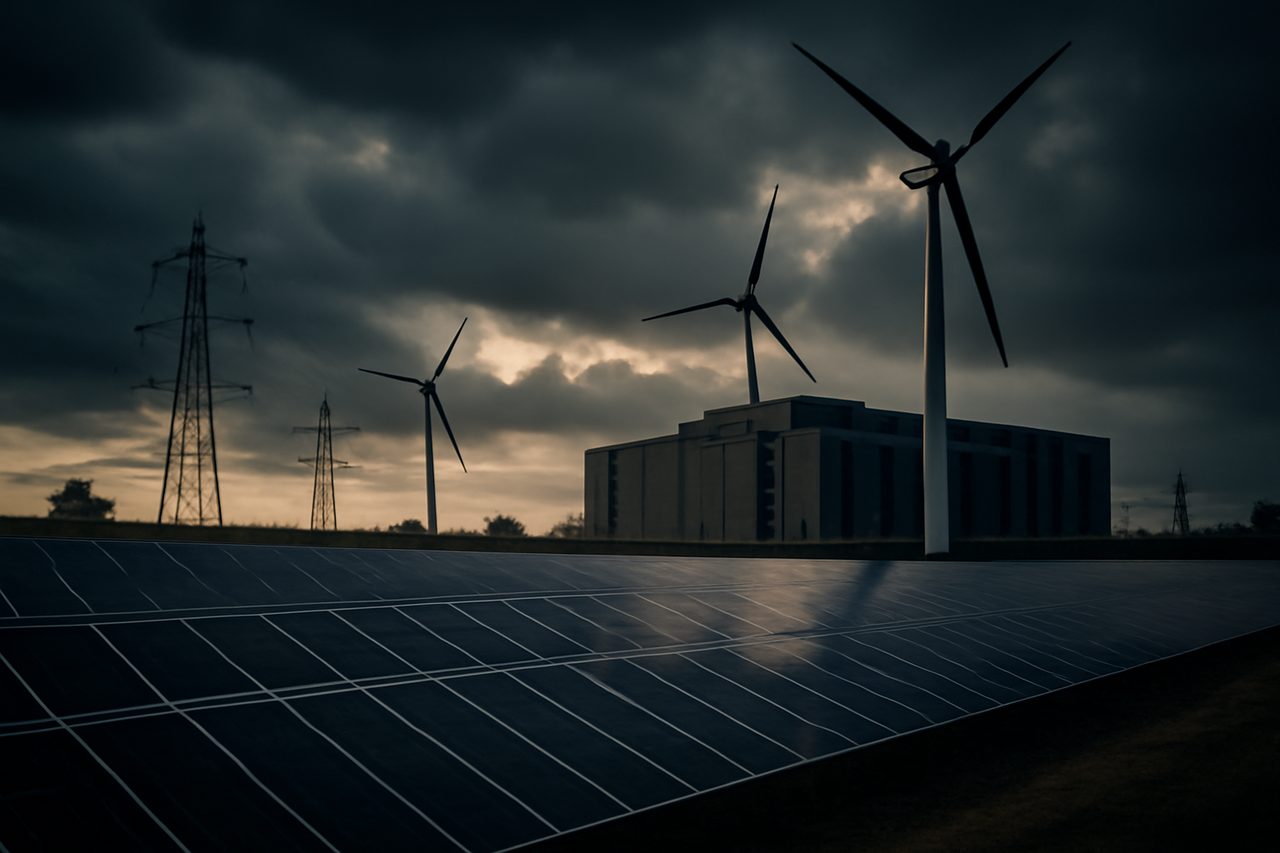
India’s data-centre market is scaling quickly, but the energy procurement conversation is shifting from generic renewable sourcing to a harder question: what ownership and contracting structure actually delivers low-cost, bankable, policy-resilient power at high utilisation? For 2026, one of the most practical decision points is not whether a data centre should buy clean power, but whether it should do so through third-party open access, captive, or group captive structures.
This article focuses on that decision for Indian data centres. It examines the economics, legal tests, scheduling realities, grid-interface issues, and the role of firming with BESS and thermal balancing. It is intentionally different from broader 24/7 CFE, grid-connectivity, and RTC articles. The lens here is ownership structure and risk allocation for renewable procurement serving data-centre loads in India.
Why captive structures matter for data centres in 2026
Data centres are unusually sensitive to delivered power cost, curtailment risk, and contracting certainty because:
- IT load is continuous and highly predictable relative to many industrial loads
- Uptime requirements push operators toward layered supply arrangements rather than single-source procurement
- Large campuses can cross 25 MW, 50 MW, or 100 MW quickly, making grid charges and surcharge exemptions material
- Long asset life means short-term tariff wins can be destroyed by poor regulatory positioning
In 2026, many Indian data-centre operators are comparing three pathways:
- Third-party open access procurement from a generator or trader
- Captive procurement from a special purpose vehicle primarily owned by the consumer
- Group captive procurement where qualifying consumers collectively own at least 26% of the project equity and consume at least 51% of generated electricity on an annual basis, in line with captive power rules
The reason this choice matters is simple: cross-subsidy surcharge and additional surcharge can substantially alter landed energy cost. In several states, these charges can add roughly Rs 1.5/kWh to more than Rs 3.5/kWh for third-party open access users, depending on voltage level, state policy, and category-specific notifications. For a 50 MW average-equivalent data-centre load, that difference can swing annual energy cost by tens of crores.
Open access versus captive versus group captive: the landed-cost framework
For data centres, the correct comparison is not headline PPA tariff. It is all-in delivered cost at the busbar or delivery meter, including:
- Generator tariff or levelised project tariff
- Interstate or intrastate transmission charges
- Wheeling charges
- Losses and loss-adjusted billing impact
- SLDC/RLDC charges
- Scheduling and forecasting compliance cost
- Cross-subsidy surcharge where applicable
- Additional surcharge where applicable
- Banking charges and banking-adjustment losses, if allowed
- Standby and deviation-related costs
- Firming cost through market purchases, gas, hydro, or BESS
As a 2026 rule of thumb, utility-scale solar and wind project tariffs for strong offtakers and bankable sites may still sit broadly in the range of:
- Solar: around Rs 2.4 to Rs 3.2/kWh depending on state, land, evacuation and CUF assumptions
- Wind: around Rs 3.0 to Rs 4.2/kWh depending on site quality and evacuation
- Wind-solar hybrid: around Rs 3.0 to Rs 4.3/kWh before firming layers
But that is not what the data centre pays in practice.
For a third-party open access structure, landed power can rise to roughly Rs 4.5 to Rs 7.0/kWh in many cases after network and surcharge stack-up, especially where banking is weak and balancing has to be bought from the market. By contrast, a well-structured group captive arrangement can reduce the same delivered cost materially because CSS and additional surcharge exposure is often avoided, subject to continued compliance with captive rules and state-level implementation.
That does not automatically mean group captive is always superior. It comes with equity lock-in, compliance monitoring, shareholder coordination, and potential litigation risk if captive status is challenged.
The legal and regulatory tests that can make or break group captive
For data-centre operators, the biggest mistake is treating group captive as a tariff product rather than a legal structure that must be maintained continuously and evidenced properly.
The core group captive tests remain critical:
- Captive users together must hold at least 26% of ownership in the captive generating plant
- Captive users together must consume at least 51% of the electricity generated on an annual basis, in proportion broadly aligned with ownership principles
In practice, lenders, auditors, and regulators will examine:
- Shareholding pattern through the year
- Energy drawal by each captive user
- Alignment between ownership and consumption
- Treatment of affiliate entities and load transfers
- Annual generation shortfall or over-generation impact
- Consequences of load migration or delayed commissioning of the consuming facility
For data centres, this is especially important because load ramp-up often occurs in phases. A campus may commission 20 MW initially but plan for 80 MW in three years. If the renewable project is sized for the full eventual load from day one, the captive consumption test can become difficult in early years unless multiple qualified consuming entities are stitched into the structure.
Key practical safeguards in 2026 include:
- Phased RE capacity addition aligned to actual IT-load energisation
- Multiple captive consumers within the sponsor group where permitted and commercially sensible
- Tight shareholder agreements covering dilution, exit, default, and minimum offtake obligations
- Monthly compliance dashboards, not just annual retrospective checks
- Legal review of state-level interpretations and recent appellate orders before financial close
A failed captive test can trigger retrospective surcharge exposure and contractual disputes. For a large data-centre load, that is not a rounding error; it can materially impair project IRR and debt service coverage.
Sizing strategy: why 100% annual energy matching is often the wrong first step
Many new entrants assume the objective is to offset 100% of annual consumption with captive solar or wind. For data centres, that is often not the optimal first move.
A better planning sequence is:
- Determine critical load, non-critical load and auxiliary profile separately
- Model 15-minute demand shape, not monthly average consumption
- Identify base renewable injection that can be absorbed with minimal spill or banking dependence
- Add BESS or market firming only after establishing the cheapest no-regret renewable tranche
For example, a 30 MW constant IT and cooling-linked load may consume about 262.8 million units annually at near-flat utilisation. If a developer proposes a 150 MWp solar-linked captive structure, annual generation may look attractive on paper in a high-radiation state. However, without robust banking or a second balancing source, mid-day surplus can become economically inefficient while night-time deficit remains large.
That is why many sophisticated buyers in 2026 are moving toward a portfolio approach:
- Daytime solar for low-cost energy block
- Wind or wind-solar hybrid for profile smoothing
- Limited-duration BESS for ramp management, peak shaving, and demand optimisation
- Exchange or bilateral top-up for residual deficits
- Utility grid retained as reliability backbone
For some data centres, the first 35% to 60% of annual consumption can be decarbonised at relatively strong economics through captive or group captive structures. Chasing the next 20% to 30% without state-friendly banking, balancing flexibility, or hybridisation can sharply worsen effective cost.
State policy differences: banking, wheeling and surcharge risk still dominate outcomes
In India, the same captive strategy can look excellent in one state and mediocre in another. Data-centre sponsors should not generalise from national headlines.
The following variables remain decisive in 2026:
- Whether the load and project are intrastate or interstate
- Banking availability, settlement cycle and whether banking is allowed for third-party and/or captive users
- Banking charges and restrictions on peak-hour withdrawal
- Voltage-level wheeling charges and losses
- Additional surcharge treatment for standby-heavy users
- Curtailment risk and actual SLDC operating behaviour
- State commission stance on captive compliance disputes
A state with limited banking and frequent curtailment can undermine solar-heavy structures for a 24x7 load like a data centre. In contrast, a state with more stable evacuation and predictable wheeling framework can support higher renewable penetration even without large BESS deployment.
The ISTS waiver framework continues to matter for interstate projects, but data-centre buyers should be careful not to treat it as the only lever. If the offtake profile requires heavy balancing purchases or if scheduling complexity rises due to multi-node delivery, nominal transmission savings may not compensate for operational friction.
This is why pre-bid and pre-term-sheet diligence should include:
- State-specific landed-tariff modelling under at least three regulatory scenarios
- Curtailment and evacuation history at candidate substations
- Banking economics under monthly and annual mismatch cases
- Sensitivity to loss-factor changes and surcharge revisions
- Contractual treatment of change in law and pass-through mechanisms
Where on-site BESS fits in a captive strategy
Data centres are already evaluating BESS for backup optimisation, diesel displacement in limited use cases, and power-quality support. In a captive RE context, the role of on-site BESS is narrower but still valuable if applied correctly.
In 2026, on-site BESS is usually not the cheapest tool for converting a solar-heavy captive portfolio into full RTC supply. That remains expensive if done at large duration solely through batteries. However, BESS can make economic sense in specific functions:
- Peak demand shaving where contract demand and demand charges are significant
- Short-duration shifting of behind-the-meter or wheeled renewable surplus
- UPS and energy-storage architecture optimisation where electrical design permits integration benefits
- Reduction of grid draw volatility and improved scheduling discipline
- Backup-system rationalisation in campuses redesigning diesel and battery layers together
Indicative installed BESS costs continue to vary widely by duration, thermal management, augmentation strategy and safety standard, but for serious data-centre applications, buyers should evaluate total delivered lifecycle cost rather than Rs/kWh capex headline alone. Fire safety design, HVAC interaction, degradation assumptions, and integration with EMS are more important than superficial vendor comparisons.
An EMS-led architecture is often the real enabler. The right control system can optimise:
- Renewable dispatch visibility
- Battery charge-discharge windows
- Utility import bands
- Market purchase timing
- PUE-sensitive cooling load response where available
- Outage and reserve logic
For many campuses, a modest-duration BESS plus strong EMS produces better economics than overbuilding renewable capacity and relying on weak banking provisions.
Contracting pitfalls: what lenders and serious sponsors now look for
Project finance and corporate credit teams are more disciplined in 2026 about captive and group captive risk. Data-centre energy deals are getting larger, and documentation quality now directly affects bankability.
The common weak points are:
- Vague definition of captive compliance responsibilities
- No remedy waterfall if annual consumption thresholds are missed
- Poorly drafted force majeure treatment for curtailment and transmission unavailability
- Inadequate change-in-law pass-through language
- No clarity on balancing power procurement responsibility
- Mismatch between shareholder agreement, PPA, and energy supply agreement
- Optimistic generation assumptions not backed by site-grade resource data
For data-centre offtakers, the contract package should clearly allocate:
- Equity contribution obligations and dilution protections
- Minimum offtake and make-whole provisions
- Metering hierarchy and settlement formulae
- Curtailment risk and deemed-generation treatment if any
- Balancing and shortfall procurement responsibility
- Replacement power methodology
- Exit mechanics if the campus is sold, restructured or expanded
Lenders also increasingly ask whether the data-centre load is sufficiently ramped to support the consumption test from year one, whether the sponsor has fallback demand from sister facilities, and whether state policy history suggests future surcharge or banking disputes.
A practical decision matrix for data-centre operators
In 2026, the most robust approach is usually not ideological. It is portfolio-based.
Third-party open access may suit a data centre if:
- Speed is critical and equity participation is undesirable
- Load is still uncertain and captive compliance would be hard to maintain
- State surcharge framework is manageable or likely to improve
- The buyer wants shorter tenor flexibility
Group captive may suit if:
- Load is large, stable and creditworthy
- The buyer can commit equity and governance attention
- CSS and additional surcharge savings materially improve landed cost
- Consumption thresholds can be reliably maintained
- Long-term decarbonisation strategy justifies structural complexity
Plain captive may suit if:
- The sponsor wants tighter control over generation assets
- Balance sheet and governance setup permit direct strategic ownership
- The energy programme is large enough to justify internal management bandwidth
For many large Indian data centres, the winning structure in 2026 is a layered one:
- Group captive solar or hybrid for lowest-cost bulk renewable units
- Selective wind addition for shape improvement
- Utility supply retained for reliability and balancing
- On-site BESS sized for operational value, not symbolic decarbonisation
- EMS-driven optimisation across all sources
- Contracted market top-up for residual deficits and maintenance windows
The key message is that data-centre energy strategy should not start with a technology preference. It should start with a legal-commercial architecture that survives real operating conditions, state policy variation, and lender scrutiny.
For sponsors, developers, utilities and financiers, the next wave of successful data-centre power procurement in India will be defined less by the cheapest quoted tariff and more by who best manages captive compliance, balancing economics, and grid-interface risk over a 15- to 25-year horizon.
If your organisation is evaluating captive, group captive, open access, BESS or EMS strategy for a data-centre project, contact Growthifye’s advisory desk for a practical assessment of structure, tariffs, bankability and implementation risk.
About the author

Chief Executive Officer, Growthifye — With over 23 years in management consulting, Sudarshan has taken businesses from concept to scale — building and scaling new-age digital and energy businesses.
- 23+ years in management consulting
- EY alumnus
- Led large-scale BESS programmes, capital raises and advisory mandates
Want this analysis applied to your project?
Talk to our team