Frame & prepare
Frame & Prepare: Building the Lender-Ready Case for Green Debt
Before approaching lenders or investors, a clean-energy asset needs a financing narrative that stands up to scrutiny. We build ICMA Green Bond Principles-aligned frameworks mapped to applicable national taxonomies, construct lender-grade financial models, and prepare risk matrices and information memoranda that give credit committees the confidence to move quickly.
Typical duration · 4-6 weeks
Samples generated 08 Sept 2026, 07:33 pm ISTWhat happens in this step
- 01Kick-off workshop to confirm financing objectives, target lender/investor pool, and green loan vs green bond routing
- 02Draft green financing framework mapped to ICMA GBP pillars and relevant national green taxonomy categories
- 03Build a fully integrated lender-grade financial model with debt sizing, DSCR waterfall and sensitivity toggles
- 04Prepare a risk matrix scoring construction, market, regulatory and currency risks with named mitigation owners
- 05Draft the information memorandum combining technical, financial, legal and ESG sections for lender circulation
- 06Scope second-party opinion (SPO) engagement to run in parallel with lender outreach
- 07Internal QA and legal review of all documents before external distribution
What we need from you
- Detailed project report (DPR) or feasibility study with technical specifications
- EPC/O&M contract terms, cost estimates and warranty structure
- PPA/PSA or tender documents including tariff and payment security mechanism
- Historical or projected generation/dispatch and availability data
- Sponsor/SPV corporate financials and shareholding structure
- Land, connectivity and regulatory approval status
- Existing ESG policies or sustainability commitments, if any

Worked example (anonymised, illustrative)
400 MW / 800 MWh Standalone BESS – DISCOM Capacity Tender · 400 MW / 800 MWh · Western India
A standalone battery storage project competitively awarded a 12-year capacity contract by a state DISCOM, requiring senior and mezzanine green debt financing across a phased construction drawdown.
Sample deliverables from this step
Every sample below is analyst-written and anonymised for illustration — structure and depth mirror our real deliverables; figures and names are not from any client engagement.
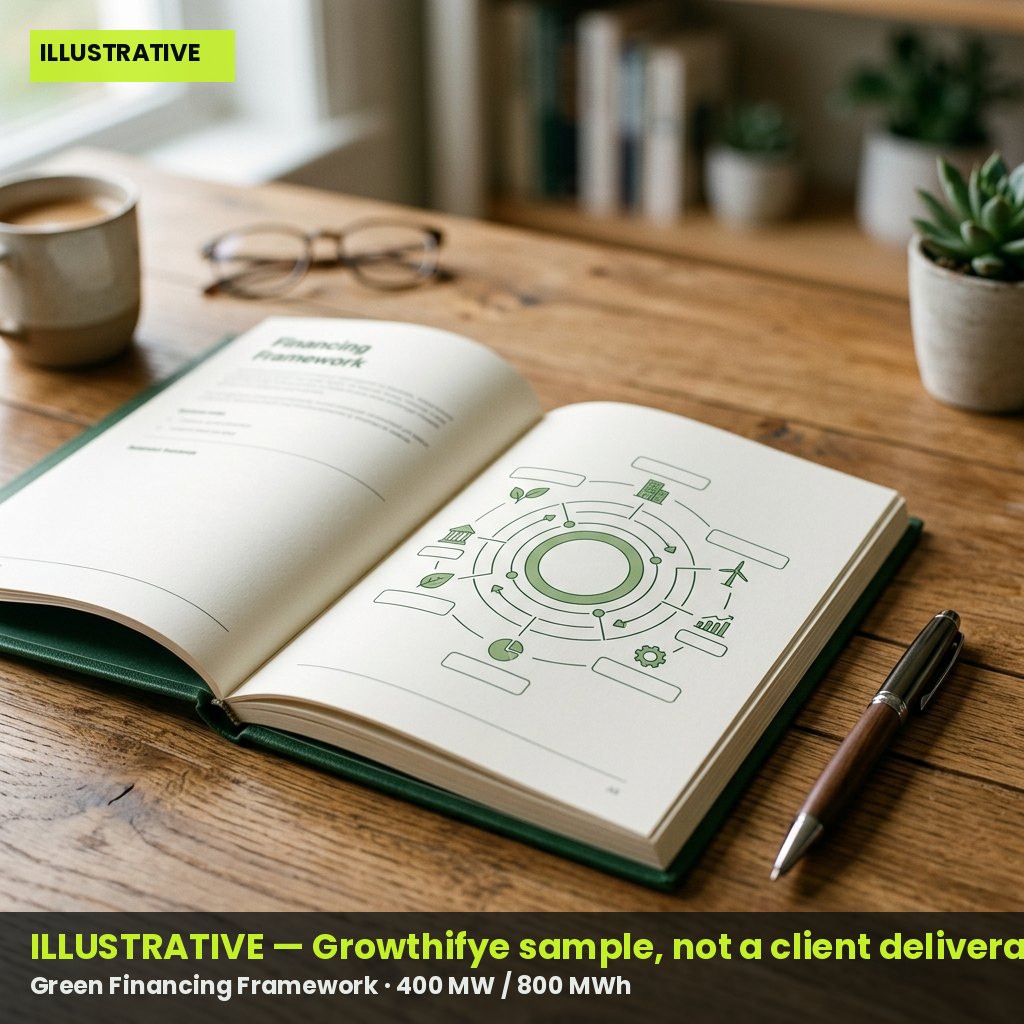 Illustrative · Growthifye-prepared
Green Financing Framework
ICMA GBP-aligned framework defining eligible use-of-proceeds categories, project evaluation and selection process, and ongoing reporting commitments.
Sample excerpt · Framework – Use of Proceeds Categories (Extract) — illustrative figures
| Category | ICMA GBP Pillar | Taxonomy Reference | Eligible Assets | Exclusion Threshold |
| Storage Systems | Use of Proceeds | Draft Natl. RE Taxonomy 3.2 | BESS >4hr duration, LFP chemistry | Lead-acid, <2hr duration |
| Grid Interconnection | Use of Proceeds | Taxonomy 3.5 | 33/132 kV evacuation infrastructure | Fossil-linked substations |
| Land & Civil Works | Use of Proceeds | Taxonomy 3.1 | Site preparation for RE/storage | Not applicable |
| Reporting | Reporting Commitment | ICMA Para 4 | Annual allocation & impact report | Not applicable |
- Framework drafted for independent review ahead of formal SPO engagement
- Aligned to draft national green taxonomy pending final notification
 Illustrative · Growthifye-prepared
Lender-Grade Financial Model
Fully integrated 25-year financial model with debt sizing, DSCR waterfall and sensitivity toggles for tariff, capex and availability assumptions.
Sample excerpt · Base Case – Key Output Summary — illustrative figures
| Metric | Year 1 | Year 5 | Year 10 | Year 15 |
| Net Capacity Revenue (INR Cr) | 142 | 148 | 151 | 149 |
| EBITDA Margin (%) | 78% | 80% | 81% | 79% |
| DSCR (Minimum) | 1.32x | 1.41x | 1.38x | 1.29x |
| Debt Outstanding (INR Cr) | 1,120 | 890 | 540 | 180 |
| Equity IRR (Project Life) | - | - | - | 14.6% |
- Model built lender-agnostic with export views for multiple credit templates
- Sensitivity toggles cover tariff escalation, capex overrun and degradation scenarios
Risk Matrix & Mitigation Register
Comprehensive risk register scoring probability and impact across construction, market, regulatory and currency risks with mitigation owners assigned.
Sample excerpt · Risk Register – Top Risks (Extract) — illustrative figures
| Risk | Category | Probability | Impact | Mitigation Owner |
| Cell degradation beyond warranty | Technical | Medium | High | EPC/OEM performance guarantee |
| Capacity payment shortfall | Market | Low | Medium | Fixed capacity payment structure |
| Land acquisition delay | Regulatory | Medium | Medium | SPV legal team & nodal agency |
| Currency mismatch on import content | Financial | Medium | High | Forward hedge on capex tranche |
| Grid curtailment risk | Regulatory | Low | Medium | Firm connectivity agreement |
- Matrix reviewed jointly with technical and legal advisors before circulation
- Updated at each financing stage as mitigations are actioned
Information Memorandum
Lender and investor-facing IM combining project overview, sponsor track record, financial highlights and ESG/green framework alignment.
Sample excerpt · Information Memorandum – Table of Contents (Extract) — illustrative figures
| Section | Page |
| Executive Summary | 3 |
| Project & Technology Overview | 6 |
| Contractual Structure (EPC/O&M/PPA) | 14 |
| Financial Model Summary & Sensitivities | 22 |
| ESG & Green Framework Alignment | 30 |
| Risk Matrix & Mitigants | 36 |
| Annexures – Technical & Legal | 42 |
- IM structured to support both green loan and green bond circulation formats
- Finalised only after internal legal and technical sign-off
Outcomes
- A lender-ready documentation package that shortens due-diligence cycle time
- Framework alignment positioning the project for green loan or green bond pricing benefits
- Clear, quantified risk visibility that speeds up credit committee approvals
- A consistent financing narrative usable across both debt and equity investor conversations
Questions clients ask
Do we need a Second Party Opinion (SPO) before this stage is complete?
Not necessarily. We scope the SPO engagement in parallel so formal verification of the framework can begin immediately once lender feedback is incorporated.
Can the financial model be reshaped for different lenders' internal formats?
Yes, the base model is built lender-agnostic with export views that can be adapted to specific credit templates without rebuilding core logic.
How much does taxonomy alignment actually affect financing terms?
Taxonomy-aligned green tagging can support tighter margins with a subset of ESG-focused lenders, though final pricing always depends on overall credit quality and market conditions.