VGF for BESS in India 2026: Project Structuring, Tariffs and Bankability
By Sudarshan Karweer · sudarshan@growthifye.com · +91 84510 99371 (Call / WhatsApp) · 2026-08-29
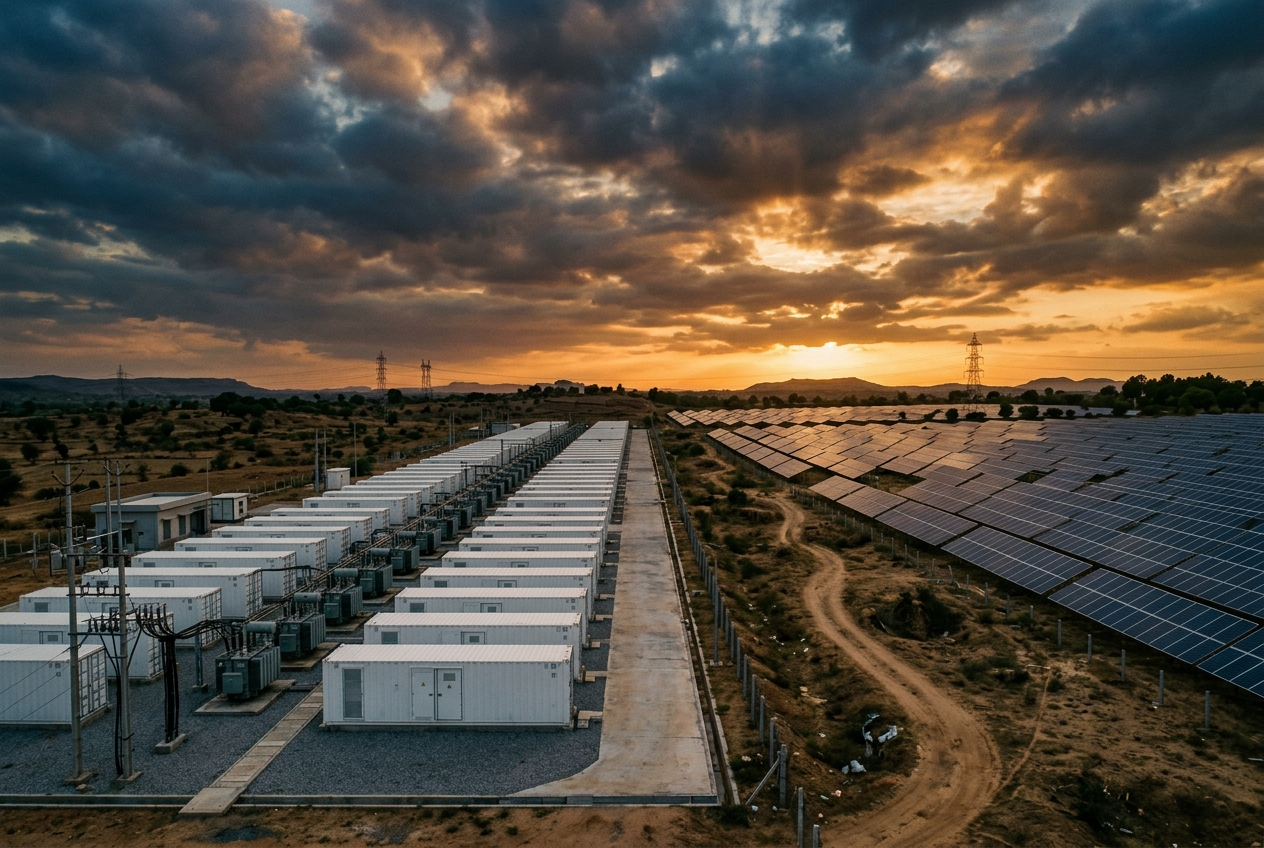
India’s battery energy storage system market is no longer a policy side-note. In 2026, it sits at the center of dispatchable renewable procurement, peak management, ancillary services, and distribution utility reliability planning. Yet one issue still decides whether many standalone and grid-support storage projects move from award to financial close: viability gap funding, or VGF.
For developers, VGF changes bid strategy and capex recovery. For DISCOMs and government agencies, it lowers tariff pressure while expanding procurement options. For lenders, it affects debt sizing, DSCR stability, termination values and construction-period risk. For C&I consumers tracking storage-led open access or group-captive structures, VGF-backed price discovery is also shaping expectations on future storage tariffs.
This article takes a practical 2026 view of VGF for BESS in India: what it solves, what it does not solve, how it changes tariff outcomes, and where project structuring still fails despite subsidy support.
Why VGF matters for BESS in India in 2026
Battery storage economics in India have improved, but not enough for every use case to stand on merchant spreads alone. Utility-scale systems still face four linked constraints:
- High upfront capex relative to contracted fixed revenue
- Degradation and augmentation requirements over a 10-15 year contract life
- Unclear or evolving monetisation of ancillary and congestion-relief value
- Utility concerns over first-year tariffs and payment commitments
In 2026, turnkey utility-scale BESS costs in India vary materially by duration, chemistry, warranty package, augmentation philosophy, grid interconnection scope and fire-safety design. As a broad market range, fully installed AC-side project costs for large systems are often seen around:
- 2-hour systems: roughly Rs 4.8 crore to Rs 6.5 crore per MW
- 4-hour systems: roughly Rs 8.5 crore to Rs 11.5 crore per MW
These numbers move with cell prices, PCS configuration, imported-content mix, GST treatment, evacuation scope, SCADA/cyber requirements and EPC wrap assumptions. In such a market, even when system prices soften, a DISCOM or procurer may still resist storage tariffs if the delivered cost per dispatched kWh appears too high versus short-run alternatives.
That is where VGF matters. It reduces the capital that must be serviced through project revenue, making competitive bidding more viable for applications such as:
- Peak shifting of solar power
- firm and dispatchable renewable integration
- supply during non-solar evening hours
- deferred network reinforcement in selected cases
- reliability support for state utilities
The policy rationale is straightforward: storage delivers system value that energy-only tariffs may not fully compensate in current market designs. VGF bridges that gap until market mechanisms mature.
How VGF changes project economics
A common mistake in early market commentary was to assume that VGF simply makes storage cheap. It does not. It makes certain contracted structures bankable enough to clear procurement thresholds.
At project level, VGF typically improves economics through three channels:
- Lower equity requirement at COD or during construction, depending on disbursement structure
- Lower annual fixed revenue needed to meet lender coverage ratios
- Better bid competitiveness in tariff-based tenders
Consider a simplified illustration for a 100 MW / 400 MWh standalone BESS contracted under a long-term utility tender.
Assume:
- Base project cost: Rs 950 crore
- Debt-equity ratio without VGF: 70:30
- Cost of debt: 10.25% to 11.5%, depending on offtaker and security package
- Contract tenure: 12 years
- Annual availability guarantee with cycling obligations
Without VGF, annual fixed charges plus O&M, augmentation reserve, insurance and financing overhead can push required tariff levels well above what some state utilities are willing to accept.
If VGF covers a meaningful share of capex, the funded project base falls sharply. That can reduce the required annuity or monthly capacity charge enough to change the bid order. Depending on the exact tender design, this may improve discovered tariffs by a material margin, sometimes by 15% to 30% versus an equivalent non-VGF structure.
But tariff reduction is not automatic. Three details matter more than the headline subsidy:
- Whether augmentation cost remains fully with the developer
- Whether the contract compensates only for availability or also for energy throughput/cycling
- Whether charging energy cost is pass-through, bundled, or left as developer risk
A VGF-backed project with poor charging-energy treatment can still become unbankable. Likewise, a low tariff bid based on aggressive degradation assumptions can fail later during operations.
Key structuring issues in VGF-backed BESS tenders
By 2026, sophisticated bidders no longer evaluate VGF tenders on subsidy percentage alone. They focus on the full risk-allocation matrix.
1. Rated energy versus delivered energy
Tender documents often specify MW and MWh, but the contract must clearly define:
- BOL capacity at AC or DC level
- guaranteed deliverable energy at interconnection point
- annual degradation path
- augmentation obligations and testing protocol
If VGF is tied to nameplate installation while revenue depends on stricter delivered-energy performance, developers can end up under-recovering lifecycle cost.
2. Charging rights and source of power
Storage value depends heavily on charging flexibility. The project economics differ if charging energy comes from:
- dedicated co-located solar or wind
- grid charging under utility scheduling
- hybrid charging rights with time-window restrictions
For BESS linked to renewable integration, charging restrictions can materially affect usable cycles and round-trip economics. State-level scheduling practice and SLDC operating discipline are now as important as central tender language.
3. Availability versus utilisation risk
Lenders prefer contracted availability payments because utilisation risk remains with the offtaker. Developers prefer a structure where dispatch uncertainty does not destroy revenue. However, some procurers expect aggressive cycling without paying separately for throughput stress. That creates hidden degradation risk.
A bankable VGF BESS contract should specify:
- minimum availability standard
- n- dispatch window obligations
- cycle assumptions embedded in bid
- treatment of excessive dispatch beyond base assumptions
- compensation for extraordinary grid instructions, if applicable
4. VGF disbursement milestones
From a financing perspective, timing matters almost as much as amount. If VGF is disbursed late, developers still face a high construction funding burden. This raises IDC and bridge-finance costs.
The cleanest structures usually provide transparent milestone-linked disbursement tied to:
- financial close
- major equipment supply completion
- commissioning milestones
- final performance acceptance
Any ambiguity here increases bid contingency.
Tariff design: what DISCOMs, SECI-style procurers and lenders should watch
In 2026, storage tenders in India generally move around one of three payment frameworks:
- pure capacity tariff
- capacity tariff plus variable dispatch-linked payment
- integrated tariff bundled with renewable supply obligation
For standalone VGF-backed BESS, capacity-based models remain most understandable to lenders, but only if the contract also addresses charging energy. If the developer must procure charging energy at volatile market prices without adequate pass-through, the apparent simplicity of a capacity tariff becomes misleading.
For RTC and FDRE-linked procurement, storage is often only one piece of a broader portfolio. In these cases, VGF may improve overall hybrid bid viability, but its value can be diluted if the PPA heavily penalises shortfall without recognising weather correlation, storage degradation and curtailment risk.
A practical lender review in 2026 should examine at least the following:
- Is revenue indexed or flat through the contract life?
- Is battery augmentation mandatory, optional, or performance-linked?
- Are liquidated damages capped realistically?
- Is there deemed availability or deemed dispatch protection during grid outages or curtailment events?
- What is the payment security package: LC, escrow, state guarantee support, or pooled intermediary strength?
- How are change-in-law events handled for taxes, import duties, safety compliance and recycling obligations?
In India’s current market, payment security remains decisive. A VGF-backed project with weak offtaker discipline is still not automatically financeable. Many lenders will underwrite the subsidy benefit but continue to haircut receivables if DISCOM payment performance is uncertain.
Where developers misprice VGF BESS bids
The most common pricing errors in 2026 are no longer about battery capex alone. They are about lifecycle assumptions.
Underestimating augmentation
A bid based on optimistic degradation can look competitive in year 1 and fail by year 6. Developers must model:
- usable energy retention curve
- temperature and duty-cycle effects
- warranty throughput limits
- replacement cell pricing uncertainty
- import dependence and logistics lead times
Ignoring auxiliary consumption and HVAC load
In hot Indian operating conditions, thermal management is not a footnote. Auxiliary consumption affects delivered efficiency and net dispatch energy. This matters especially in strict availability-performance contracts.
Weak integration assumptions
Grid interconnection, protection coordination, metering boundaries and SCADA integration still create delay risk. BESS projects are often treated as fast-build assets, but substation readiness and protection approvals can become the true critical path.
Overstating secondary revenues
Some bidders still assume future ancillary services or market-based revenues will rescue thin contracted tariffs. Lenders typically discount such upside unless the revenue pathway is already contracted or strongly evidenced by regulation and operating history.
Policy and regulatory context shaping VGF outcomes
The 2026 storage market sits within a broader policy architecture that includes central tenders, state procurement initiatives, resource adequacy discussions, renewable integration targets, and market-design evolution through CERC/SERC frameworks.
Several policy themes matter for VGF-backed BESS projects:
- Push for energy storage to support renewable absorption and peak demand management
- Greater procurement interest from states facing evening peak stress
- Increasing attention to ancillary services and balancing markets
- Need for standardised technical specifications and performance measurement
- Emerging focus on battery safety, testing, recycling and end-of-life compliance
As these frameworks mature, VGF should gradually shift from being a blanket viability tool to a more targeted instrument. The best use cases are not all storage projects, but projects where system value exceeds presently monetisable value. That includes selected grid-support, renewable-firming and reliability applications.
Policymakers should therefore focus not only on VGF quantum but on contract design quality. Poorly drafted tenders can waste subsidy by producing underperforming assets or post-award renegotiation. Better outcomes usually come from:
- clear dispatch philosophy
- standardised testing and degradation definitions
- realistic payment security provisions
- transparent change-in-law clauses
- coordination between procurement agency, SLDC/STU and financing stakeholders
What C&I buyers and market participants should take away
Even though most VGF-backed BESS procurement today is utility-led, C&I consumers should pay close attention. Why? Because these tenders shape India’s benchmark storage pricing, warranty expectations, O&M standards and dispatch philosophy.
For large industrial and commercial buyers considering future storage-linked open access or behind-the-meter peak management, the lessons are immediate:
- Storage economics must be assessed on delivered use case, not headline capex per MWh
- Contract rights around charging, dispatch and performance are as important as equipment cost
- Safety, augmentation and degradation planning are central to lifecycle value
- Grid-integration studies and scheduling assumptions can make or break viability
For developers, the winners in 2026 are not those quoting the lowest nominal tariff, but those aligning technical design, contractual performance, and financing assumptions. For lenders, VGF can improve coverage metrics, but it does not replace disciplined diligence on offtaker risk, augmentation reserve and operating model. For utilities and policymakers, subsidy works best when paired with procurement clarity.
India’s BESS market is moving quickly from policy ambition to execution discipline. VGF is an important catalyst, but not a substitute for sound project structuring.
If you are evaluating a VGF-linked BESS bid, storage sizing, RTC/FDRE integration, lender diligence, or utility procurement strategy, contact Growthifye’s advisory desk for a practical project-level assessment.
About the author

Chief Executive Officer, Growthifye — With over 23 years in management consulting, Sudarshan has taken businesses from concept to scale — building and scaling new-age digital and energy businesses.
- 23+ years in management consulting
- EY alumnus
- Led large-scale BESS programmes, capital raises and advisory mandates
Want this analysis applied to your project?
Talk to our team