VGF for BESS in India 2026: Bid Design, Tariffs, Bankability and Sizing
By Sudarshan Karweer · sudarshan@growthifye.com · +91 84510 99371 (Call / WhatsApp) · 2026-08-29
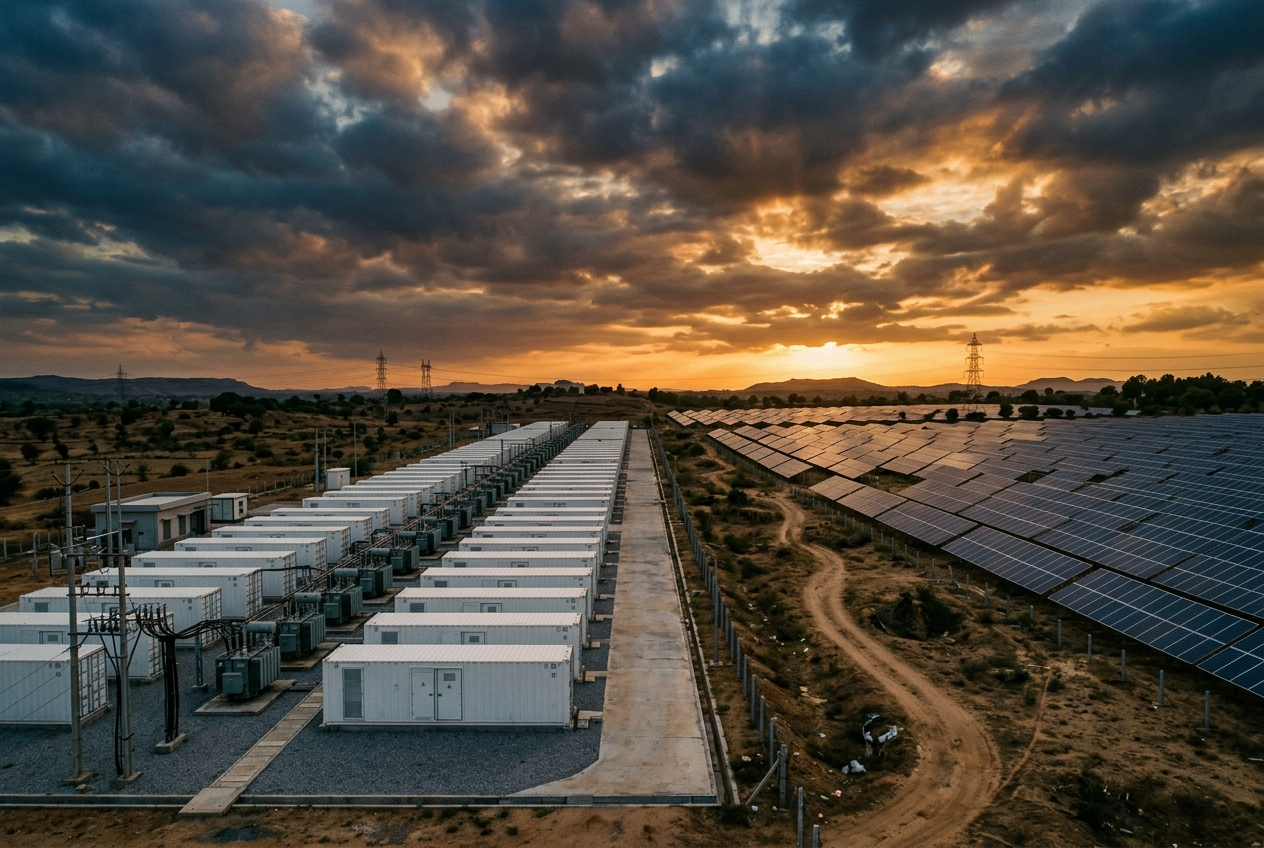
Battery Energy Storage Systems in India are moving from pilot scale to mainstream procurement, but the investability question in 2026 is not simply capex per kWh. It is whether the tender architecture, VGF mechanics, dispatch rights, availability guarantees and augmentation assumptions produce a project that can clear both bid committees and lender credit screens. For developers, a badly structured VGF-backed BESS project can win on tariff and still lose on equity IRR. For DISCOMs and utilities, weak bid design can suppress competition, encourage aggressive underbidding and create future delivery risk.
This article focuses on a specific angle that matters now: how Viability Gap Funding for standalone and grid-connected BESS should be evaluated in India in 2026 from the perspective of sizing, tariff discovery, bankability and implementation. It is a different conversation from merchant storage, ancillary services or open-access BESS. Here, the core issue is public-support design and whether it leads to durable projects rather than only low quoted numbers.
Why VGF matters for BESS in India in 2026
India’s storage demand is now being shaped by three simultaneous pressures:
- evening peak growth in urban and industrial load centres
- higher renewable penetration creating curtailment and ramping problems
- procurement targets tied to resource adequacy, FDRE and reliability obligations
Despite a sharp decline from the peak lithium price cycle of 2022-23, utility-scale BESS economics in India still depend heavily on use case, cycling intensity, augmentation strategy and debt terms. In many grid applications, the system benefit is real but not fully monetisable through a single contracted revenue stream. That is exactly where VGF becomes relevant.
In practical terms, VGF reduces the upfront capital burden and narrows the gap between what a procurer can pay and what a project needs to remain financeable. In Indian tenders, this can improve affordability for DISCOMs while supporting deployments in strategic locations where grid support value is high but direct revenue certainty is incomplete.
By 2026, a typical 2-hour utility BESS in India may still show a substantial spread in all-in installed cost depending on cell chemistry, imported-content exposure, fire-suppression configuration, HVAC philosophy, SCADA and PPC scope, evacuation readiness and GST treatment assumptions. Market participants often quote broad capital ranges in Rs crore per MWh or USD per kWh, but actual bankable cost can diverge materially once EPC wrap, augmentation reserves, IDC, spares and owner’s cost are included.
That is why VGF should not be discussed as a headline subsidy alone. It must be analysed as one component in a full project-finance structure.
What developers should read carefully in VGF-backed BESS tenders
The strongest mistake in BESS bidding is to anchor on VGF quantum before understanding the operating model. In India’s current storage procurements, five clauses often make or break economics.
- Contracted service definition: Is the project being paid for available capacity, delivered energy, peak shifting service, grid support or a hybrid metric?
- Dispatch rights: Does the procurer control dispatch fully, or is there shared optimisation logic?
- Performance guarantees: Are guarantees linked to AC discharge at interconnection, DC block performance or net injected energy after auxiliary consumption?
- Degradation treatment: Is augmentation mandatory, optional or left to the developer without tariff relief?
- Payment security: Is there an LC, escrow, state guarantee support or central counterparty comfort?
A VGF-backed project can still become unbankable if dispatch is uncertain but availability penalties are hard, or if the tender assumes a degradation path that forces expensive mid-life augmentation without revenue adjustment.
Developers should also review whether the tender measures storage duration at beginning-of-life only or requires sustained duration across the contract term. The difference is critical. A 500 MWh BESS contracted for 250 MW x 2 hours may be straightforward at COD, but if the offtaker expects near-flat duration over 12 to 15 years, then augmentation capex has to be built into the bid model. That immediately changes the effective cost of service, even after VGF.
Bid maths: how VGF changes tariff, but not always project quality
In India, many stakeholders still treat VGF as a way to reduce quoted tariff directly. That is only partly true. VGF can improve affordability, but the tariff outcome depends on financing structure, contract design and lifecycle operating assumptions.
A simple conceptual framework is useful. Assume a standalone BESS project with:
- 250 MW / 500 MWh rating
- 12 to 15 year contract term
- one major cycle per day equivalent, depending on dispatch profile
- augmentation around years 6 to 9, depending on chemistry and operating temperature
- debt tenor shorter than project life, often with DSRA and standard lender covenants
Now add VGF support as upfront capital assistance. The immediate impact is to lower debt requirement and equity cheque. However, the actual tariff reduction depends on:
- whether VGF is disbursed fully at COD or in milestones
- whether IDC on the non-VGF portion remains high due to schedule risk
- whether augmentation is funded separately by sponsor equity or retained cash
- whether the offtaker tariff compensates for variable cycling intensity
In a well-structured case, VGF can materially reduce fixed capacity charges or annual storage service fees. In a poorly structured case, the project still carries high reserve requirements because the contract pushes too much technology and dispatch risk onto the developer.
The result is a pattern already familiar in Indian infrastructure: low discovered tariff, followed by requests for schedule relief, performance disputes or muted lender appetite.
This is why bid evaluation should move beyond lowest quoted charge. Procurers should ask whether the tariff is consistent with:
- realistic round-trip efficiency at site conditions
- actual auxiliary load assumptions in Indian summers
- augmentation provision across contract life
- battery replacement timing and imported component risk
- working capital needs under payment delay scenarios
If those assumptions are missing or too aggressive, VGF has not solved the problem. It has simply masked it for the bid stage.
Sizing BESS under VGF: 1-hour, 2-hour or 4-hour?
Sizing remains one of the most misunderstood elements in Indian storage procurement. Too often, tenders copy international templates or use broad policy categories instead of a location-specific grid need.
In 2026, the right duration in India depends on the use case.
For frequency support and short ramp management, 1-hour systems may be sufficient in some nodes. For renewable time-shifting and evening support, 2-hour systems are more common. For deeper peak shaving, renewable firming or resource adequacy obligations, 4-hour systems may be more defensible, especially where thermal flexibility is weak or transmission import capability is constrained.
Under a VGF structure, the danger is that uniform support per MWh may encourage oversizing or undersizing relative to system need.
Examples:
- If VGF support is generous and contract payment is capacity-led, bidders may optimise toward larger energy blocks even where dispatch data suggests lower economic utilisation.
- If VGF is capped too tightly, bidders may compress duration to keep tariffs low, weakening the intended reliability outcome.
That is why proper sizing should begin with hourly and sub-hourly demand and generation analysis, not with generic benchmarks. A serious procurement process should examine:
- feeder or substation loading profile
- renewable injection volatility by season
- evening peak width, not only peak height
- congestion hours and transmission constraints
- expected number of equivalent full cycles per year
- reserve and contingency support value
For RE developers and utilities, this is where detailed BESS sizing/economics work adds more value than rule-of-thumb estimates. A 2-hour battery is not automatically better than a 1-hour or 4-hour configuration if the actual avoided cost or reliability gain does not support it.
Bankability issues lenders will focus on in 2026
Lenders in India have become far more informed on storage than they were two years ago, but they remain cautious where revenue is single-buyer, performance guarantees are strict and technology assumptions are optimistic.
The key bankability questions in a VGF-backed BESS project are usually the following.
- Is the contracted payment stream fixed enough to support debt sizing?
- Are availability tests technically measurable and commercially reasonable?
- Does the contract acknowledge degradation and augmentation transparently?
- Is payment security robust enough for a state utility counterparty?
- Is OEM support aligned with project debt tenor and warranty obligations?
On the technology side, lenders will increasingly examine warranty architecture in detail. It is no longer enough to cite a battery warranty headline. The real questions are:
- Is the warranty throughput-based, calendar-based or hybrid?
- What operating window is assumed for temperature and depth of discharge?
- Are liquidated damages and replacement obligations back-to-backed through the supply chain?
- Who bears software and BMS upgrade risk over time?
On the contract side, lenders strongly prefer clarity on dispatch logic. If the procurer controls charging and discharging but penalties remain fully on the project SPV, then misalignment emerges quickly. If the developer controls optimisation but the offtaker expects guaranteed service during all called events, then a different risk appears. Either way, the agreement must allocate responsibility cleanly.
A practical issue often underestimated in India is augmentation financing. Many financial models include augmentation in O&M or reserve lines without fully assessing whether debt documents permit that cash usage at the required time. If the project cannot fund augmentation when needed, service quality and availability can deteriorate just when contracted obligations remain firm.
Policy and procurement design improvements India should prioritise
If India wants VGF-backed BESS procurement to scale efficiently, three improvements are especially important in 2026.
First, standardise core definitions across agencies and tenders. Terms such as available capacity, contracted energy, response time, state-of-charge floor, round-trip efficiency and end-of-term capacity should not vary excessively from one tender to another. Standardisation lowers diligence cost and widens bidder participation.
Second, align VGF disbursement with actual project-risk milestones. Front-loaded support can reduce financing stress, but only if tied to verifiable delivery events and timely release. Delayed VGF reimbursement weakens the benefit by increasing bridge financing needs and IDC.
Third, strengthen data-driven sizing and location selection. Storage should be procured where system value is measurable, not merely where land is available or policy targets need quick allocation. Grid studies, renewable profile analysis and substation-level peak mapping should shape procurement volume and duration.
For policymakers, there is also a strategic question: should VGF support be neutral across chemistry and duration, or should it reflect the specific service being procured? A one-size-fits-all mechanism is easy to administer but may not deliver the most efficient system outcome.
For DISCOMs, utility-scale BESS procurement should be evaluated against alternatives, including peaking power purchases, transmission reinforcement deferral, DSM measures and hybrid RTC/FDRE contracts. Storage is powerful, but only when compared honestly with substitute options.
What C&I buyers, developers and utilities should do now
For C&I consumers, VGF-backed BESS may look distant from day-to-day procurement, but it matters because utility-scale storage affects evening tariffs, grid reliability and future open-access operating conditions. Better utility storage can reduce curtailment pressure and improve renewable integration in industrial states.
For RE developers, the priority should be disciplined bid strategy. In 2026, winning a BESS tender at an uneconomic tariff on the expectation of future cell-price declines is not a robust strategy. Pricing should reflect site realities, augmentation needs, dispatch risk and payment security.
For utilities and procurers, the objective should be fewer disputes and more executable projects. That means:
- realistic technical specifications
- clear degradation treatment
- reasonable response and availability metrics
- strong payment security structures
- pre-bid disclosure of grid conditions and intended use case
For lenders, diligence must move beyond capex benchmarks. The right questions are about contractability of service, replacement obligations, operating regime and sponsor ability to support lifecycle capex.
India’s storage market is unquestionably scaling, but VGF should be used as a precision tool, not a blunt policy instrument. The winners in 2026 will be the stakeholders who understand that BESS value sits at the intersection of engineering, dispatch modelling, tariff design and financeability. A project is not viable because it received VGF. It is viable when VGF is embedded in a procurement and financing structure that can survive actual operating conditions over the contract term.
If you are evaluating a VGF-backed BESS tender, preparing a bid, assessing bankability or reviewing storage sizing for utility and FDRE applications, contact Growthifye’s advisory desk for project-specific support.
About the author

Chief Executive Officer, Growthifye — With over 23 years in management consulting, Sudarshan has taken businesses from concept to scale — building and scaling new-age digital and energy businesses.
- 23+ years in management consulting
- EY alumnus
- Led large-scale BESS programmes, capital raises and advisory mandates
Want this analysis applied to your project?
Talk to our team