Pumped Hydro Storage in India 2026: Site Screening, Economics and Bankability
By Sudarshan Karweer · sudarshan@growthifye.com · +91 84510 99371 (Call / WhatsApp) · 2026-08-30
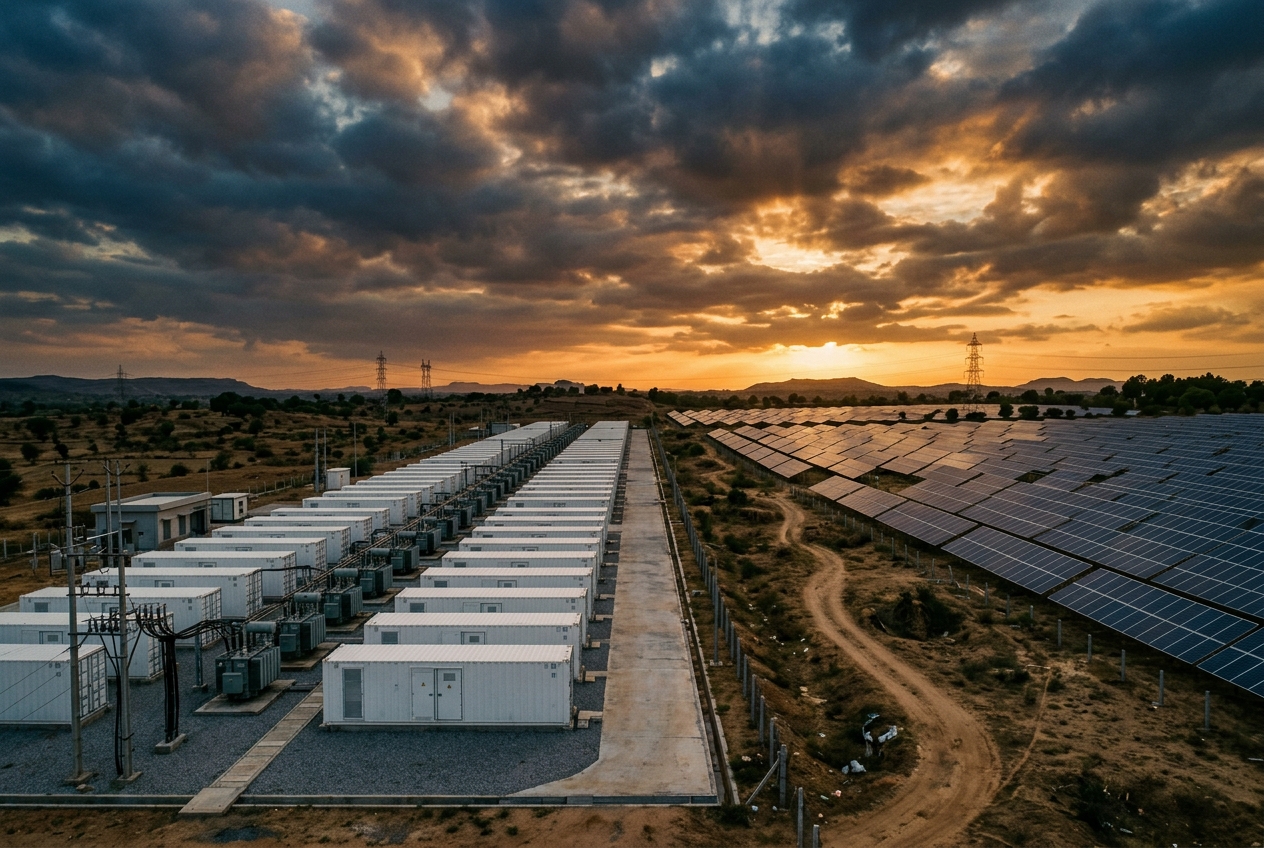
India’s storage conversation in 2026 is no longer only about batteries. Pumped hydro storage is moving from concept lists to serious procurement, state-level development pipelines and lender due diligence. For utilities, renewable developers, industrial buyers and financiers, the key question is not whether pumped hydro has strategic value. It is which projects can actually clear approvals, connect to the grid, deliver dispatchable capacity at competitive tariffs and achieve financial close.
This matters because India’s evening peak is deepening, solar penetration is rising, thermal flexibility remains limited in parts of the system, and round-the-clock supply products need longer-duration storage than many battery configurations can economically provide. Pumped hydro can address these needs, but only when project selection, design basis, offtake structure and execution planning are handled with discipline.
This article sets out a practical 2026 view of pumped hydro storage in India: where the economics work, how developers should screen sites, what tariffs and risk allocations lenders are looking for, and where policymakers still need to reduce friction.
Why pumped hydro is back in India’s storage stack
Pumped hydro storage projects, or PSPs, are not new in India. What has changed is the demand context.
- Utility-scale solar has pushed midday energy costs lower, increasing the value of shifting energy to evening and early-morning peak periods.
- Several states are procuring firm and dispatchable renewable power rather than plain vanilla solar or wind.
- Central agencies and state utilities are increasingly focused on peak balancing, inertia, ramping support and reserve adequacy.
- Longer-duration storage is becoming more relevant as renewable energy penetration rises beyond levels where 2-hour shifting alone is sufficient.
In simple terms, pumped hydro competes less with standalone batteries and more with the need for 6-hour, 8-hour or even longer system flexibility. In India, that flexibility has value in at least four use cases:
- peak energy shifting for discoms and load-serving entities
- firming renewable portfolios under RTC and FDRE procurement
- capacity adequacy and reserve support at state and regional level
- arbitrage and balancing support in high-solar systems
For many grids, PSP is attractive because its technical life can extend well beyond 40 years, with electro-mechanical refurbishment cycles that are familiar to lenders and utilities. That long life can support lower levelised storage costs over time than shorter-life assets, provided construction risk and hydrology-related risks are appropriately managed.
The 2026 economics: what makes a PSP viable
The biggest mistake in PSP discussions is using a single tariff number without context. Pumped hydro economics depend on six variables that matter more than headline capex.
- project configuration: on-river, off-river, closed-loop, reversible units, hours of storage
- civil works intensity: tunnels, headrace, underground powerhouse, reservoir development, access roads
- hydraulic head and round-trip efficiency
- transmission evacuation distance and voltage level
- cost and timing of charging energy
- offtake structure and dispatch certainty
In the current Indian market, broad capital-cost references for pumped hydro vary substantially by site and design complexity. A practical 2026 market discussion often starts in the range of roughly Rs 8 crore/MW to above Rs 14 crore/MW for many announced concepts, with some difficult projects exceeding that range once full civil and transmission costs are included. A simple MW metric can also mislead, because two projects with the same MW can have very different storage durations and therefore very different economics per delivered MWh.
For that reason, serious evaluation should track at least these metrics:
- Rs crore per MW installed
- Rs crore per usable MWh of storage
- round-trip efficiency, often in the 70% to 80% range depending on design
- annual fixed cost recovery requirement
- charging energy cost in Rs/kWh
- delivered discharge cost by time block
A developer selling peak power from PSP is effectively converting low-value off-peak or renewable-surplus energy into high-value peak-period energy. If charging energy costs Rs 2.2 to Rs 3.0 per kWh and round-trip efficiency is 75%, the energy input required to deliver 1 kWh is about 1.33 kWh. That alone implies an energy cost of roughly Rs 2.9 to Rs 4.0 per delivered kWh before fixed charges, O&M, transmission and financing costs. Once full project costs are included, the delivered peak tariff can rise meaningfully unless capacity payments, fixed availability payments or hybrid structures are available.
This is why PSP works best where revenue is not dependent only on simple energy arbitrage. Bankable structures usually require one or more of the following:
- long-term capacity-linked offtake with availability payment
- renewable-plus-storage supply contracts with clear dispatch windows
- state utility procurement for peak support with contracted annual utilisation
- multi-part tariffs that separate fixed cost recovery from variable charging cost
If a project relies on merchant spreads alone, lenders will heavily discount projected revenue. Indian market depth for purely merchant long-duration storage remains limited in 2026.
Site screening: the difference between a real asset and a PowerPoint project
India has no shortage of announced PSP opportunities. It does have a shortage of development-ready, permit-ready, transmission-ready and geologically de-risked sites.
That is why the first 90 days of PSP evaluation matter disproportionately. A robust screening framework should cover the following.
- hydraulic head: adequate elevation difference drives energy density and civil efficiency
- reservoir feasibility: upper and lower reservoir sizing, land footprint and lining needs
- water availability: initial filling, evaporation losses, monsoon variability and competing water use
- geology and geotechnical conditions: slope stability, tunnelling risk, foundation conditions
- environmental and forest constraints: protected areas, forest diversion, biodiversity issues
- social footprint: land acquisition complexity, rehabilitation exposure, local acceptance
- transmission access: substation proximity, bay availability, network congestion risk
- construction logistics: access roads, spoil disposal, labour camp requirements, monsoon disruption
Off-river closed-loop PSPs are attracting interest because they can reduce hydrology dependence and in some cases simplify environmental risks compared with river-linked developments. But they are not automatically easy. Upper-reservoir integrity, liner performance, water sourcing for initial fill and geotechnical stability can still become major cost drivers.
A practical no-go filter for developers and investors should include:
- very high forest diversion exposure with uncertain timelines
- weak geotechnical confidence before expensive tunnelling commitments
- long transmission spur requirements without evacuation certainty
- unresolved downstream water-use conflict
- tariff assumptions that only work under unrealistic cycling profiles
This is where independent advisory work becomes central. Too many projects move to term-sheet discussions before the storage duration, cycling assumptions and site constraints are reconciled into a coherent financial model.
Approvals and development timelines in India
In 2026, policy intent for storage is stronger than the average project-development experience. The approvals path for PSP remains material to bankability.
Depending on the project structure and state, developers may need to navigate:
- state government allotment or concession arrangements
- water-use permissions and irrigation interface where applicable
- land acquisition or lease processes
- forest clearance and environmental approvals where triggered
- geological investigations and design approvals
- grid connectivity and transmission approvals
- power sale approvals and offtaker consent frameworks
Even where central and state governments are supportive, timeline slippage remains one of the biggest financing risks. Lenders are especially sensitive to the gap between preliminary MoUs and genuinely executable development rights.
For this reason, developers should avoid presenting PSPs as near-term operating assets until three items are substantially advanced:
- detailed topographical and geotechnical validation
- realistic construction schedule with monsoon and logistics assumptions
- a credible route to transmission and offtake lock-in
For many projects, a 4- to 6-year path from serious development initiation to commissioning is more realistic than aggressive headline timelines. Complex underground works can extend beyond that. Any tariff bid or financing case that assumes a compressed build programme without contingencies will struggle in due diligence.
Bankability: what lenders and investors want to see in 2026
Pumped hydro is infrastructure-heavy, and financing appetite improves sharply when risk is allocated transparently. In the current market, lenders are asking five core questions.
First, is the civil-risk profile understood? Civil packages drive the highest uncertainty. Incomplete geology is one of the fastest ways to destroy cost certainty.
Second, is the offtake structure strong enough to support debt service? Lenders prefer contracted revenues, minimum availability payments and clearly defined dispatch logic.
Third, are the charging-energy assumptions bankable? If the project depends on cheap charging power, the source, price path, transmission charges and scheduling rights must be explicit.
Fourth, is there enough contingency in capex and schedule? PSPs need more conservative contingency treatment than standard solar or wind EPC projects.
Fifth, does the sponsor have the execution capability for multi-year civil and electro-mechanical coordination?
A lender-friendly PSP package in 2026 typically includes:
- bankable DPR-level engineering inputs, not just concept notes
- independent geotechnical review
- fixed or semi-fixed price contracting strategy with clear interface management
- conservative hydrology and auxiliary consumption assumptions
- offtake agreement with payment security and force majeure clarity
- DSRA and contingency structures sized to construction realities
Tariff design matters here. A pure single-part energy tariff can leave too much revenue risk with the project. Multi-part tariff structures are generally more financeable, especially where they include:
- fixed annual charge for capacity availability
- variable charge linked to actual charging energy or dispatch
- deemed-availability protections when grid constraints are not project-caused
- scheduled maintenance windows aligned with hydrology and demand seasonality
Where PSP fits against BESS, RTC and FDRE portfolios
For Indian buyers, pumped hydro should not be framed as a universal substitute for battery storage. The technologies solve overlapping but different problems.
BESS remains stronger where the requirement is:
- fast response and frequency services
- modular build-out with shorter construction timelines
- 1-hour to 4-hour applications
- co-location with solar or load centres where land and transmission permit
PSP becomes more compelling where the need is:
- 6-hour to 10-hour or longer duration shifting
- high annual cycling over long asset life
- system-scale peak support
- portfolio-level firmness beyond what short-duration BESS can economically provide
For RTC and FDRE developers, the decision is often portfolio-based rather than technology-based. A sensible architecture may involve:
- solar for low-cost daytime energy
- wind for seasonal and evening generation support
- BESS for ramping, shape correction and fast reserves
- PSP for deep shifting and capacity support over longer windows
The commercial implication is important. If a developer is modelling firm supply obligations at high annual CUF, using PSP can lower replacement-power exposure during non-solar evening periods, but only if the charge-discharge schedule is compatible with contracted renewable generation and grid charges. Poorly integrated modelling can overstate firmness and understate delivered cost.
Policy and market signals to watch in 2026
Three market developments will shape PSP execution in India over the next 12 to 24 months.
- state procurement design for peak and firm power
- transmission-planning alignment with storage corridors
- standardisation of concession, charging and dispatch frameworks
Policymakers can improve project viability by reducing uncertainty in four areas:
- faster and clearer allotment processes for suitable sites
- coordinated treatment of water, land, forest and transmission approvals
- procurement formats that value capacity and duration, not just cheapest energy block
- payment security structures that support long-tenor debt
For discoms and state agencies, the lesson is straightforward: if procurement documents ask PSP developers to absorb all construction, charging-energy, dispatch and payment risks while competing on a simplistic tariff basis, only a small share of projects will be truly financeable. Good procurement must reflect how storage assets recover value.
For developers, discipline matters just as much as policy support. Announcing gigawatt pipelines is easy. Delivering bankable projects means saying no to weak sites, investing early in geotechnical intelligence and structuring offtake before capex assumptions harden.
What Indian market participants should do now
Different stakeholders should act differently in 2026.
Developers should:
- prioritise site quality over pipeline size
- build integrated models combining capex, dispatch, charging power and transmission charges
- secure development rights and technical studies before aggressive fundraising claims
C&I buyers should:
- track PSP mainly through utility and third-party firm power procurement rather than direct behind-the-meter analogies
- assess how longer-duration storage may reduce peak procurement cost volatility over time
Utilities and discoms should:
- procure storage with duration-specific and availability-based design
- align charging windows with system surplus periods
- evaluate PSP as part of resource adequacy planning, not only tariff comparison with standalone generation
Lenders should:
- distinguish between policy-backed site pipelines and technically de-risked assets
- insist on construction-risk realism and energy-cost sensitivity analysis
- test refinancing and tenor assumptions against actual project complexity
Pumped hydro can become a major pillar of India’s storage system, but only selectively. The winning projects will not be the ones with the loudest announcements. They will be the ones with sound topography, manageable approvals, realistic construction schedules, strong offtake and tariff structures that recognise long-duration storage value.
If you are evaluating a pumped hydro project, procurement strategy or firm-power portfolio, contact Growthifye’s advisory desk for project screening, commercial assessment and bankability support.
About the author

Chief Executive Officer, Growthifye — With over 23 years in management consulting, Sudarshan has taken businesses from concept to scale — building and scaling new-age digital and energy businesses.
- 23+ years in management consulting
- EY alumnus
- Led large-scale BESS programmes, capital raises and advisory mandates
Want this analysis applied to your project?
Talk to our team