N-1 and GNA Planning for RE Evacuation in India 2026: ISTS Design, Cost, Risk
By Sudarshan Karweer · sudarshan@growthifye.com · +91 84510 99371 (Call / WhatsApp) · 2026-09-04
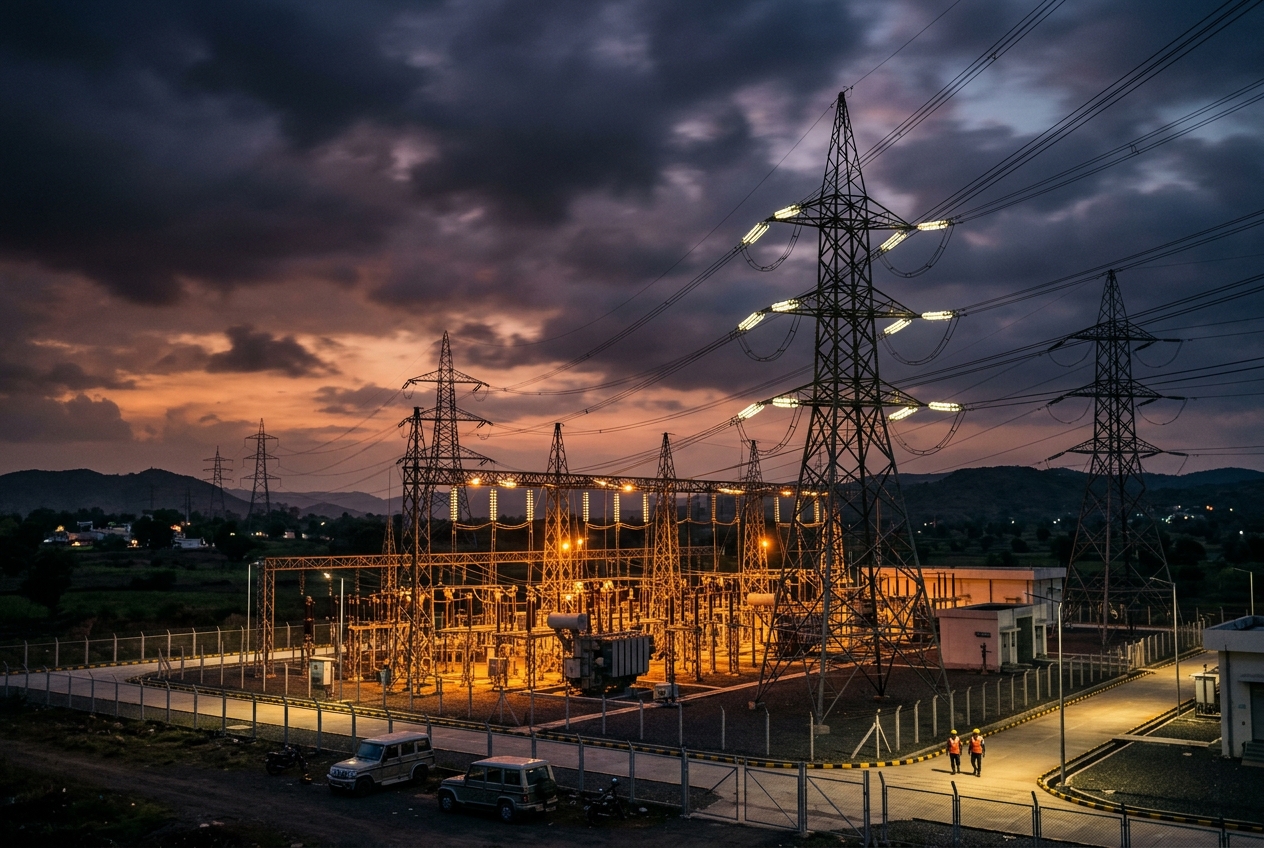
India’s renewable pipeline in 2026 is no longer constrained only by module supply, land aggregation, or PPA quality. For utility-scale solar, wind, hybrid and storage-linked projects, transmission planning has become one of the most material value drivers in the entire project stack. The difference between a bankable evacuation plan and an optimistic one can show up as a 6–18 month delay, a higher cost of debt, curtailment exposure, or a redesign of the pooling and interconnection scheme after award.
A key reason is the growing interaction between General Network Access (GNA), N-1 planning criteria, ISTS augmentation sequencing, and substation readiness. Many developers still treat these as separate workstreams handled by different advisors, CTU interface teams, and OEM engineers. In practice, they are tightly linked. If the evacuation concept is weak at bid stage, every downstream activity becomes harder: connectivity approvals, bay allocation, load-flow acceptance, short-circuit compliance, lender diligence, and schedule certainty.
This article explains how N-1 planning and GNA are shaping renewable evacuation in India in 2026, what numbers matter, where projects get delayed, and how developers, lenders, utilities and large C&I offtakers should assess real transmission readiness.
Why N-1 now matters more for renewable evacuation
N-1 security is not a new concept in transmission engineering. The principle is simple: the system should continue to operate within permissible limits even if one critical element is lost, such as a transmission line, ICT, bus section, or reactor depending on the topology being assessed. What has changed in 2026 is the commercial consequence of N-1 non-compliance for renewable projects.
India’s renewable zones are becoming denser. In Rajasthan, Gujarat, Karnataka, Tamil Nadu and parts of Andhra Pradesh, evacuation corridors are carrying far larger injections from inverter-based resources than they were originally designed for. As a result:
- post-contingency loading margins are thinner
- voltage recovery performance is more sensitive
- reactive support assumptions matter earlier in the design cycle
- outage of one 400 kV or 765 kV path can trigger generation backing down across multiple projects
- remnant capacity visible on paper may not be firm under contingency conditions
For a developer, this means the headline availability of a nearby ISTS node is not enough. The real question is whether the node, corridor and downstream sink path can absorb scheduled injection under credible outages without violating thermal, voltage, stability, or protection constraints.
In lender reviews, this is now being looked at more closely. A project with apparent connectivity but weak post-contingency evacuation may still pass a superficial diligence memo, but it will face tougher questions on deemed generation assumptions, curtailment risk allocation, DSCR resilience, and time contingency in the EPC schedule.
GNA in 2026: access rights are necessary, but not sufficient
GNA has changed the framework for transmission access, but many market participants still overestimate what it solves for a project.
In practical terms, GNA gives network access rights within the approved framework, but it does not eliminate the need for actual physical network readiness, bay completion, terminal equipment integration, and compliant system studies. A developer may secure connectivity milestones yet still face delays if the associated upstream strengthening package or terminal arrangement is not synchronized.
In 2026, the most common sources of confusion around GNA are:
- assuming granted access is equivalent to evacuation certainty at full contracted capacity
- underestimating dependence on shared ISTS augmentation packages
- not stress-testing injection profiles for solar-wind-storage hybrid operating cases
- not mapping inter-stage dependencies between the project pooling station, dedicated transmission line, and CTU bay readiness
- failing to update studies after changes in generation mix, inverter controls, or COD phasing
For example, a 500 MW solar project may appear straightforward at bid stage, but if the actual injection pattern is paired with another 300 MW BESS-enabled hybrid cluster in the same zone, post-contingency power flows may differ significantly from the original planning case. Likewise, a 1 GW wind-solar hybrid may have lower annual CUF than a thermal generator equivalent, but its simultaneous high-output periods can still be the binding case for line loading and voltage management.
This is why serious developers are now commissioning Power system studies much earlier, often before final land aggregation is complete. The purpose is not only to satisfy formal connectivity requirements, but to identify whether the proposed interconnection concept survives realistic 2026 operating scenarios.
The real bottlenecks: bays, ICTs, line sections and downstream sinks
Transmission delays for renewable projects are often described vaguely as “grid issues”. That description is too broad to support decision-making. In 2026, the bottleneck is usually traceable to one of a few specific elements.
First, substation bay availability remains a critical issue. A bay may be planned in a transmission scheme, but planning approval, package award, civil progress, equipment delivery and protection integration are all separate schedule risks. For a 400 kV bay, even when land and switchyard space are available, practical completion timelines can still extend to 12–18 months depending on owner readiness, GIS or AIS configuration, and interface complexity.
Second, ICT capacity can be the hidden bottleneck. Many projects focus on line connectivity but ignore transformer loading under outage conditions. A node may be adequate in normal topology yet constrained when one transformer or adjacent corridor is out. This becomes especially relevant where renewable injection is concentrated around 220/400 kV or 400/765 kV transformation points.
Third, downstream sink adequacy is often overlooked. A renewable-rich source node can be technically ready, but if the onward corridor to load centres or balancing regions is delayed, the effective evacuation headroom shrinks. In several cases, the limiting constraint is not the immediate evacuation line from the project, but the second or third network segment beyond the connection point.
Fourth, interface engineering between project assets and CTU/STU assets is still a recurrent cause of slippage. Metering architecture, protection philosophy, communication redundancy, PMU integration, SCADA point lists, and synchronization requirements can delay charging even when the physical yard appears complete.
Typical 2026 cost ranges illustrate why early clarity matters:
- 220 kV dedicated line: roughly Rs 1.2-1.8 crore per ckm depending on terrain, RoW and conductor choice
- 400 kV dedicated line: roughly Rs 2.0-3.5 crore per ckm in many standard cases, higher in difficult corridors
- 400 kV AIS bay package: often Rs 12-20 crore depending on configuration and owner scope split
- 400/220 kV ICT addition: commonly Rs 18-30 crore per unit, excluding broader yard augmentation where required
- STATCOM-linked or dynamic reactive support packages: can add several tens of crores depending on MVAR rating and integration scope
These are broad market ranges, not tender quotes. But they show why transmission assumptions cannot be left to late-stage optimization.
What developers should check before bid submission or financial close
A robust evacuation strategy in 2026 needs more than a single connectivity letter or a notional nearest substation map. Developers should test at least six questions.
- Is the evacuation scheme viable under N-1, not just in intact system conditions?
- Is the identified bay physically and contractually tied to a realistic completion schedule?
- Are there upstream or downstream ISTS packages that must be completed first?
- Do the load-flow and reactive studies reflect the actual plant configuration, including BESS if applicable?
- Is there enough margin for phased COD, not just full-capacity COD?
- Have owner-engineer and lender assumptions on curtailment been aligned with system realities?
For hybrids and RTC-oriented projects, one more layer is needed: hourly dispatch diversity. Many planning notes still use simplified injection assumptions. That is increasingly inadequate. Storage-charged export, wind coincidence, and seasonal solar peaks can materially change corridor loading and reactive exchange requirements.
This is where integrated technical advisory creates value. A transmission concept should connect electrical studies, package design, interconnection approvals, and commercial schedule logic. When these sit in silos, projects discover contradictions late. For example, the study model may assume one transformer impedance, while procurement and OEM selection introduce another; or the approved line route may increase losses and change reactive compensation needs.
A stronger approach is to align Power system studies with HV/EHV substation design from the beginning, so that bay arrangement, bus scheme, transformer sizing, protection interfaces and contingency performance are all assessed together.
Lender perspective: evacuation quality now affects debt terms
In 2026, transmission diligence has become more quantitative. Lenders are asking not only whether connectivity exists, but whether evacuation risk has been translated into financial downside cases.
The strongest credit files usually include:
- clear mapping of connectivity milestones to project COD milestones
- independent review of N-1 adequacy and contingency constraints
- confirmation of bay and line package progress, not just approval status
- sensitivity cases for curtailment, delayed charging, and phased commissioning
- allocation of interface responsibilities across developer, EPC, CTU/STU and OEMs
- documentary evidence of updated study submissions after material design changes
This matters because a transmission slip often cascades into multiple commercial impacts at once. A delayed bay energization can trigger IDC overrun, liquidated damages exposure under offtake contracts, inverter warranty clock issues, and mismatch with debt drawdown timing. For merchant-exposed or partially merchant projects, it can also push COD into a weaker tariff window.
For C&I buyers considering long-tenor open access procurement from interstate renewable projects, transmission quality also affects delivered savings. A project with fragile evacuation may produce attractive headline tariffs but weaker actual availability. If a buyer is evaluating a 25-year supply arrangement, it is prudent to ask where the project sits in relation to ISTS reinforcement, whether contingency constraints are likely during peak RE seasons, and how scheduling risk has been addressed.
Policy and system context in 2026
The broader policy environment is supportive of renewable transmission expansion, but execution remains uneven across assets and regions. India continues to build out ISTS and renewable energy corridors, with central and state utilities pursuing new substations, line sections and transformation capacity. However, project developers should distinguish between policy intent and commissioned infrastructure.
In the current market, a planning approval or bid award is not equivalent to evacuation readiness. Manufacturing lead times for key EHV equipment, right-of-way complexity, multi-agency approvals, and interface coordination continue to affect transmission schedules. Even where major backbone corridors are progressing, the last-mile link between the project pooling station and the evacuation node can still become the critical path.
At the same time, grid operators are becoming more demanding about model quality, controller settings, and operational behavior of inverter-based resources. This is positive for system reliability, but it increases the need for disciplined engineering. Renewable developers cannot rely on generic assumptions copied from prior projects in another state or voltage level.
The implication for policymakers and utilities is also clear: queue transparency, augmentation sequencing, and realistic publication of bay readiness status will materially improve investment efficiency. Better data on what is approved, under construction, delayed, or commissioned helps the market make better siting and bid decisions.
A practical checklist for reducing evacuation risk
For developers, lenders and large power buyers, the most effective transmission-risk mitigation steps in 2026 are straightforward.
- start interconnection strategy before bid submission, not after award
- verify N-1 evacuation using project-specific generation profiles
- confirm physical bay and transformer readiness with dated milestones
- track upstream and downstream dependency packages, not just the terminal node
- re-run studies after major design changes, especially hybridization or storage addition
- align technical assumptions across developer, EPC, OEM, lender engineer and legal teams
- budget realistic contingency for dedicated line, bay and interface works
- document curtailment and delay allocation clearly in commercial contracts
The projects that move fastest today are not necessarily those nearest to a substation. They are the ones with the clearest understanding of network topology, contingency behavior, package interfaces and approval sequencing.
Transmission planning for renewable projects in India has entered a more disciplined phase. GNA has improved the market framework, but it has not replaced the need for sound engineering judgment, realistic scheduling and early risk identification. N-1 adequacy, bay readiness, transformer constraints and system studies now sit at the center of project bankability.
If you are evaluating a new renewable site, refinancing an operating asset, or diligence-testing evacuation assumptions for a portfolio, contact Growthifye’s advisory desk. Our team supports transmission strategy, Power system studies, HV/EHV substation design, and connectivity-risk assessment for bankable project execution.
Explore Growthifye's related capabilities
This analysis connects directly to our advisory practice: Power system studies · HV/EHV substation design · Transmission line engineering · Protection, control & SCADA.
About the author

Chief Executive Officer, Growthifye — With over 23 years in management consulting, Sudarshan has taken businesses from concept to scale — building and scaling new-age digital and energy businesses.
- 23+ years in management consulting
- EY alumnus
- Led large-scale BESS programmes, capital raises and advisory mandates
Want this analysis applied to your project?
Talk to our team