Grid Interconnection Queue Risk in India 2026: RE Connectivity Delays, Costs and Fixes
By Sudarshan Karweer · sudarshan@growthifye.com · +91 84510 99371 (Call / WhatsApp) · 2026-08-29
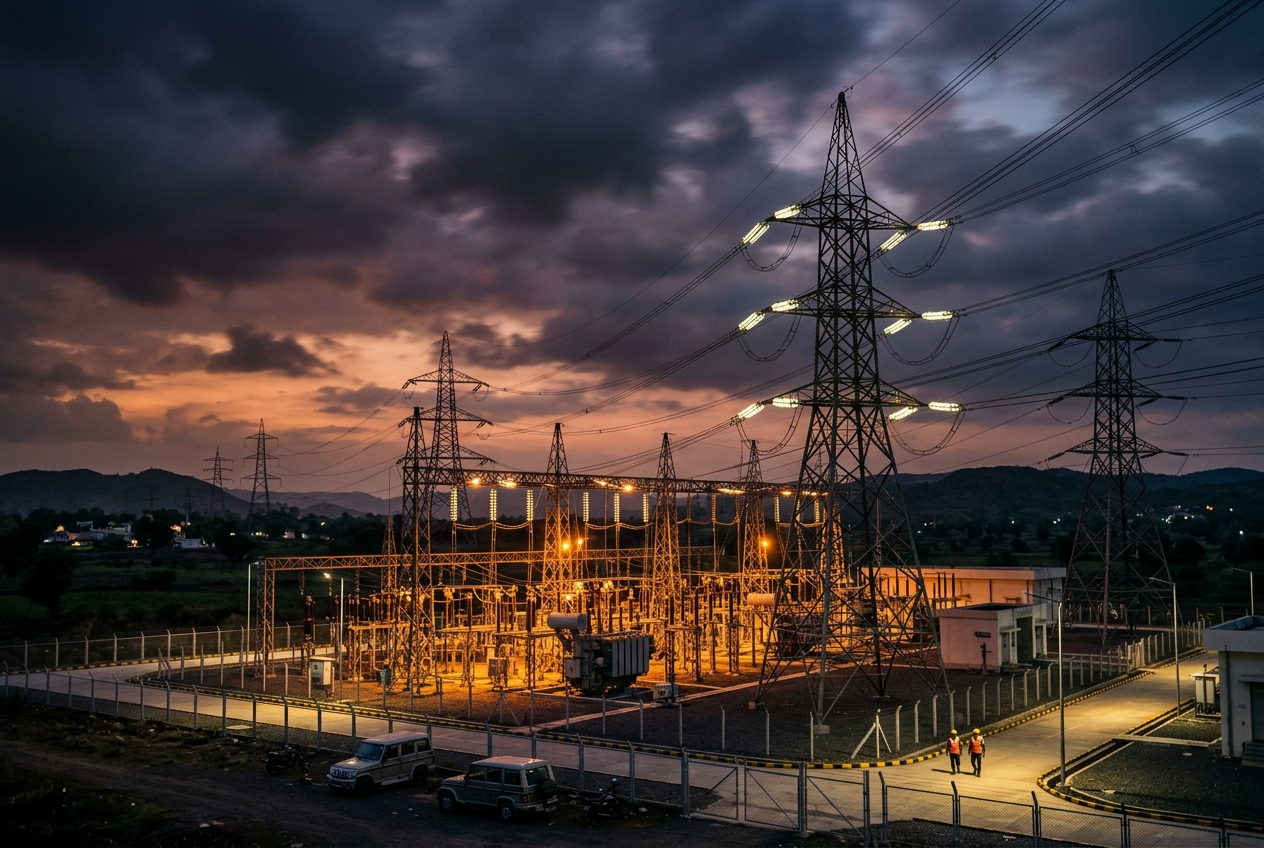
India’s renewable-energy market in 2026 is no longer constrained only by land, tariffs or equipment. For many utility-scale solar, wind, hybrid and storage-linked projects, the biggest execution risk sits in the grid interconnection queue: who gets connectivity first, whether the identified bay is actually deliverable, whether upstream transformation and line augmentation are ready, and how long system studies, approvals and construction take in practice.
For developers, this is now a first-order bankability issue. For C&I consumers relying on open access or group captive supply, it affects contracted start dates and landed power cost. For lenders, interconnection queue risk has become as material as resource assessment or offtaker payment discipline. For utilities and policymakers, it is where India’s clean-energy ambition meets physical network limits.
This article focuses on a distinct but often under-analysed angle in transmission engineering: interconnection queue risk in India’s renewable buildout. The issue is not merely obtaining an in-principle connectivity approval. The real challenge is converting an application, bay allocation or connectivity grant into energisation on a predictable timeline and at a cost that does not erode project IRR.
Why interconnection queue risk matters more in 2026
India’s renewable pipeline has continued to outpace transmission execution in several corridors. Solar parks, standalone IPP projects, wind repowering clusters, RTC portfolios and hybrid capacities are competing for the same evacuation nodes. In high-activity states and ISTS-linked corridors, queue congestion shows up in four ways:
- bay scarcity at 220 kV, 400 kV and 765 kV substations
- delays in upstream line or ICT augmentation by CTUIL, STUs or transmission licensees
- repeated study iterations because project configurations change after application
- misalignment between generation COD and transmission readiness
For a 100 MW to 300 MW solar project, even a six-month interconnection delay can have a major value impact. If the tariff is around Rs 2.45-3.20/kWh and PLF is 24-30% depending on technology and location, revenue deferral alone can run into several crore rupees. For a 250 MW solar project at 27% PLF and Rs 2.60/kWh tariff, six months of deferred energy can mean roughly 88.7 million units not billed, or about Rs 23 crore of delayed revenue. Add IDC extension, O&M standing costs, liquidated damages exposure under PPA or PSA structures, and DSCR pressure, and the connectivity timeline becomes a financing issue, not just an engineering detail.
For wind and hybrid projects, the impact is often larger because monsoon-season generation concentration means missing a single evacuation-ready window can permanently reduce first-year output.
Where queue risk actually comes from
In market discussions, “connectivity delay” is often treated as a generic problem. In practice, queue risk arises from a chain of specific constraints.
First is application concentration. Multiple developers apply for connectivity at the same node or within the same transmission pocket because the node appears nearest, cheapest or already referenced in bid documents. This creates a paper queue well before physical works start.
Second is conditional bay allocation. A developer may receive connectivity linked to a future bay, line LILO, extension bay or transformer augmentation that is not yet under construction. On paper, the project has a path to evacuation. On the ground, the critical path still depends on third-party execution.
Third is upstream dependency. A project-level dedicated transmission line may be fully ready, but energisation can still be blocked because the receiving substation bus extension, protection integration, SCADA readiness, metering scheme, communication channels or upstream line charging are incomplete.
Fourth is data instability. Developers often revise project capacity, inverter block size, BESS sizing, point of interconnection, collector system layout or commissioning phasing after the initial application. Each change can trigger fresh review of load flow, short-circuit, transient or protection coordination assumptions.
Fifth is land and RoW on the transmission side. While generation-side land may be secured, the associated line route for evacuation can still face forest diversion, highway crossing, railway approval, defence clearance, aviation constraints or local compensation disputes.
Sixth is sequencing mismatch between central and state processes. A project may be commercially advanced under one approval track but still blocked by another. This is common where ISTS-linked generation, state-side dedicated lines, and open access sale structures interact.
The 2026 process pinch points developers underestimate
Most developers budget for application fees, bay equipment and the dedicated evacuation line. Fewer properly model the process pinch points that consume months.
A typical utility-scale project can face the following timeline elements in 2026:
- connectivity application preparation and clarifications: 4-8 weeks
- system study review and iteration: 6-16 weeks depending on node congestion and data quality
- approval or grant with conditions: 4-10 weeks after study closure in many cases
- bay or substation scope freeze: 4-12 weeks
- detailed engineering, drawings and utility approvals: 8-16 weeks
- long-lead equipment procurement for EHV scope: 5-9 months
- dedicated line construction and RoW closure: 4-10 months
- protection, telemetry, ABT metering and communication integration: 6-12 weeks
- pre-commissioning tests and final charging coordination: 2-6 weeks
These stages often overlap, but they can also stall sequentially. In congested nodes, one unresolved issue in a bus extension or protection interface can push the energisation date by a quarter.
Developers also underestimate the practical implications of phased commissioning. A 300 MW project planned in three 100 MW blocks may secure a single connectivity framework, but the utility may insist on milestone-linked readiness of dedicated bay equipment, metering, forecasting interface and disturbance recording for each stage. Unless this is planned early, the first block can be ready while the interconnection package is not.
This is where disciplined Power system studies and transmission package engineering can save months. The most successful projects in 2026 are not those with the cheapest line item estimate, but those that freeze assumptions early and avoid iterative redesign.
Cost impact: what queue and interconnection delays do to project economics
Interconnection risk has both visible and hidden costs.
Visible costs include:
- bay development, extension or augmentation contributions
- dedicated transmission line CAPEX
- EHV equipment price escalation if procurement is deferred
- IDC during delay period
- contractor prolongation claims
- resubmission, redesign and testing costs
Hidden costs are usually larger:
- deferred generation revenue
- mismatch between debt disbursement and asset readiness
- PPA milestone stress or extension negotiations
- loss of high-generation season output
- inability to start open access supply to C&I consumers on contracted date
- short-term power purchase cost for replacement energy
- lower first-year CUF/PLF and covenant pressure
Indicatively, 220 kV dedicated evacuation systems for medium-scale projects can range widely depending on line length, terrain, bay scope and substation work. For many 100-250 MW projects, the evacuation package can move from around Rs 20-45 lakh/MW at the lower end of simple short-distance arrangements to materially higher numbers where long line routes, multi-bay augmentation, STATCOM-linked interfaces, difficult RoW or pooled infrastructure are involved. At 400 kV and above, costs step up sharply. The problem is not only absolute cost; it is cost uncertainty caused by queue-linked design changes.
For lenders, the key issue is that interconnection CAPEX and COD schedule are often treated as “manageable” until they become the main source of slippage. Credit teams in 2026 increasingly want evidence of node readiness, transmission package status, RoW strategy, and realistic energisation coordination, not just a connectivity letter.
What lenders, C&I buyers and policymakers should diligence
Different stakeholders should read queue risk differently.
For lenders:
- verify whether connectivity is firm, conditional or dependent on future augmentation
- check if the identified substation bay already exists, is under execution, or is only proposed
- review whether upstream line and transformer readiness are on the same COD path as generation
- examine dedicated line route constraints and approval dependencies
- insist on sensitivity for 3-month, 6-month and 12-month interconnection delay cases
- test whether debt drawdown assumptions match actual transmission milestone dates
For C&I buyers and open access consumers:
- ask whether the seller’s evacuation path is already energised or still under development
- evaluate replacement power and deemed supply clauses carefully
- assess whether state network and scheduling arrangements are in place for contracted commencement
- price in the risk of delayed flow of low-cost renewable power to the contracted load centres
For policymakers and utilities:
- publish more transparent queue status by node and voltage level
- distinguish between granted, reserved and physically executable bay capacity
- link connectivity awards more tightly to milestone discipline
- reduce speculative applications that block practical projects
- coordinate generation tendering with transmission readiness windows
Queue transparency is particularly important. In several corridors, market participants know informally that a node is saturated long before formal documents clearly reflect practical execution constraints. Better disclosure would improve capital allocation and reduce unproductive application churn.
How developers can reduce queue risk before financial close
The best mitigation starts before land is fully tied up and before tariff assumptions are finalised. Developers should treat grid interconnection as a parallel development workstream, not a post-award utility formality.
A practical mitigation framework in 2026 includes:
- node screening beyond simple distance minimisation
- comparison of at least two technically feasible evacuation nodes
- review of existing and under-construction bays, transformers and line loading at candidate substations
- early load flow, short-circuit and reactive assessment based on realistic plant configuration
- dedicated line route reconnaissance with land, forest and crossing constraints mapped
- procurement strategy aligned with the actual critical path of bay and line packages
- phasing plan for staged commissioning if full-capacity energisation is unlikely on day one
Developers should also avoid over-optimising the interconnection package at bid stage. A lower assumed evacuation CAPEX can make a tariff model look competitive, but if it relies on an uncertain node or future augmentation, the apparent savings can vanish after award.
In complex projects, specialist support in HV/EHV substation design and utility interface management is often the difference between a paper connectivity pathway and an executable one. The interconnection package has to be developed as an integrated system: line, bay, metering, communication, protection, SCADA and energisation sequencing.
Contract structure matters too. EPC and BoP contracts should clearly allocate responsibility for:
- utility approvals and owner-furnished data
- design freeze dates
- assumptions on bay availability and shutdown windows
- interface points for protection and telemetry
- delay consequences arising from third-party transmission readiness
- documentation for trial charge and final energisation
Without this clarity, disputes emerge precisely when the project is mechanically complete but cannot export power.
A practical 2026 playbook for bankable interconnection planning
In today’s market, the projects that move fastest are usually those that adopt a bankable interconnection playbook.
Step one is to classify the evacuation path into risk tiers:
- Tier 1: existing bay and upstream readiness largely available
- Tier 2: bay or extension under execution with credible completion path
- Tier 3: connectivity dependent on future augmentation or congested corridor assumptions
Step two is to assign schedule contingency by tier. Too many financial models still use generic COD buffers of 30-60 days. In reality, Tier 2 and Tier 3 interconnections may require 4-9 months of schedule risk allowance.
Step three is to maintain a utility-facing issue tracker from day one. This should include every drawing, approval, protection matrix, communication requirement, metering detail, shutdown need and dependency owner. Transmission execution delays often result not from one major technical defect, but from fifteen small unresolved interfaces.
Step four is to lock plant electrical design early enough to avoid repeated study changes. When inverter control philosophy, BESS operation mode, export limit, or reactive strategy keeps changing, utility review cycles keep resetting.
Step five is to integrate transmission milestones into financing covenants and offtake commitments. COD should not be modelled solely around module delivery, turbine erection or internal electrical completion.
For RE developers scaling portfolios across states, a standardised interconnection diligence protocol is now essential. Every megawatt in the pipeline should be tagged not only by tariff and resource quality, but by evacuation complexity, node congestion and energisation confidence.
The bottom line
In India’s 2026 renewable market, interconnection queue risk is one of the clearest separators between projects that commission on time and projects that slip into value erosion. A connectivity approval is not the same as executable grid access. Bay scarcity, upstream augmentation, study iterations, RoW constraints and utility interface delays can all turn a nominally ready project into a stranded asset for months.
Developers that win on this front are the ones that treat transmission engineering as part of core project development. They stress-test nodes, quantify delay scenarios, freeze electrical assumptions early, and build realistic utility coordination into budget and schedule. Lenders and C&I buyers should demand the same discipline before committing capital or contracted supply timelines.
If your project is evaluating ISTS or state-side evacuation, facing node congestion, or needs a bankable interconnection roadmap, contact Growthifye’s advisory desk. Our team supports developers, investors and power buyers across transmission strategy, Connectivity & open access, and construction-stage grid interface planning.
Explore Growthifye's related capabilities
This analysis connects directly to our advisory practice: Power system studies · HV/EHV substation design · Transmission line engineering · Protection, control & SCADA.
About the author

Chief Executive Officer, Growthifye — With over 23 years in management consulting, Sudarshan has taken businesses from concept to scale — building and scaling new-age digital and energy businesses.
- 23+ years in management consulting
- EY alumnus
- Led large-scale BESS programmes, capital raises and advisory mandates
Want this analysis applied to your project?
Talk to our team