Grid Compliance Testing for RE Projects in India 2026: FGMO, LVRT, PMU and SAT
By Sudarshan Karweer · sudarshan@growthifye.com · +91 84510 99371 (Call / WhatsApp) · 2026-08-28
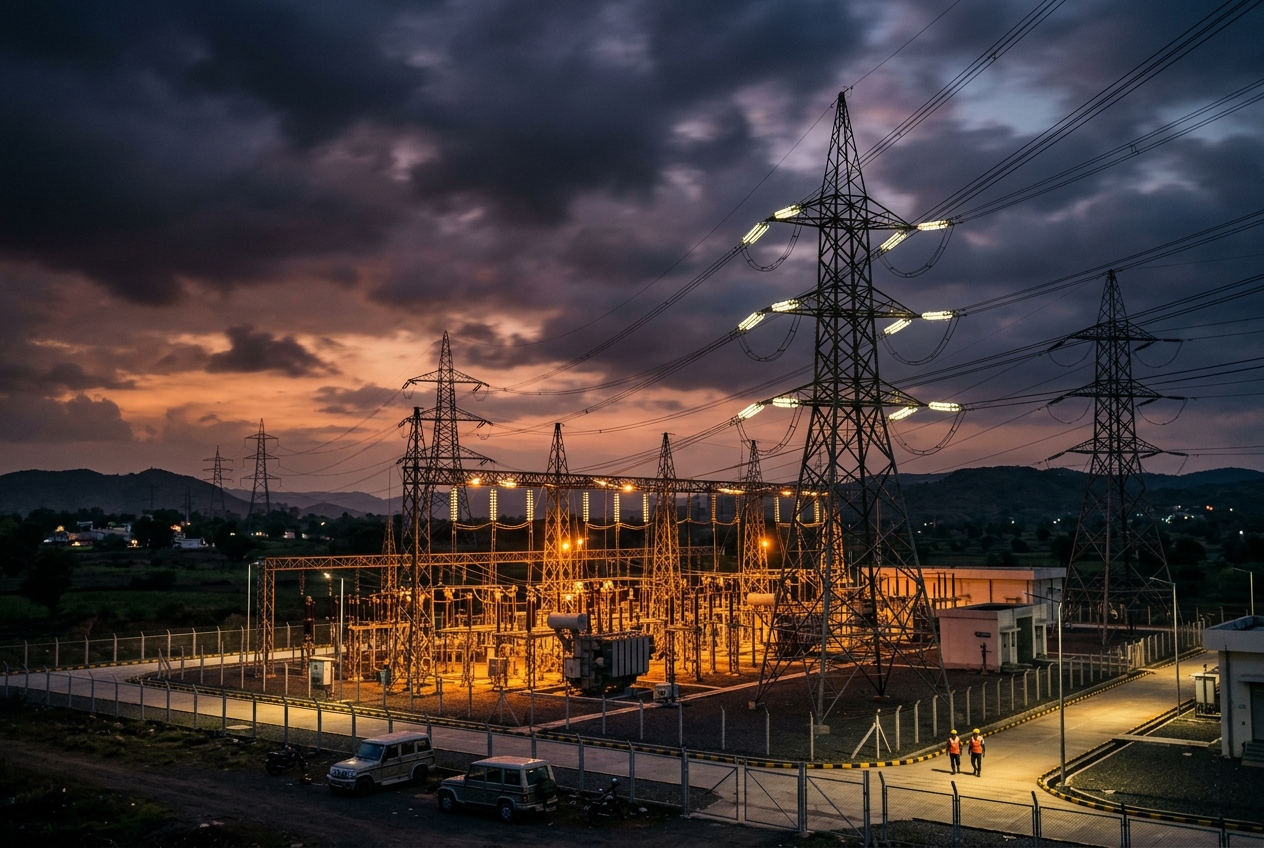
India’s renewable pipeline is no longer constrained only by land, modules, turbines or transmission access. In 2026, a growing number of solar, wind, hybrid and BESS-linked projects are discovering that grid connectivity can be technically available on paper, yet commercial operation gets delayed by compliance testing, telemetry readiness, controller tuning, and utility sign-offs.
This is a distinct issue from bay readiness, ISTS connectivity approval, GNA/LTA, green energy corridor buildout, or standard power system studies. The bottleneck now is the last-mile proof that a project actually behaves as the grid expects under normal and disturbed conditions. For developers, IPPs, C&I offtakers, lenders and state utilities, this is becoming a material schedule and revenue risk.
In practical terms, a project may have evacuation infrastructure completed, protection drawings approved, and pooling substation energised, but still not achieve reliable COD if plant controllers, PMU streams, fault ride-through settings, AGC/FGMO logic, or SCADA interoperability are incomplete. On larger ISTS-connected assets, even a 30-60 day delay can materially affect merchant strategy, PPA milestones, deemed-generation claims, and debt drawdown sequencing.
This article explains the 2026 grid-compliance testing stack for renewable projects in India, the common failure points, realistic costs and timelines, and how project owners should allocate responsibility across OEMs, EPCs, transmission contractors and owners’ engineers.
Why compliance testing is now a critical transmission issue
The Indian grid in 2026 is operating with a much higher share of inverter-based resources than it did even three years ago. Solar-wind hybrid parks, co-located BESS, and large RE zones connected through ISTS have changed system behaviour during frequency deviations, voltage swings and faults. As a result, grid operators and transmission utilities are paying much closer attention to whether projects meet the intended performance envelope, not merely whether equipment has been installed.
The compliance focus usually includes:
- Frequency response capability, including primary response behaviour and plant active power control logic
- Low-voltage ride-through and high-voltage ride-through capability
- Dynamic reactive power response and voltage control through inverters, STATCOMs or SVCs where applicable
- PMU, disturbance recorder, event logger and SCADA data visibility
- Telemetry integration with SLDC, RLDC, NLDC or CTU/STU systems as relevant
- Protection coordination between plant, pooling substation and grid substation
- Controller interactions in hybrid plants, especially when PV, wind and BESS share a common point of interconnection
- Site acceptance testing for substation automation, SAS, communication links and remote control commands
For lenders, these are not minor punch-list items. A plant that cannot demonstrate stable response under test conditions can face delayed charging approval, conditional synchronisation, restricted export, or prolonged observation periods. In projects with tight DSCR assumptions, one missed seasonal generation window can be painful.
The 2026 testing stack: what actually gets checked
Grid compliance in India is not one single test. It is a sequence of validations across design, factory acceptance, installation, pre-commissioning and live-grid acceptance. The exact mix depends on whether the project is connected at STU or ISTS level, the voltage class, technology configuration, and utility requirements.
At a minimum, most utility-facing testing packages now cover:
- Protection relay settings verification and secondary injection
- End-to-end signal checks for tripping, interlocking and breaker failure schemes
- SCADA point-to-point checks
- RTU/gateway integration tests
- ABT meter, SEM and time synchronisation checks
- PMU installation and communication validation where mandated
- Plant controller and PPC testing for active/reactive power commands
- Voltage control mode tests at the interconnection point
- Frequency response logic checks, including ramp rate and power reduction commands
- LVRT/HVRT functional validation through OEM records, simulations and where required, site demonstration protocols
- Disturbance recorder and sequence-of-events recording verification
- Site acceptance testing of SAS and remote operation logic
On large solar projects above 100 MW, a combined compliance package involving OEMs, the PPC vendor, SCADA integrator, substation EPC and owner’s engineer often spans 3-6 weeks after mechanical completion, assuming documentation is ready. On hybrid projects or plants with dynamic compensation equipment, 6-10 weeks is more realistic.
Typical direct compliance and testing costs in 2026, excluding major hardware rectification, are often in these ranges:
- Utility interface testing and documentation: Rs 10-25 lakh
- Plant controller tuning and retesting: Rs 8-20 lakh
- PMU, communication and time-sync integration support: Rs 5-15 lakh
- SAS/SCADA FAT-SAT closure support: Rs 10-30 lakh
- Third-party electrical/protection testing support: Rs 6-18 lakh
- Additional OEM engineer mobilisation for repeat tests: Rs 3-10 lakh per event
For a 250 MW ISTS-connected hybrid plant, it is not unusual for the full last-mile compliance budget to land in the Rs 40 lakh to Rs 1.2 crore band once retesting, communication troubleshooting and controller modifications are included.
FGMO, AGC and active power control: the misunderstood risk
One recurring misconception is that active power control compliance is merely a software checkbox. In reality, frequency-linked and dispatch-linked behaviour has become one of the most frequent causes of delayed acceptance.
Projects are now expected to demonstrate reliable response to:
- Ramp-rate limits during sunrise, cloud transients or wind pickup
- Remote curtailment commands from load dispatch centres
- Setpoint tracking from PPC/EMS systems
- Frequency-sensitive behaviour without unstable oscillations or hunting
- Coordinated output control in hybrid and BESS-coupled plants
This is where plant architecture matters. If inverter blocks, wind turbine controllers, BESS PCS controls and the plant power controller are from different vendors, interface mismatches are common. A command issued at the grid interface may not propagate cleanly to all generating units, or the realised response may lag beyond acceptable time windows.
In 2026, utilities are increasingly less tolerant of “to be tuned post-COD” commitments. If the plant cannot hold voltage setpoints, follow active power commands, or maintain stable response during dispatch changes, commercial operation can be deferred.
For developers, the practical takeaway is simple: active power control logic must be frozen earlier in the project cycle. Controller hierarchy, command priority, deadbands, fallback modes and data ownership should be contractually defined before equipment shipment.
LVRT/HVRT and dynamic performance: where desktop studies are not enough
Most developers are familiar with fault ride-through requirements at a high level. The problem in 2026 is not awareness; it is proof. Utilities increasingly expect consistency between submitted simulation models, OEM type-test evidence, as-built settings and measured site behaviour.
Common problem areas include:
- OEM PSCAD/PSSE models not matching field firmware versions
- Inverter or WTG control parameters changed during commissioning without updated study files
- Hybrid controller interactions causing unexpected reactive power swings during disturbances
- STATCOM or capacitor-bank logic not coordinating properly with PPC voltage-control mode
- Protection settings operating too conservatively, causing avoidable tripping during transient events
For this reason, compliance work must bridge both modelling and field execution. Good Power system studies remain essential, but they are only one layer. The field team must confirm that the relay settings, PPC logic, inverter settings and communication architecture installed on site match the assumptions used in the grid studies submitted to utilities.
If they do not match, a project can be trapped in a loop: study revision, utility review, retuning, repeat SAT, and fresh sign-off. On time-sensitive PPAs, that loop can easily consume 4-8 weeks.
Realistically, developers should maintain a live compliance matrix that tracks:
- Study assumption
- Approved value
- Installed value
- Tested value
- Utility witness status
- Closure evidence
Without this discipline, multi-vendor plants lose control of the acceptance process.
PMU, telemetry, SCADA and communication readiness
Another major source of hidden delay is data visibility. Grid authorities increasingly require near-real-time observability and dependable event capture, especially at high-voltage interconnection points. A project may be physically ready but commercially stuck because time synchronisation, telemetry mapping, communication redundancy or PMU streaming is not accepted.
Typical issues seen across 2026 projects include:
- Wrong SCADA point list mapping between plant and substation
- Inconsistent naming conventions across OEM systems, RTU and SAS
- GPS clock or time synchronisation problems affecting SOE and PMU quality
- Latency or packet-loss issues in communication links to SLDC/RLDC endpoints
- Missing redundancy in fibre paths or network switches
- Cybersecurity restrictions blocking remote access needed for final tuning
- Event and disturbance recorders not configured to utility format expectations
These issues can be especially painful because each individual defect appears small, but utility sign-off often depends on all of them being closed together. A single unverified remote command, a failed status indication, or bad timestamp quality can hold back final approval.
This is where detailed work on Protection, control & SCADA becomes central to transmission success. Many projects still underestimate the integration effort needed between the plant side and the evacuation substation side, particularly when different EPC packages are awarded separately.
A good rule of thumb in 2026 is to freeze the complete SCADA/telemetry point list at least 90-120 days before expected synchronisation, and to complete dry-run checks 30-45 days before utility witnessing.
Contracting, risk allocation and lender due diligence
Compliance delays often happen not because the tests are technically impossible, but because nobody clearly owns them. In many Indian RE projects, the substation EPC says the issue lies with the plant controller vendor, the inverter OEM blames telemetry integration, the SCADA vendor blames missing utility details, and the developer is left coordinating everyone at the end.
This is a contract-structuring failure.
Developers and lenders should check whether the project documents clearly allocate:
- Who owns end-to-end grid compliance matrix preparation
- Who is responsible for model validation versus field settings
- Who attends utility witness testing and at whose cost
- What response time applies for repeat mobilisation after failed tests
- Which liquidated damages apply for missed readiness milestones
- Whether COD depends on utility-issued final acceptance or only technical completion
- How OEM warranty obligations interface with controller retuning or firmware changes
For lenders, this should now be a standard technical due-diligence item. It is no longer enough to ask whether transmission connectivity exists. The more relevant question is whether the project has a credible, funded and contractually backed plan to pass grid compliance testing on schedule.
Red flags during diligence include:
- No integrated testing schedule across plant and substation packages
- No utility-approved SCADA/telemetry architecture
- Incomplete or outdated dynamic models
- Controller vendor not under direct obligation to support witnessed tests
- PMU/DR/SOE hardware procured late in the schedule
- SAT/FAT documentation not aligned to utility protocols
- No contingency budget for retesting and tuning
Where these red flags exist, lenders should assume higher COD slippage risk than the base EPC schedule suggests.
A practical execution plan for developers in 2026
For projects targeting commissioning in 2026-27, the most effective strategy is to treat compliance testing as a separate workstream, not as the last line item under commissioning.
A workable execution approach is:
- T-180 days: freeze grid compliance responsibility matrix across OEMs, EPC and owner’s engineer
- T-150 days: lock approved point lists, communication architecture and time-sync philosophy
- T-120 days: validate final study models against intended field firmware and controller settings
- T-90 days: complete FAT closure for SAS, RTU, gateways and key communication systems
- T-60 days: perform integrated dry-run testing at site for SCADA, remote commands, alarms and PPC logic
- T-30 days: conduct pre-witness mock SAT with complete issue log and closure owners
- T-15 days: verify all as-built drawings, settings files, communication database and evidence folders
- Witness window: ensure all OEMs, testing teams and utility coordinators are physically or remotely available for immediate retest
For large ISTS-connected or hybrid assets, this process benefits from specialist support in Transmission line engineering where remote terminal interfaces and line protection dependencies exist, and in HV/EHV substation design where SAS, relay architecture, bay interlocking and communication philosophies affect approval outcomes.
The commercial logic is straightforward. Spending an additional Rs 25-75 lakh on early compliance planning and integrated testing support is often cheaper than losing one month of generation on a 100 MW+ project. At a CUF-driven monthly revenue level that can run into several crore rupees depending on tariff and technology mix, the economics are obvious.
What C&I buyers, utilities and policymakers should take from this
C&I buyers sourcing power through open access or third-party PPAs should care about this issue because grid-compliance delays directly affect supply start dates, banking strategy, DSM exposure and contract energy delivery. If a seller’s project is delayed at the compliance stage, the buyer may be forced to continue with higher-cost grid supply or short-term market purchases.
Utilities should recognise that clearer, standardised testing protocols reduce friction for everyone. Many avoidable delays arise from late clarification on telemetry formats, PMU expectations, remote command sequences or witness prerequisites. Publishing standard SAT and communication checklists by voltage level and project type would improve readiness and reduce repeated correspondence.
For policymakers and regulators, the priority should be consistency. As inverter-based generation grows, compliance expectations must become more predictable, model-based and auditable. That means stronger alignment across CEA regulations, Grid Code practice, CTU/STU implementation, and dispatch-centre acceptance procedures.
India does not have a transmission challenge only in terms of line and substation capacity. It also has a performance-verification challenge. In 2026, successful evacuation increasingly depends on proving that renewable plants behave correctly in a dynamic grid, not just that they are physically connected.
If you are planning a solar, wind, hybrid or BESS-linked project and want to de-risk last-mile connectivity, testing and utility approvals, contact Growthifye’s advisory desk. Our team supports grid-readiness planning, compliance coordination, studies and execution support across transmission and interconnection workstreams.
Explore Growthifye's related capabilities
This analysis connects directly to our advisory practice: Power system studies · HV/EHV substation design · Transmission line engineering · Protection, control & SCADA.
About the author

Chief Executive Officer, Growthifye — With over 23 years in management consulting, Sudarshan has taken businesses from concept to scale — building and scaling new-age digital and energy businesses.
- 23+ years in management consulting
- EY alumnus
- Led large-scale BESS programmes, capital raises and advisory mandates
Want this analysis applied to your project?
Talk to our team