FDRE in India 2026: Hybrid Sizing, Tariffs, Curtailment and Bankability
By Sudarshan Karweer · sudarshan@growthifye.com · +91 84510 99371 (Call / WhatsApp) · 2026-08-31
India’s FDRE Market in 2026: Hybrid Sizing, Tariffs, Curtailment and Bankability
Firm and Dispatchable Renewable Energy, or FDRE, is now one of the most important procurement formats in India’s utility-scale power market. For developers, it offers a route beyond plain vanilla solar and wind bids. For DISCOMs and utilities, it promises cleaner supply with tighter delivery profiles. For lenders, it creates a new asset class that sits between intermittent renewables and conventional capacity. And for large commercial and industrial buyers, it signals what 24x7 decarbonised procurement may increasingly look like once open-access structures catch up.
The opportunity is real, but so is the modelling complexity. An FDRE project is not just a solar plant with a battery attached. It is a contracted delivery obligation that depends on weather diversity, seasonal balancing, hourly shaping, transmission availability, charging strategy, degradation assumptions, scheduling discipline and payment security. Small errors in design assumptions can shift project IRR by more than the apparent tariff spread between winning and losing bids.
This article focuses on the practical questions market participants in India are asking in 2026: what FDRE means in commercial terms, how hybrid portfolios are being sized, where tariffs are clearing, how curtailment and DSM risk should be allocated, and what lenders now expect to see before financing these projects.
What FDRE means in India’s current procurement context
FDRE is often used loosely, but in practice Indian tenders usually define it through a minimum assured supply profile, annual or monthly availability conditions, and deviation consequences if committed energy is not delivered. The design may vary by procurer, but the broad structure is similar:
- generation is sourced from a hybrid renewable portfolio, usually solar plus wind
- storage may be included to shape output and improve delivery reliability
- the project commits to supply power in specified time blocks or according to a contracted schedule
- penalties, reduced payment, or both apply for under-delivery beyond allowable tolerance bands
- the buyer values firmness, not just annual energy quantity
That distinction matters. A conventional solar PPA rewards installed capacity and annual generation. An FDRE contract rewards coincidence between generation and obligation.
In 2026, FDRE sits alongside RTC, peak power, solar-plus-storage and standalone BESS tenders. It is attractive where utilities want a lower-carbon alternative to thermal balancing without paying full thermal fixed-cost equivalents. It is also emerging as a stepping stone for states and central agencies that are not yet ready to procure full 24x7 renewable supply but do want dispatchable renewable blocks.
Why solar-wind-storage mix matters more than nameplate size
The most common mistake in early-stage FDRE evaluation is over-focusing on MW and under-focusing on hourly complementarity. The economics depend on effective delivered MWh per committed block, not on installed capacity in isolation.
In India, the best FDRE configurations in 2026 are typically based on three balancing principles:
- solar provides lower-cost daytime energy and supports battery charging
- wind improves evening, night and monsoon output diversity
- storage covers intraday ramps, short weather gaps and schedule adherence
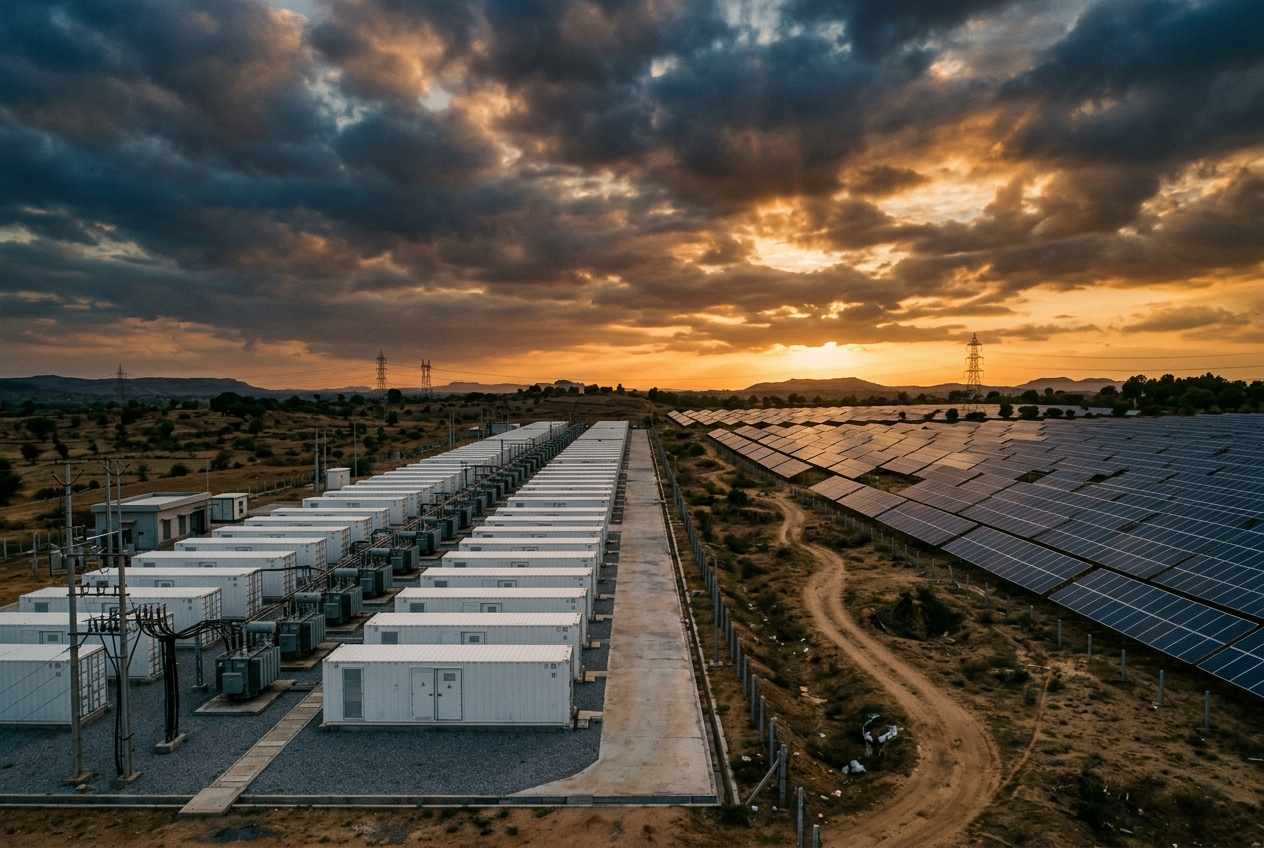
A typical utility-scale FDRE portfolio may have renewable oversizing of 2.2x to 3.5x against contracted capacity, depending on resource quality, transmission constraints and firmness requirements. For example:
- a 100 MW FDRE obligation may be backed by 160-220 MW solar and 120-180 MW wind in strong hybrid corridors
- storage may range from 0.25 to 1.0 hours of contracted capacity for milder shaping obligations, and 2 to 4 hours where tighter evening delivery is required
- annual contracted CUF-equivalent delivery for the FDRE block may target roughly 45% to 80%, depending on tender design and whether supply is around-the-clock or during nominated windows
These are not universal benchmarks. A windy site in Karnataka, Tamil Nadu or Gujarat may reduce storage dependence. A solar-heavy site with weaker evening wind support may need more battery energy capacity and more aggressive renewable oversizing. Transmission access also changes everything: if the evacuation corridor has recurring congestion during solar peaks, excess PV nameplate does not automatically improve firmness.
The design question is therefore not “How much battery should we add?” but “What mix minimises levelised delivered cost after penalties, curtailment and degradation?”
Tariff ranges and cost drivers in 2026
By 2026, tariff discovery for dispatchable renewable formats in India has become more segmented. Plain renewable tariffs and FDRE tariffs can no longer be compared directly without normalising for delivery obligations and payment mechanics.
In broad market terms, FDRE tariffs in 2026 have tended to sit above standard wind-solar hybrid tariffs but below the fully loaded cost of many new thermal alternatives when fuel risk and emissions exposure are considered. Depending on contract design, transmission assumptions and storage requirement, market-observed FDRE tariff expectations are often discussed in a rough band of about Rs 4.80 to Rs 6.80 per kWh. Tighter firmness obligations, stricter peak delivery requirements, higher storage content and weaker resource diversity can push required tariffs above this range.
The main cost drivers are straightforward:
- renewable oversizing ratio
- battery power and energy sizing
- battery cycling intensity and augmentation plan
- ISTS or intra-state transmission charges and losses
- scheduling and forecasting performance cost
- curtailment assumptions
- debt pricing and DSRA requirements
- payment security mechanism quality
Battery costs have moderated compared with earlier peaks, but FDRE economics are still highly sensitive to usable energy over life, not just upfront capex. In many project models, a seemingly small difference in battery round-trip efficiency or annual degradation can change delivered-energy cost by 10 to 25 paise per kWh. If the dispatch strategy assumes heavy daily cycling, augmentation timing becomes a first-order variable, not a footnote.
A practical point for developers: do not present a single headline tariff from the model without disclosing the implied operational regime. A tariff assuming 220 battery cycles per year is not comparable to one assuming 330 cycles. Lenders and sophisticated offtakers now ask for full dispatch logic, not only LCOE outputs.
Curtailment, forecasting, DSM and the real risk allocation problem
Most FDRE business plans look healthy before curtailment and deviations are applied. That is why risk allocation in the PPA and associated connectivity framework is central to bankability.
There are four recurring risk buckets in India’s 2026 FDRE tenders.
1. Grid curtailment risk
Curtailment can be of two kinds:
- system-backed curtailment, where grid security or network congestion prevents evacuation
- commercial curtailment, where the buyer backs down power despite contractual availability
For FDRE, this distinction is critical because the seller has already incurred the cost of overbuilding generation and storage to maintain firm delivery. If the project is deemed unavailable or unpaid during non-fault curtailment, the economics can unravel quickly.
Bankable structures usually require:
- deemed generation or deemed energy payment provisions for specified curtailment events
- clear metering hierarchy at generation, storage and delivery points
- non-discriminatory curtailment language where conventional generators are not prioritised without basis
2. Forecasting and scheduling exposure
Because FDRE is a shaped product, scheduling discipline matters more than for standalone solar or wind. State DSM regulations, central scheduling protocols, and tender-specific deviation rules can materially affect annual revenue.
Developers should model at least three cases:
- base case using current forecasting error assumptions from internal operations data
- stressed case with adverse weather correlation and communication lag events
- change-in-law case where tighter DSM or scheduling norms are imposed over contract life
An FDRE bid can look competitive at the tariff stage and still fail later if the scheduling platform, control systems and battery dispatch algorithm are not robust enough to maintain compliance.
3. Charging-source restrictions
In some structures, storage charging may be expected predominantly from the co-located renewable asset; in others, limited grid charging may be possible or at least not explicitly prohibited. This point materially affects firming economics.
Where grid charging is prohibited, battery sizing must compensate for renewable intermittency more conservatively. Where grid charging is permitted under controlled circumstances, the project can improve schedule adherence, but the regulatory treatment of such energy, including losses, charges and renewable accounting, must be clearly defined.
4. Payment security and counterparty quality
As with all utility-linked procurement in India, receivables quality matters. Even a well-designed FDRE portfolio becomes difficult to finance if payment cycles stretch and LC discipline is weak.
Lenders in 2026 remain focused on:
- offtaker credit profile
- LC structure and replenishment discipline
- state payment history
- curtailment payment enforceability
- termination compensation formula
How lenders assess FDRE bankability in 2026
Debt providers are no longer treating FDRE as a simple extension of solar project finance. Credit committees now want evidence that the asset has been engineered around the contract, not merely attached to it.
A lender-grade FDRE package should typically include:
- at least 8,760-hour generation and dispatch modelling over long-term weather datasets
- resource correlation analysis between solar and wind sites
- storage dispatch logic with degradation and augmentation assumptions
- P50, P75 and downside delivered-energy cases at contract-delivery level, not just raw generation level
- transmission availability assumptions and congestion sensitivity
- DSM penalty and under-delivery stress tests
- battery warranty, throughput and replacement strategy
- integrated financial model linking technical dispatch to revenue and debt service
In practice, lenders are especially alert to two issues.
First, they want to know whether the project’s firmness relies on frequent battery deep cycling. If yes, the model must show a credible augmentation reserve and working-capital plan.
Second, they want clarity on whether the renewable sites are geographically diversified enough to reduce common-mode weather risk. A solar and wind project located too closely may not provide the diversity that the bid strategy assumes.
Debt sizing metrics also need care. Using annual generation DSCR logic can understate delivery risk if revenue is highly dependent on specific high-value blocks. For FDRE, monthly and seasonal revenue concentration analysis is as important as annual averages.
Procurement strategy for DISCOMs, utilities and C&I buyers
For procurers, the lesson from 2025 and 2026 tenders is that poorly drafted firmness requirements either inflate tariffs unnecessarily or invite aggressive bids that struggle after award.
A good FDRE procurement framework should define:
- the exact delivery window or scheduling obligation
- monthly versus annual minimum supply requirement
- treatment of forced outage, curtailment and transmission non-availability
- deviation tolerance and settlement rules
- storage charging permissions and restrictions
- metering and energy accounting sequence
- change-in-law treatment for DSM, transmission charges and market reforms
For C&I buyers considering future dispatchable renewable procurement, the utility-scale FDRE market offers a useful reference point. It shows the cost of moving from annual green-energy accounting to shaped supply. Many corporates underestimate this premium. If a buyer wants evening-heavy renewable supply with tighter hourly matching, the cost uplift is driven less by installed megawatts and more by flexibility infrastructure and risk allocation.
This is also why procurement teams should compare FDRE offers against alternatives such as:
- plain hybrid plus market purchase balancing
- peak-power renewable blocks
- standalone BESS linked to existing open-access renewable supply
- short-duration dispatch contracts for critical operations
In several cases, the cheapest path to better hourly matching is not a full FDRE structure from day one, but a phased portfolio strategy.
What developers should do before bidding
Given the complexity and the thin margin for modelling error, developers should treat FDRE bidding as a structured advisory and risk-management exercise, not just a tariff race.
Before submitting a bid, the minimum checklist should include:
- site-level solar and wind complementarity analysis over multi-year time series
- seasonal contract-delivery mapping, especially monsoon and low-wind periods
- battery duration optimisation based on penalty curve, not rule of thumb
- transmission and curtailment scenario analysis at the intended injection point
- realistic auxiliary consumption and round-trip efficiency assumptions
- OEM-backed degradation and augmentation plan
- financing feedback on contract bankability before final tariff lock-in
This is where specialist RE & Energy Storage Advisory becomes valuable. The difference between an investable FDRE project and an over-optimistic one is often hidden in dispatch assumptions, contract wording and transmission realities rather than in headline capex alone.
India’s 2026 market is mature enough to support FDRE growth, but only where project design is anchored in operational truth. The winning strategy is not the lowest theoretical tariff. It is the lowest tariff that still survives weather volatility, grid constraints, battery ageing and lender diligence.
If you are evaluating an FDRE bid, shaping a hybrid portfolio, or testing bankability for a dispatchable renewable project, contact Growthifye’s advisory desk for a technical and commercial review tailored to Indian market conditions.
About the author

Chief Executive Officer, Growthifye — With over 23 years in management consulting, Sudarshan has taken businesses from concept to scale — building and scaling new-age digital and energy businesses.
- 23+ years in management consulting
- EY alumnus
- Led large-scale BESS programmes, capital raises and advisory mandates
Want this analysis applied to your project?
Talk to our team