
India Solar Repowering & Revamp EPC 2026: Yield Recovery, ALMM and BESS Retrofit
By Sudarshan Karweer · sudarshan@growthifye.com · +91 84510 99371 (Call / WhatsApp) · 2026-08-29
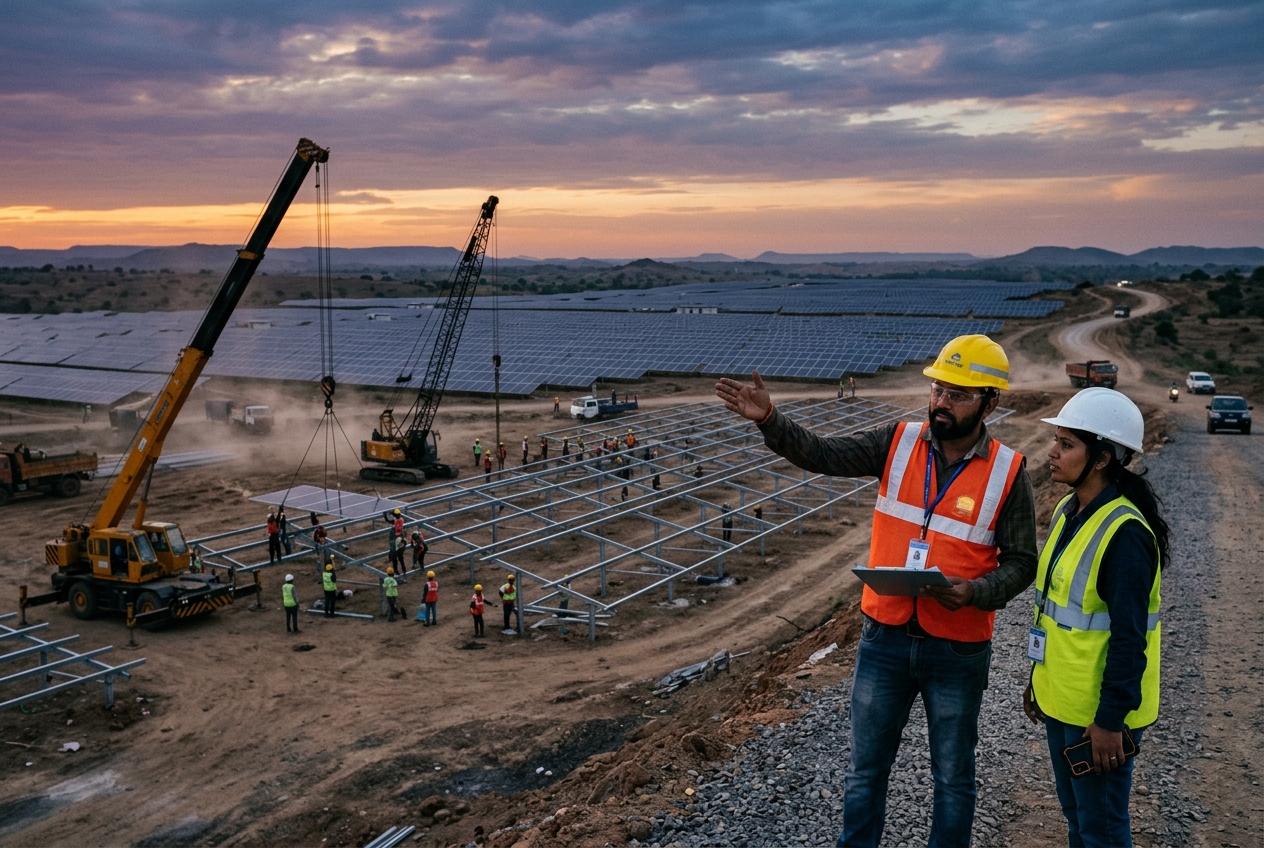
India’s solar market in 2026 is no longer only about building new capacity. It is also about fixing, upgrading and extending the life of plants commissioned between roughly 2014 and 2020, especially assets facing underperformance, inverter obsolescence, rising outage rates, SCB failures, module mismatch, and changing grid-code expectations. For developers, C&I owners, lenders and utilities, solar repowering has become a serious EPC and asset-management topic.
Repowering is not the same as routine O&M. It means a structured technical and commercial intervention to recover yield, improve availability, remove chronic failures, increase export stability, and in some cases add capacity within the same land and evacuation envelope. In India, this discussion is especially relevant because older projects were built under earlier module watt classes, earlier string-voltage windows, older central inverter architectures, and less mature quality controls than what is standard in 2026.
This article explains when repowering makes sense, what EPC scope typically changes, how ALMM and policy constraints affect equipment selection, where BESS retrofit fits, and how lenders should assess the risk-reward case.
Why solar repowering is rising in India in 2026
The first large cohort of Indian solar assets is now old enough to show a clear gap between original P50 assumptions and actual operating reality. That gap often comes from cumulative issues rather than one dramatic failure.
Typical triggers include:
- module degradation above warranted curves due to PID, backsheet cracking, hot spots or encapsulant browning
- central inverter obsolescence and weak OEM service support
- repeated SCB and DC cable failures in harsh thermal environments
- low CUF relative to peer plants in the same irradiation zone
- chronic clipping or poor DC design choices from older ILR strategies
- tracker retrofits considered for fixed-tilt assets only in rare, site-specific cases
- evacuation constraints that make energy-shifting or ramp support valuable
- tariff pressure in C&I portfolios where every recovered kWh improves savings economics
In practical terms, a 50 MW plant commissioned in 2017 that is delivering 6-10% below adjusted expectation can leave significant money on the table. At a net realised value of Rs 2.8-4.2 per kWh, even a few percentage points of recoverable yield can justify targeted capex if execution risk is controlled.
For C&I projects under captive or group-captive structures, repowering can also protect contracted savings where DISCOM tariffs have moved up and the consumer wants more dependable daytime generation. In open-access settings, better inverter response, forecasting integration and selective BESS retrofit can improve scheduling and reduce curtailment-related value loss.
What repowering actually includes in EPC scope
Repowering is often misunderstood as “replace old modules with new modules.” In reality, that is only one option, and often not the first one. A good repowering programme starts with a plant-wide failure and yield diagnosis before equipment decisions are locked.
A typical diagnostic package should cover:
- six- to twenty-four-month generation analysis normalised for irradiation and outages
- string- and block-level underperformance mapping
- IR thermography, EL testing and sample destructive analysis where needed
- inverter trip history, thermal derating and spare-part support assessment
- DC ohmic-loss review and connector mismatch inspection
- structure integrity and corrosion checks
- HT yard, transformer and protection coordination review
- SCADA data quality audit
- warranty claimability mapping by component and vendor
Only after this stage should the EPC strategy be frozen. In 2026, most Indian repowering mandates fall into one of five buckets.
- inverter replacement without module replacement
- selective module replacement in the worst-performing tables or strings
- DC BOS revamp, SCB replacement and cable re-termination
- plant control, protection and SCADA modernization
- hybrid retrofit with BESS to improve dispatch quality or evacuation utilisation
For example, older 1,000 V central inverter plants may benefit from migration to modern string inverters in specific distributed layouts, but this is not automatically the best answer. AC collection redesign, protection philosophy changes, spare strategy and O&M capability all matter. In some utility-scale blocks, replacing old central inverters with new central units of comparable architecture may be lower risk than full topology change.
Similarly, module repowering can mean selective replacement rather than a full swap. If 8-15% of installed modules account for a disproportionate share of mismatch loss and outages, replacing only damaged or severely degraded populations may have a better payback than complete DC-side renewal.
ALMM, DCR and policy constraints in retrofit decisions
In India, repowering economics cannot be separated from policy compliance. By 2026, ALMM remains central in many procurement decisions, but its relevance depends on project category, offtake structure, subsidy linkage and contractual terms.
Questions to settle early include:
- Is the plant linked to any scheme or procurement condition that requires ALMM-listed modules for replacement?
- Is there a DCR-linked obligation due to a CFA-supported segment, public-sector counterparty or scheme-specific requirement?
- Does the original PPA or financing document restrict changes in technology type, nameplate capacity or OEM profile?
- Will replacing modules change approved design parameters or interconnection documentation?
For rooftop and selected distributed segments linked to CFA or scheme conditions, replacement choices may be narrower than for a pure private C&I asset. For utility-scale projects selling under SECI, NTPC, state bids or legacy PPAs, the repowering team must review change-in-law interpretation, performance guarantee treatment and whether uprating could trigger approvals.
ALMM also affects lead times and price assumptions. In 2026, domestic module supply is more mature than in 2023-24, but not all form factors and technology variants are equally available at short notice. If a plant uses older module dimensions and structure geometry, replacing with current high-watt modules may force clamp-zone review, structure checks, string redesign and inverter window validation.
That is why Procurement & vendor management is not a back-office function in repowering. It is a core technical-commercial workstream. The cheapest replacement module can become expensive if it creates re-engineering, extended shutdowns or non-bankable mismatch conditions.
Module and inverter retrofit choices: where the numbers matter
The repowering decision should be driven by recovered kWh per rupee of capex, not by nameplate enthusiasm. Many owners see today’s 600 W-plus modules and assume a simple capacity increase is the answer. In practice, land coverage ratio, row spacing, structure loading, DC cable sizing, inverter MPPT windows, and sanctioned AC evacuation often limit what is sensible.
A practical 2026 framework is:
- If measured annual degradation is modest, say around 0.6-0.8% but outages are high, prioritise inverter and BOS revamp first.
- If degradation exceeds financial-model assumptions by 2-4 percentage points cumulatively and failure clustering is visible, selective or full module replacement may be justified.
- If inverter unavailability is the main loss bucket, repowering capex may pay back in 3-5 years.
- If module replacement requires major structure rework and AC export cannot increase, yield gain may be too small for full-scale replacement.
Indicative 2026 retrofit cost ranges in India vary widely by scale and scope, but market discussions commonly fall in these broad bands:
- inverter-only revamp: roughly Rs 0.18-0.40 crore per MW
- DC BOS and SCB-heavy revamp: roughly Rs 0.12-0.30 crore per MW
- selective module replacement programme: highly site-specific, often Rs 0.20-0.60 crore per MW equivalent across affected capacity
- full module-plus-inverter repowering: can move toward Rs 0.9-1.8 crore per MW or more depending on extent of redesign
These are not benchmark quotes and should not be used without site diligence, but they illustrate a key point: partial repowering often beats full repowering on IRR.
Technology choice in 2026 also needs realism. TOPCon modules dominate many procurement conversations, while HJT appears in select premium or niche cases. For retrofit projects, however, the best module is not simply the highest-efficiency option. It is the one that fits the electrical window, mechanical envelope, warranty confidence, degradation profile, and procurement timeline of the existing asset.
On inverters, modern string platforms offer better granularity, faster fault isolation and easier expansion in many layouts. But plants with centralized AC design, large block capacities and constrained shutdown windows may still favour central inverter replacement. The answer is engineering-specific, not ideology-driven.
When BESS retrofit makes sense for an operating solar plant
BESS retrofit is one of the most interesting repowering pathways in 2026, especially where the solar plant itself is technically sound but monetisation is weak due to curtailment, scheduling mismatch or contracted load shape.
A battery does not fix a badly designed solar plant. It can, however, materially improve asset value in certain use cases:
- open-access and C&I portfolios with high evening tariff offset value
- plants facing intra-day curtailment or ramp-rate constraints
- feeders where export smoothing helps grid acceptance
- campuses or industrial consumers seeking backup and demand optimisation alongside solar
- hybrid tenders or bilateral structures where dispatchability commands a premium
In Indian C&I cases, even a 0.25-0.5 hour battery sized to a fraction of solar AC capacity can solve specific commercial problems without turning the project into a full merchant arbitrage play. For example, a 10 MW AC solar plant adding 5 MW / 10 MWh BESS may improve self-consumption alignment, reduce export spill in constrained windows, and support continuity for critical loads.
For utility-facing assets, the case depends on tariff design, offtake flexibility, scheduling rules and the value of firming. The EPC challenge is integration: EMS logic, inverter compatibility, metering architecture, protection coordination, and augmentation planning. This is where BESS system integration and Testing, commissioning & handover become critical specialist scopes rather than optional add-ons.
Lender and investor diligence for repowering projects
Lenders should not underwrite repowering based only on OEM brochures or headline yield improvement claims. The diligence standard should be closer to acquisition-quality technical review.
Priority diligence items include:
- root-cause separation between degradation, outage loss, soiling, curtailment and data gaps
- proof that proposed equipment is electrically and mechanically compatible
- shutdown planning and generation-loss estimate during revamp
- warranty continuity and responsibility matrix across legacy and new equipment
- updated energy model with P50 and downside cases after retrofit
- spares strategy and O&M capability for mixed-technology fleets
- contract structure for LDs, availability guarantees and performance testing
One common mistake is assuming that new modules or new inverters automatically reset plant risk. In reality, repowered plants can inherit old-cable weaknesses, old-transformer stress, poor earthing, and legacy SCADA blind spots unless the EPC scope addresses them explicitly.
From a financing perspective, the strongest cases are usually those where:
- baseline losses are well evidenced
- the retrofit scope is modular and executable in phases
- generation uplift is measurable within one season
- policy compliance is clean
- OEM support is bankable for at least the remaining debt tail
For some operating portfolios, a phased approach works best: first fix data quality and inverter outages, then replace worst module populations, then consider BESS after actual solar recovery is proven.
Execution strategy: how to repower without creating new EPC risk
The best repowering projects are engineered as live-asset interventions, not as mini greenfield jobs. Outage planning, material traceability, worker safety, and interface control matter more because the plant is already energized and revenue generating.
A sound execution model should include:
- block-wise shutdown sequencing to limit revenue disruption
- pre-approved method statements and switching procedures
- incoming inspection and traceability for replacement components
- IV curve and thermography validation before handover
- revised as-built documentation and updated O&M manuals
- post-repowering performance test over an agreed stabilization period
For older plants, balance-of-plant interfaces are often where hidden surprises sit. Junction boxes, connector families, earthing continuity, corrosion in structures, and degraded trenches can undermine otherwise good retrofit hardware. That is why owners increasingly seek integrated Solar & hybrid plant EPC support rather than piecemeal vendor swaps.
Execution discipline also matters for claim recovery. If old-equipment failure evidence is not documented before removal, warranty and insurance avenues may weaken. Good QA/QC records are commercial assets in a repowering programme, not just engineering paperwork.
The 2026 outlook for Indian solar repowering
Repowering will become a distinct market segment in India over the next three years, especially for early utility plants, underperforming C&I portfolios, and assets where evacuation is in place but energy yield or dispatch quality is lagging. The business case is strongest where owners can unlock more value from existing land, interconnection and permits than from starting over elsewhere.
The winning strategy is rarely “replace everything.” It is usually a targeted combination of diagnostics, selective hardware renewal, controls modernization, and in the right cases, BESS add-on capacity. ALMM, CFA-linked constraints, OEM bankability and shutdown planning will continue to separate bankable projects from expensive experiments.
For developers, lenders and industrial power buyers, the key 2026 question is simple: is the next rupee better spent on a new megawatt or on recovering the hidden megawatt already sitting inside an existing plant? In many cases now, the answer is the latter.
If you are evaluating a solar repowering, inverter revamp, module replacement or battery retrofit case, contact Growthifye’s advisory desk for a plant-specific technical, commercial and execution assessment.
Explore Growthifye's related capabilities
This analysis connects directly to our advisory practice: Solar & hybrid plant EPC · BESS system integration · Balance of system & civil works · Procurement & vendor management.
About the author

Chief Executive Officer, Growthifye — With over 23 years in management consulting, Sudarshan has taken businesses from concept to scale — building and scaling new-age digital and energy businesses.
- 23+ years in management consulting
- EY alumnus
- Led large-scale BESS programmes, capital raises and advisory mandates
Want this analysis applied to your project?
Talk to our team