
India Solar Plant Performance Ratio 2026: EPC Design, Testing and Yield Assurance
By Sudarshan Karweer · sudarshan@growthifye.com · +91 84510 99371 (Call / WhatsApp) · 2026-09-03
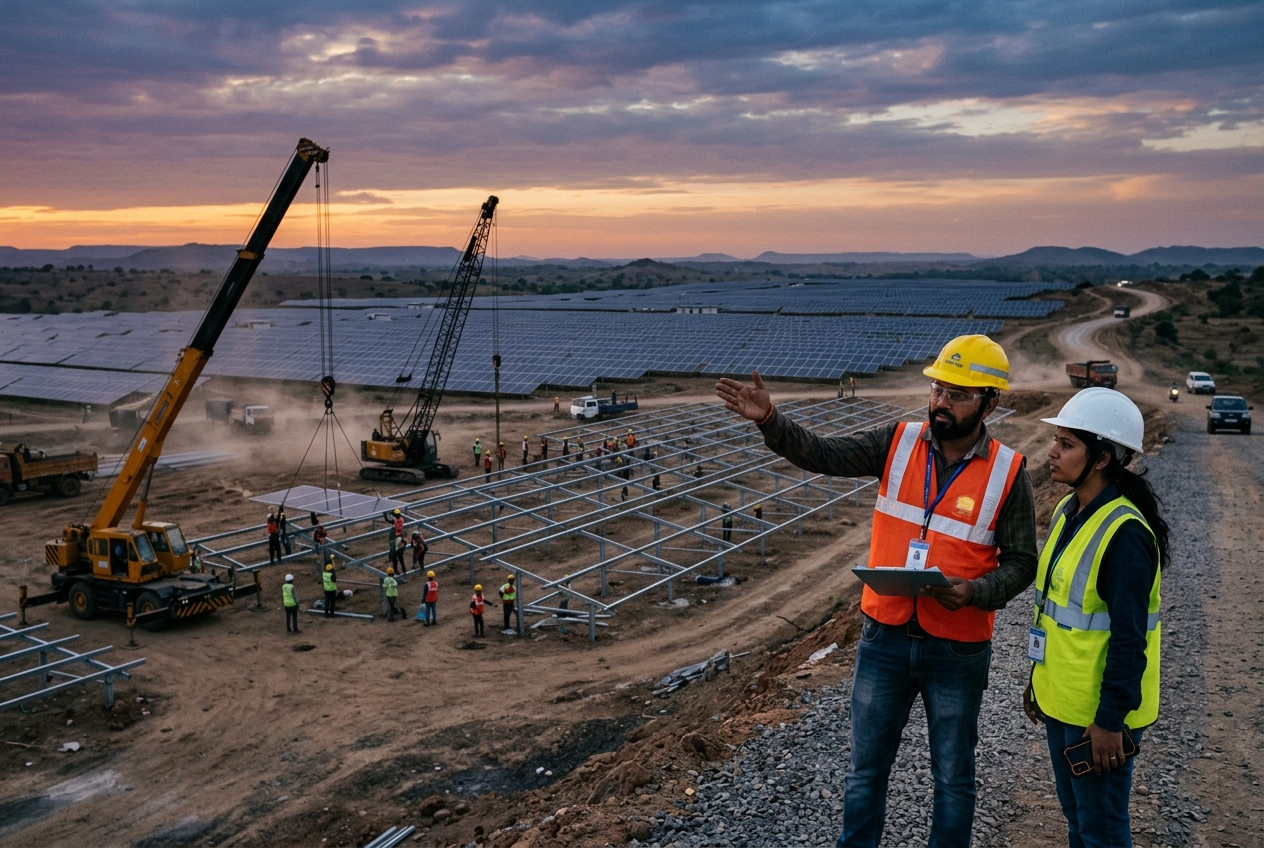
India’s utility-scale and C&I solar market has become far more sophisticated in 2026, but one number still drives oversized claims, missed guarantees and lender discomfort: performance ratio, or PR. Developers use it to benchmark design quality. C&I offtakers use it to compare competing EPC proposals. Lenders use it to test downside cases. Yet many proposals still present PR as a single neat percentage without explaining assumptions on temperature, clipping, soiling, transformer losses, auxiliary loads or grid outages.
For Indian solar projects, PR is not just a reporting metric. It is a practical tool that connects engineering choices to annual generation, contractual guarantees and debt service confidence. A 1.0% to 1.5% swing in net PR can materially affect levelised cost of energy, P90 estimates and the economics of open-access and captive projects, especially in states where landed power replacement values remain in the Rs 5.0 to Rs 8.5 per kWh range for C&I consumers after banking, wheeling and cross-subsidy adjustments.
This article explains how Indian developers, C&I buyers, utilities and lenders should assess solar PR in 2026. The focus is not theoretical. It is on EPC design decisions, commissioning discipline, contract structuring and field realities in Indian conditions.
What performance ratio actually means in Indian solar projects
At a basic level, PR measures how efficiently a plant converts available solar irradiation into usable AC energy at the delivery point. It normalises actual output against the theoretical output under measured irradiance. In practice, PR helps answer a simple question: given the sunlight received, how much energy did the plant really deliver after all technical losses?
For Indian projects, that answer depends on where PR is measured and how exclusions are defined.
Common reference points include:
- DC array output relative to plane-of-array irradiation
- Inverter AC output relative to DC generation conditions
- Plant export at pooling substation or interconnection point
- Net export after auxiliaries and station consumption
This distinction matters. One EPC contractor may quote a PR at inverter terminals excluding transformer and evacuation losses. Another may quote PR at the HT interconnection meter including those losses. The second number will naturally look lower even if the plant is better engineered.
In India, well-designed utility-scale fixed-tilt projects commissioned in 2026 often target first-year net PR ranges broadly around 78% to 82%, depending on climate, DC/AC ratio, module temperature behaviour, grid curtailment assumptions and point of measurement. Single-axis tracker projects may show different hourly behaviour, especially where backtracking, wind stow and clipping profiles are significant. C&I rooftop and elevated structures can vary much more because of orientation constraints, cable routing, mismatch and higher operating temperatures.
Any PR discussion without a clear boundary definition is incomplete.
The biggest PR loss buckets in 2026 and the numbers buyers should ask for
PR is the result of cumulative losses, not one single design outcome. Serious bid evaluation should force line-item disclosure of losses. A realistic Indian loss stack in 2026 may include:
- Soiling loss: 1.5% to 6.0% depending on rainfall, dust load, cleaning frequency and water access
- Module temperature loss: often 6.0% to 10.0% depending on state, mounting, wind regime and module technology
- Module mismatch and nameplate tolerance: 0.8% to 2.0%
- DC ohmic losses: 0.8% to 1.8%
- Combiner and connector losses: 0.2% to 0.6%
- Inverter conversion losses: 1.2% to 2.5% depending on loading profile and topology
- MV transformer losses: 0.8% to 1.8%
- AC cable and evacuation losses within plant boundary: 0.5% to 1.5%
- Auxiliary consumption: 0.2% to 1.0%
- Availability-related losses: highly project-specific
- Curtailment and grid outage losses: should usually be separated from technical PR in contracts
The key issue is not the exact number but whether the bid is internally consistent. For example, some proposals present an aggressive PR above 82% for a hot, dusty site in western India while simultaneously assuming a high ILR, significant clipping and minimal soiling. That should trigger immediate scrutiny.
C&I customers comparing tariffs should also check whether promised savings are based on gross generation or net billable export after all losses and state-specific charges. In open-access projects, a 1% PR miss can become materially larger in financial impact when banking restrictions, time-of-day settlement and grid support charges are applied.
How EPC design choices move PR up or down
PR is heavily shaped before procurement starts. Several engineering choices influence it materially.
First, module operating temperature. In hot Indian climates, rear-side ventilation, mounting height, row spacing and local wind flow affect actual cell temperature. Modules with superior temperature coefficients can narrow summer losses, but only if the mounting system and site layout avoid unnecessary heat build-up. Elevated industrial rooftops, low-clearance sheds and dense layouts often underperform optimistic simulations.
Second, DC cable architecture. Longer homeruns, poor string grouping and undersized cable selection raise ohmic losses. In large utility projects, careful string routing and combiner placement can save 20 to 40 basis points of annual yield. Those gains are real and financeable over project life.
Third, inverter loading strategy. A high DC/AC ratio may improve annual energy monetisation in some states, but clipping increases during high-irradiance windows. If the exported tariff is flat and afternoon prices are not materially higher, controlled clipping can be acceptable. But if a project relies on late afternoon commercial loads or time-sensitive settlement, clipping economics must be reviewed together with PR and revenue assumptions.
Fourth, transformer and evacuation design. Poorly optimised MV collection layouts, repeated voltage transformation and long AC cable runs can quietly erode PR. This is especially relevant in large plants where the cheapest equipment arrangement on capex can be weaker on lifetime yield.
Fifth, shading and row design. On constrained land parcels, aggressive GCR targets may save acreage but increase mutual shading and soiling complexity. The PR effect is not uniform through the year. Monthly and hourly loss analysis is more useful than annual averages.
This is where integrated delivery matters. Firms that combine Solar & hybrid plant EPC with Procurement & vendor management are generally better placed to align design assumptions with actual equipment behaviour instead of relying on catalogue values alone.
Why testing methodology matters more than headline PR guarantees
A surprising number of Indian EPC disputes come from test methodology, not from design failure alone. Contracts often include generation or PR guarantees, but the measurement basis is vague. By 2026, sophisticated buyers and lenders should insist on explicit definitions for:
- Performance test duration, such as 72-hour, 7-day or 30-day windows
- Meteorological data source and sensor calibration standards
- Plane-of-array versus GHI usage
- Data filtering rules for low irradiance conditions
- Exclusions for grid outages, curtailment and force majeure
- Target delivery point for energy measurement
- Temperature correction methodology
- Degradation treatment for first-year acceptance versus long-term guarantee
Testing under unstable monsoon conditions or with poorly calibrated sensors can produce distorted PR calculations. Equally, testing immediately after rain-cleaned conditions may flatter results compared with normal site operation. A robust acceptance framework should combine initial performance testing with post-COD verification based on a longer operational dataset.
Independent engineer review is also becoming more important for financed projects. Lenders increasingly want confidence that guaranteed PR is not achieved by narrowing test windows or excluding recurring operational realities.
A credible acceptance regime usually includes:
- Factory and site acceptance checks for major equipment
- Infrared thermography and IV-curve sampling
- Torque, termination and insulation resistance checks
- SCADA point validation and meter reconciliation
- Inverter performance verification across loading bands
- Transformer and protection system testing
- Final integrated plant run before handover
That is why Testing, commissioning & handover should never be treated as a closing formality. It is the bridge between design intent and bankable operations.
PR, availability and generation guarantees are not the same thing
Indian project contracts still mix up three different concepts: PR guarantee, availability guarantee and energy generation guarantee. Each serves a different purpose.
PR guarantee indicates technical conversion efficiency under defined conditions. It is useful for assessing design and construction quality.
Availability guarantee reflects whether equipment and systems are operational when needed. It is influenced by spare parts, O&M capability, protection coordination and response times.
Generation guarantee goes further and ties the project to actual energy output over a period. It depends on resource conditions and often includes meteorological normalisation or exclusion events.
For a lender, relying only on PR can be risky. A plant may demonstrate decent PR during sunshine hours but still lose annual export due to transformer trips, SCADA integration issues, repeated inverter downtime or grid evacuation bottlenecks. For a C&I buyer, contractual savings depend on delivered units, not just good conversion efficiency during filtered test conditions.
A strong 2026 EPC and O&M framework should therefore align:
- PR guarantee for technical quality
- Availability guarantee for operational reliability
- Generation estimate methodology for financial planning
- Liquidated damages that are measurable and enforceable
In state markets with volatile open-access charges or tighter banking conditions, this alignment becomes even more important because lost units are not always recoverable later.
What lenders and developers should look for in PR assumptions
From a financing perspective, PR feeds directly into P50, P75 and P90 generation cases. Overstated PR can weaken DSCR resilience and create avoidable refinancing pressure later. Developers seeking competitive debt in 2026 should expect lenders to interrogate assumptions around loss stacking, degradation, curtailment and operational readiness.
Questions that deserve clear answers include:
- Is soiling based on local operating evidence or generic software defaults?
- Does the thermal model reflect actual site wind conditions and mounting geometry?
- Are clipping losses calculated hourly or through simplified annual assumptions?
- Are inverter efficiency curves matched to expected loading bands?
- Are transformer no-load and load losses included correctly?
- Is PR measured before or after auxiliary consumption?
- Are grid outages excluded from PR but captured elsewhere in downside cases?
- Do degradation assumptions match module warranty structure and field conditions?
For merchant-exposed or partially merchant projects, even small differences in afternoon output profile can affect realised tariffs. Therefore, lenders increasingly examine not just annual PR but seasonal and hourly production quality.
Developers should also avoid the temptation to promise headline PR numbers that procurement quality cannot support. ALMM-compliant sourcing, lot traceability, incoming inspection, electroluminescence testing where appropriate and disciplined installation practices now matter more because module and inverter supply chains remain dynamic. A weak batch, poor crimping quality or inconsistent structure tolerances can quietly erode field PR long before visible failure occurs.
This is where QA/QC & HSE enforcement has direct yield value, not just compliance value. Better installation discipline reduces mismatch, hot spots, grounding errors and repeat outages.
A practical 2026 checklist for C&I buyers and utilities
If you are evaluating a solar EPC proposal in India today, use this PR checklist before comparing tariffs:
- Ask for a detailed loss diagram with every assumption quantified
- Confirm the exact PR measurement point and exclusion events
- Review monthly generation, not only annual totals
- Compare thermal assumptions against local climate and mounting type
- Check DC and AC loss assumptions against actual layout distances
- Verify clipping assumptions against the proposed DC/AC ratio
- Separate technical PR from grid outage and curtailment effects
- Ensure acceptance testing methods are contractually defined
- Align PR guarantee with availability and generation remedies
- Request evidence from similar commissioned plants in comparable states
For utilities and policymakers, more standardised disclosure on PR methodology would improve bid comparability and reduce post-commissioning disputes. As subsidy-linked and CFA-linked distributed solar programs expand, clear output metrics also help ensure public support delivers real energy, not just installed capacity.
In 2026, the best solar projects are not the ones with the highest claimed PR on paper. They are the ones where design assumptions, procurement quality, installation discipline and test methodology are coherent from day one. A realistic PR backed by sound engineering is more valuable than an inflated number that cannot survive one summer, one dust season or one lender audit.
If you are planning a new solar or solar-plus-storage project and want independent support on design review, EPC strategy, loss assumptions, vendor selection or commissioning readiness, contact Growthifye’s advisory desk. Our team helps developers, C&I buyers and financiers turn performance assumptions into bankable project outcomes.
Explore Growthifye's related capabilities
This analysis connects directly to our advisory practice: Solar & hybrid plant EPC · BESS system integration · Balance of system & civil works · Procurement & vendor management.
About the author

Chief Executive Officer, Growthifye — With over 23 years in management consulting, Sudarshan has taken businesses from concept to scale — building and scaling new-age digital and energy businesses.
- 23+ years in management consulting
- EY alumnus
- Led large-scale BESS programmes, capital raises and advisory mandates
Want this analysis applied to your project?
Talk to our team