India Solar Module Technology 2026: ALMM, DCR, Degradation and EPC Yield Guide
By Sudarshan Karweer · sudarshan@growthifye.com · +91 84510 99371 (Call / WhatsApp) · 2026-09-02
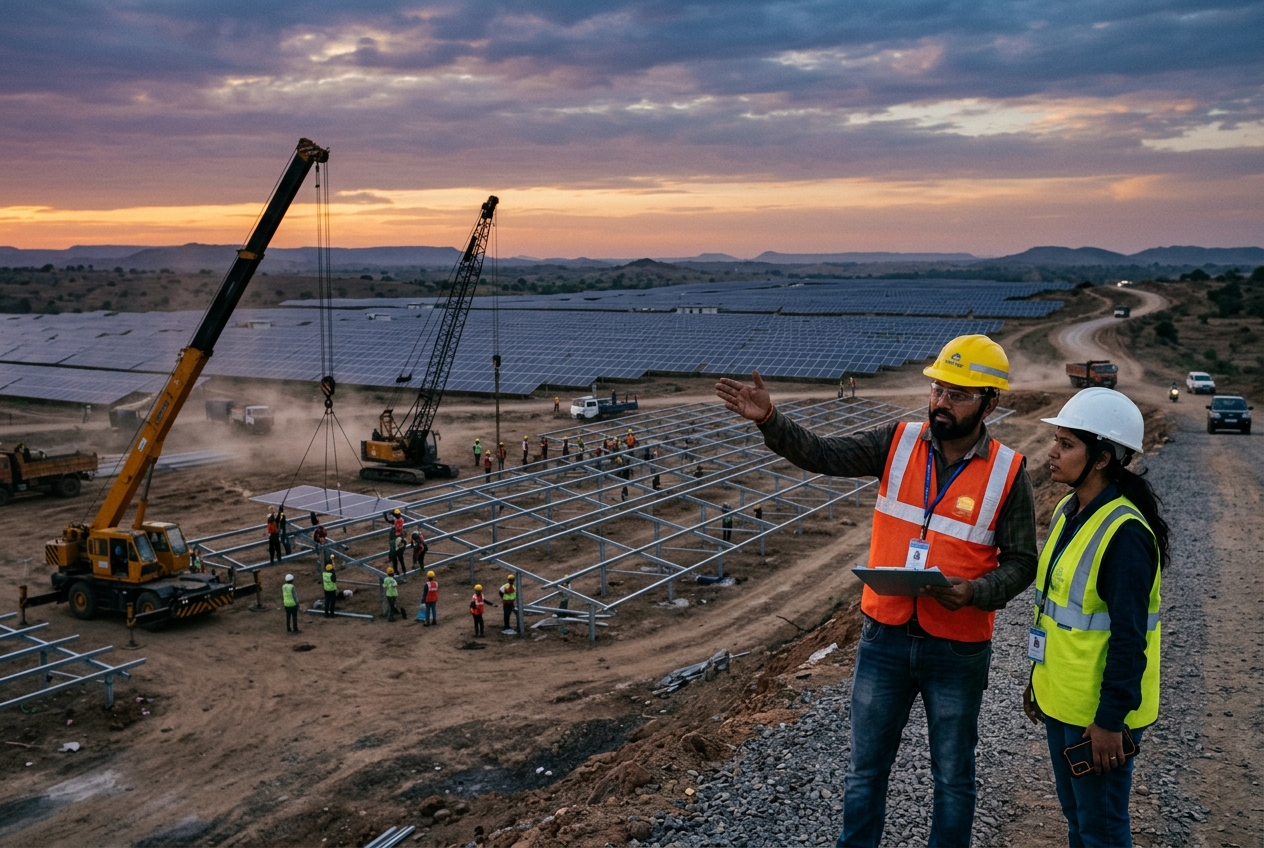
India’s utility-scale and C&I solar market in 2026 is no longer choosing modules on headline watt-peak and lowest landed price alone. Module technology has become a bankability, execution and long-term yield decision shaped by ALMM compliance, DCR-linked subsidy structures, accelerated delivery schedules, warranty quality, degradation assumptions, and India-specific site conditions such as heat, humidity, dust, wind and soiling.
For EPC contractors, developers, open-access consumers, lenders and utilities, the module package now influences everything from DC design and structure loading to insurance terms, spare philosophy, O&M planning and debt sizing. A 20–35 paise/kWh revenue difference over asset life can come from module selection and quality discipline alone, especially when projects are running tight tariffs, high debt and aggressive CUF assumptions.
This article focuses on a topic different from inverter sizing, BOS, QA/QC and commissioning: how to choose solar module technology in India in 2026 with a practical lens on ALMM, DCR, degradation, bifaciality, quality control, warranties and execution risk.
Why module choice matters more in 2026
India’s solar module market has matured, but procurement complexity has increased.
A project team today must evaluate:
- ALMM listing status and exact product-family eligibility
- DCR requirement if linked to certain government support or program conditions
- Cell and wafer supply-chain concentration risk
- Nameplate power class versus actual operating energy yield
- Temperature coefficient under high ambient Indian conditions
- Bifacial gain realism versus brochure assumptions
- Mechanical loading, hail resistance and tracker compatibility
- PID, LeTID and UV durability behaviour
- Warranty enforceability and manufacturer balance sheet strength
- Delivery lead times and lot-to-lot consistency
- Insurance and lender acceptance
In 2026, the spread between the cheapest and most bankable module option can easily be 1.5–3.5 Rs/Wp depending on format, origin mix, DCR requirement, and project timeline. On a 100 MW plant, that is a capex difference of Rs 15–35 crore. However, a cheaper module that underperforms by just 1.5–2.0% on actual annual yield, or causes replacement and claim friction, can erase that saving quickly.
This is why serious sponsors now treat module selection as a techno-commercial optimisation problem rather than a procurement auction alone.
The module technologies Indian buyers are actually comparing
By 2026, the mainstream Indian market is centered around N-type TOPCon products, with HJT present in selective premium applications and P-type PERC largely limited to legacy inventory, cost-sensitive niches, or older approved configurations.
The practical comparison in India usually looks like this:
- P-type PERC
- - Lower entry price in some cases
- - More familiar long-term field history
- - Typically weaker efficiency and degradation profile than top-tier N-type alternatives
- - Increasingly less preferred for new utility and high-quality C&I projects
- N-type TOPCon
- - Market default for many 2026 utility and C&I procurements
- - Better low-light and high-temperature performance than many older PERC offerings
- - Lower first-year degradation in many bankable data sheets
- - Broad availability across ALMM-listed suppliers
- - Often the best balance of cost, efficiency and supply depth
- HJT
- - High efficiency and good temperature behaviour
- - Can be attractive where land is constrained or balance-of-system savings matter
- - Often commands premium pricing
- - Supply depth and replacement matching should be checked carefully
- Bifacial glass-glass modules
- - Common in utility-scale and many ground-mount C&I applications
- - Improved durability perception and backside gain opportunity
- - Heavier modules affect structure, handling and installation planning
- - Actual energy upside depends heavily on albedo, row geometry and cleanliness
- Monofacial modules
- - Still relevant for rooftop, low-clearance and reflective-loss-limited environments
- - Simpler yield estimation in some use cases
- - Lower complexity where backside contribution is negligible
For many Indian projects, N-type bifacial glass-glass is now the default benchmark. But “default” should not mean automatic. Rooftop dead load limits, windy sites, weak soil, tracker torque tube constraints, and replacement standardisation may justify a different choice.
ALMM, DCR and procurement strategy: where many projects go wrong
The Approved List of Models and Manufacturers remains central to public-sector, government-linked and many risk-sensitive procurements. In 2026, module eligibility checking cannot stop at the manufacturer name. Teams must verify the exact listed model series, power class, factory source and validity status relevant to the bid or project requirement.
Common execution mistakes include:
- Assuming all modules from an ALMM-listed company are automatically acceptable
- Ignoring difference between listed module family and offered variant
- Locking project schedules before confirming dispatchable volumes from the approved plant
- Missing DCR implications on subsidy or scheme qualification
- Substituting power classes late and triggering redesign of strings, structures or land-use assumptions
For CFA-linked rooftop and selected government-supported segments, DCR conditions can materially alter vendor choice and cost. DCR-compliant modules may carry a premium, but the net project economics can still improve if subsidy capture is secured and timeline risk is reduced.
Developers and C&I buyers should therefore build procurement in three filters:
- Compliance filter
- - ALMM, DCR, BIS, IEC certifications, traceability, factory audit status
- Execution filter
- - Lead time, logistics readiness, module packaging, lot consistency, replacement support, after-sales response
- Lifetime value filter
- - Degradation guarantee, operating efficiency, temperature coefficient, breakage profile, warranty credibility
This is where Growthifye’s Procurement & vendor management capability can reduce costly late-stage changes, especially for portfolios combining rooftop, ground-mount and hybrid configurations.
Efficiency is not yield: temperature, bifaciality and degradation are the real battleground
Indian buyers often overpay for nameplate watts without properly valuing operating behaviour. Two modules with similar STC power can produce meaningfully different annual energy in Rajasthan, गुजरात, Maharashtra, Tamil Nadu or Telangana because actual field performance depends on more than front-side efficiency.
The parameters that matter most in 2026 are:
- Temperature coefficient of Pmax
- - In hot Indian sites, a better coefficient can improve midday generation retention
- - A difference of 0.03 to 0.05% per degree C matters over annual energy
- First-year degradation
- - Many premium N-type products now quote around 1.0% or even lower first-year degradation, versus older assumptions closer to 2.0%
- - Lenders should test whether these claims are conservative and independently supportable
- Annual linear degradation thereafter
- - Typical market assumptions now range roughly from 0.30% to 0.45% per year depending on product class and supplier bankability
- - That spread materially affects year-15 and year-25 revenue
- Bifaciality factor and backside gain
- - Brochures may suggest strong upside, but real Indian gain can vary from around 3% to 8% in many practical sites
- - High-albedo surfaces, elevated structures and disciplined cleaning can push results higher
- - Dense layouts, poor rear clearance and cable/shadow clutter suppress gains
- Low irradiance behaviour
- - Relevant in monsoon-prone states and shoulder-hour generation profiles
A realistic utility-scale example illustrates the stakes. Suppose two module options for a 50 MW AC plant differ by 1.8 Rs/Wp in DC capex, with about 65 MWp DC installed. The cheaper option saves roughly Rs 11.7 crore upfront. But if the premium module delivers even 1.7% higher net annual yield and 0.10% lower annual degradation over 25 years, at a realised tariff or value of around Rs 3.2–4.0/kWh, the lifecycle energy benefit can exceed the upfront saving depending on CUF, curtailment and discount rate.
In C&I open-access projects where delivered power offsets retail-equivalent tariffs of Rs 5.5–8.5/kWh, the lifetime value of superior yield is even more pronounced.
What lenders, insurers and serious offtakers now ask in module diligence
By 2026, bankability review is more granular. It is no longer enough to submit a glossy data sheet and a 30-year performance warranty.
Lenders and sophisticated offtakers increasingly ask for:
- Manufacturer audited financials and scale of operations
- Factory location mapping and supply-chain resilience
- Historic field performance in India or comparable climates
- Third-party test evidence for PID, damp heat, thermal cycling, UV and mechanical load
- Electroluminescence and flash-test acceptance protocol
- Warranty claim process, response SLAs and local service presence
- Batch traceability from cell to module serial number
- Container loading and transit damage controls
- Replacement compatibility if watt classes change after 3–5 years
Insurance underwriters also care about breakage rates, hotspot history, glass quality, frame robustness and storm survivability. For coastal and high-humidity regions, corrosion durability and junction box reliability deserve extra attention.
This is where many smaller developers are exposed. They negotiate an attractive module rate, but do not secure a robust technical schedule in the supply contract. When underperformance or visual defects appear, they discover that commercial leverage has already weakened.
At minimum, supply contracts should clearly define:
- Approved bill of materials and no-change rules without buyer consent
- Positive power tolerance commitment
- Flash-test data and serial-level traceability delivery
- EL testing thresholds pre-dispatch and at site receipt
- Breakage allowance and replacement timeline
- Packaging standard and unloading responsibility matrix
- Performance LD framework where applicable
- Warranty backstop and dispute jurisdiction
EPC implications: structures, handling, quality and commissioning
Module technology decisions directly affect EPC design and site execution. A switch from a lighter monofacial format to a large-format bifacial glass-glass panel is not a procurement footnote. It can affect pile design, rail selection, clamp zones, installation productivity, DC cable routing and crane/manual handling plans.
Key EPC checks include:
- Mechanical dimensions and tracker/fixed-tilt compatibility
- Module weight impact on rooftop and elevated structures
- Clamp location compliance with manufacturer requirements
- Torsional and wind-load impact for larger area modules
- Pallet handling and internal transport route planning
- Increased breakage risk if labour training is weak
- Junction box orientation and cable dressing implications
- String design updates if Voc and temperature behaviour differ
For rooftop C&I, dead-load limits and maintenance walkway constraints can dominate the technology decision. For ground-mount plants, larger modules may save on structure and wiring quantities per MWp, but those savings disappear if breakage rises during installation or if uneven terrain slows mounting.
Disciplined QA on modules should include:
- Pre-dispatch factory inspection
- Sampling-based EL and flash-test review
- Receipt inspection for glass, frame, label and connector damage
- Serial number reconciliation with packing list and approved BOM
- Storage protocol to avoid moisture ingress and mishandling
- Post-installation EL sampling where project economics justify it
- IR and IV curve testing during commissioning
Growthifye supports this through Solar & hybrid plant EPC and QA/QC & HSE enforcement, especially where owners need tighter control over vendor interfaces and handover quality.
How to choose the right module for each Indian project type
There is no universal best module. The right answer depends on use case.
For utility-scale ISTS/intrastate projects:
- Prioritise ALMM certainty, supply depth and lender comfort
- Use realistic bifacial gain assumptions, often not brochure-max values
- Focus on degradation, temperature coefficient and long-term replaceability
- Stress-test delivery schedule against commissioning milestones and PPA deadlines
For C&I open-access ground-mount projects:
- Compare lifecycle energy value against slightly higher module capex
- Consider higher-efficiency N-type products where land or evacuation is constrained
- Evaluate whether better yield supports stronger savings versus grid tariff
For industrial rooftop projects:
- Weight, dimensions, access logistics and roof geometry matter more than brochure efficiency alone
- Monofacial or lighter formats may outperform on implementation practicality
- Fire safety, cable routing and O&M access should influence final selection
For subsidy-linked or DCR-sensitive projects:
- Confirm exact compliance requirement before freezing BOM
- Do not assume later substitution will be accepted
- Compare net economics after subsidy/CFA, not module price in isolation
For hybrid solar-plus-storage plants:
- Match module degradation and generation profile assumptions with storage dispatch case
- Overstated backside gain or understated degradation can distort BESS sizing economics
A practical shortlist scorecard should assign weights across:
- Compliance
- Delivered cost
- Annual yield
- Degradation
- Bankability
- Mechanical/EPC fit
- Warranty support
- Lead time
This approach is far more robust than choosing solely on lowest Rs/Wp.
The 2026 outlook: what buyers should expect next
Three trends are likely to define module selection in India through 2026 and beyond.
First, N-type standardisation will deepen, but not all N-type products will be equal. Buyers should expect larger differentiation on quality consistency, degradation credibility and service response rather than just efficiency.
Second, domestic manufacturing scale-up will improve supply confidence, but project teams must continue checking exact ALMM/DCR fitment and actual dispatch capability. Policy alignment does not eliminate factory-level execution risk.
Third, lenders and sophisticated C&I buyers will increasingly price technical underperformance risk into financing and contracting. Module selection will therefore become more integrated with EPC diligence, revenue modelling and O&M strategy.
In short, the smartest Indian projects in 2026 will not be those that bought the cheapest module. They will be the ones that bought the most appropriate, compliant and bankable module for the site, tariff and financing structure.
If you are evaluating module technology, ALMM strategy, DCR-linked procurement, EPC risk or lender-grade yield assumptions for an upcoming project, contact Growthifye’s advisory desk for a practical project-specific assessment.
Explore Growthifye's related capabilities
This analysis connects directly to our advisory practice: Solar & hybrid plant EPC · BESS system integration · Balance of system & civil works · Procurement & vendor management.
About the author

Chief Executive Officer, Growthifye — With over 23 years in management consulting, Sudarshan has taken businesses from concept to scale — building and scaling new-age digital and energy businesses.
- 23+ years in management consulting
- EY alumnus
- Led large-scale BESS programmes, capital raises and advisory mandates
Want this analysis applied to your project?
Talk to our team