
India Solar Module Selection 2026: ALMM, DCR, Degradation and EPC Yield Guide
By Sudarshan Karweer · sudarshan@growthifye.com · +91 84510 99371 (Call / WhatsApp) · 2026-09-02
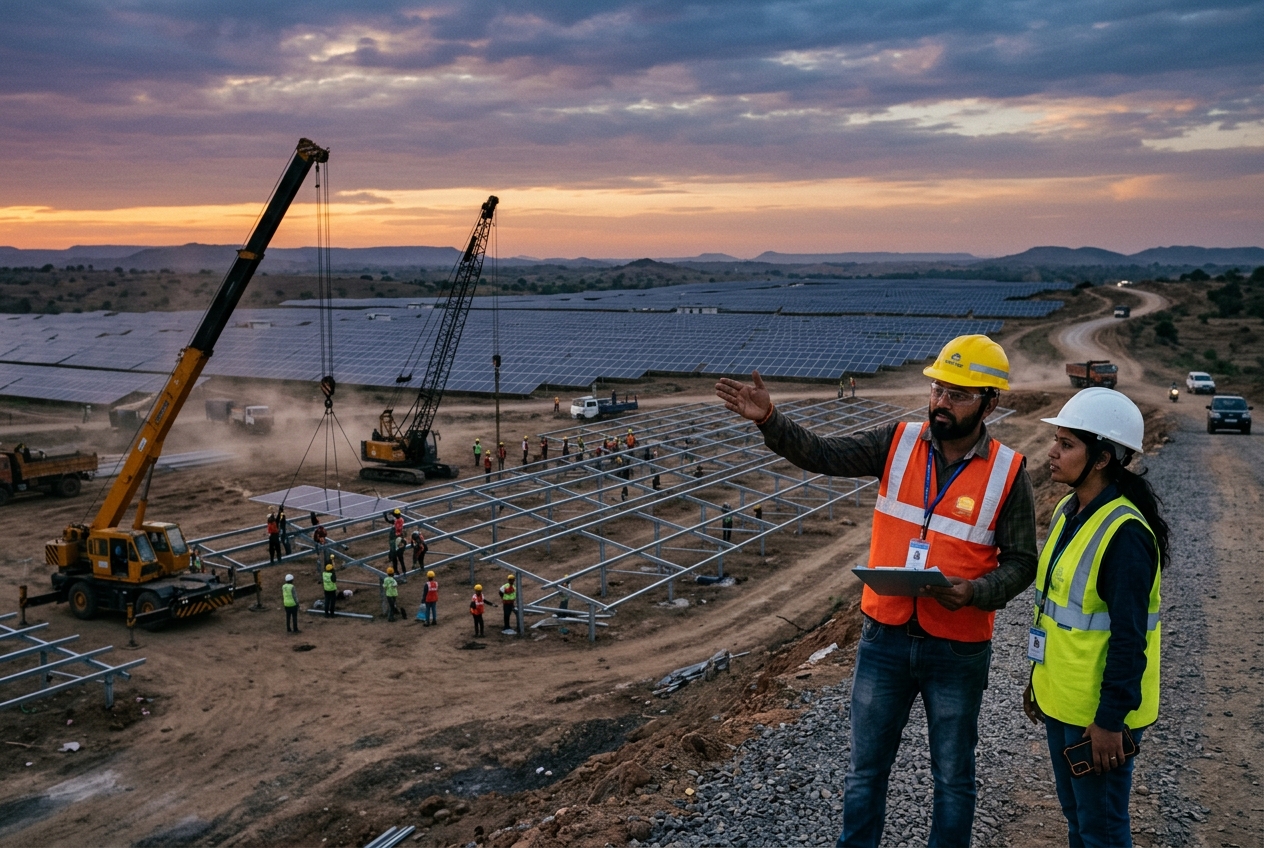
India’s solar market in 2026 is no longer just about getting the lowest Rs/Wp purchase price. Module selection now directly shapes project yield, ALMM eligibility, CFA and DCR pathway, financing comfort, replacement risk, warranty enforceability and even commissioning timelines. For C&I consumers, open-access developers, utility-scale IPPs and lenders, the module decision is one of the highest-impact choices in the entire project cycle.
This is especially true in India, where approved-list compliance, domestic-content conditions in selected schemes, logistics volatility, manufacturer bankability, high-temperature performance and field quality variation all matter more than brochure wattage. A module that looks cheaper by Rs 0.20-0.40/Wp at procurement can easily become more expensive over life-cycle energy if it carries higher degradation, weak low-light performance, less reliable encapsulation, lower bifacial response, or poor after-sales execution.
This guide explains how to evaluate solar PV modules for Indian projects in 2026 from an EPC, yield, compliance and lender-risk perspective.
Why module selection has become a board-level EPC decision in 2026
In many Indian projects, modules account for roughly 45-55% of core plant equipment value, depending on inverter architecture, mounting type and evacuation scope. But their commercial impact is even larger because module characteristics affect:
- Annual specific generation
- Performance ratio and guaranteed CUF
- DC sizing flexibility
- Structural loading and table design
- Cable losses and string design
- O&M cleaning frequency and breakage rates
- Insurance acceptability
- Degradation reserve assumptions in financial models
- Spare strategy and future replacement compatibility
By 2026, the common market offering in India has moved strongly toward n-type TOPCon modules in the 570-720 W class for utility and large C&I plants, while some HJT products are appearing in selected premium applications. P-type PERC has not disappeared, but for new mainstream projects it is increasingly a price-driven choice rather than a future-proof one.
For lenders and serious C&I offtakers, the question is no longer “Which module has the highest wattage?” It is “Which module gives the best bankable kWh over 25 years within ALMM, DCR, warranty and EPC execution constraints?”
ALMM, DCR and scheme-linked compliance: the first screening gate
Before comparing efficiency or degradation, every Indian buyer should start with compliance filters.
For many government-linked projects and a large share of utility-scale procurement, ALMM eligibility remains a critical requirement in 2026. Developers must verify not only that the manufacturer is on the relevant approved list, but that the exact manufacturing facility, product family and applicable certification status match the project requirement at order placement and supply stage. Teams often assume any product from a listed brand is automatically acceptable. That assumption creates avoidable commissioning risk.
Where Central Financial Assistance or scheme-linked domestic content rules apply, DCR compliance becomes equally important. In such projects, the lowest landed module price is irrelevant if the module fails content eligibility. For rooftop, agricultural, feeder-level and selected public-sector opportunities, this can determine whether CFA support is available at all.
In practice, the module compliance diligence checklist should include:
- Current ALMM status of the exact manufacturing line and model family
- BIS certification validity and traceability
- DCR eligibility where the scheme requires domestic content
- Factory location and origin documentation
- Warranty issuer identity and Indian enforceability
- Batch traceability linked to flash-test data
- Compatibility with project technical specifications and lender conditions precedent
Many delayed Indian solar projects in the past two years have not failed because of bad engineering, but because procurement teams locked a module source early and discovered late-stage compliance mismatch, supply slippage or documentation gaps.
This is where disciplined Procurement & vendor management makes a measurable difference, especially for developers managing multiple SPVs or staggered delivery schedules.
Technology choice in India: TOPCon vs HJT vs residual PERC
For 2026 Indian market conditions, n-type TOPCon is the default benchmark technology in most competitive projects. The reason is not just higher nameplate wattage. It is the combination of:
- Lower first-year degradation versus many legacy p-type products
- Better temperature behavior in hot Indian states
- Improved low-light response in morning and evening shoulder hours
- Lower LID and LeTID susceptibility profile relative to older p-type designs
- Stronger long-term energy-retention narrative for lenders
Typical market assumptions used in financial screening today may look like this, though exact values must come from tested product data and conservative bankability review:
- P-type PERC: first-year degradation around 1.5-2.0%, then 0.45-0.55%/year
- N-type TOPCon: first-year degradation around 1.0% or lower, then 0.35-0.45%/year
- HJT: potentially strong temperature and bifacial performance, but often at a price premium and with narrower vendor depth in India
Even a 0.10-0.15% annual degradation advantage can materially improve debt service comfort over a 20-25 year project life, particularly in tightly bid utility PPAs and open-access projects with back-ended merchant exposure.
That said, developers should not assume all TOPCon modules are equal. The 2026 market includes meaningful variation in cell quality, metallization, encapsulation, glass thickness, frame robustness, PID resistance and actual delivered bifaciality. Two modules with identical STC wattage may deliver different field performance and different long-term reliability.
HJT deserves attention in premium land-constrained or high-temperature applications, but current Indian deployment still needs careful scrutiny on price, service ecosystem, availability at scale, and long-term spare compatibility. For most mainstream projects, HJT remains a selective rather than default choice.
The metrics that actually matter beyond module wattage
Indian buyers still over-focus on front-side wattage and under-focus on field-energy metrics. That is risky.
The core technical-commercial parameters to compare are:
- Module efficiency
- Temperature coefficient of Pmax
- Bifaciality factor
- First-year and linear degradation warranty
- Mechanical load rating
- Hail and backsheet or dual-glass durability
- PID resistance
- Fire rating and installation compatibility
- IAM and low-irradiance response where data is available
- Product warranty strength and replacement terms
Temperature coefficient is especially important in India. In states such as राजस्थान, गुजरात, तेलंगाना, महाराष्ट्र, and parts of Madhya Pradesh and Andhra Pradesh, cell temperatures can significantly exceed STC assumptions for long periods. A module with a meaningfully better temperature coefficient can generate more energy in actual field conditions than a nominally similar module with slightly higher STC wattage.
Bifaciality must also be treated carefully. Many procurement discussions still market bifacial gain as a universal 5-10% uplift. In reality, actual gain in India depends on:
- Ground albedo
- Mounting height
- Row spacing and back-side shading
- Tracker or fixed-tilt geometry
- Terrain reflectivity over monsoon and dust cycles
- Cable management and torque tube shading
For typical Indian utility-scale sites, realistic net bifacial gain assumptions may range roughly 3-8%, but only after site-specific modelling. Overstating bifacial gain to justify a higher module price is a common error in financial models.
Another overlooked parameter is module size and weight. Very high-power large-format modules can reduce module count, but they may also influence:
- Table dimensions and pile design
- Manual handling risk at site
- Micro-crack exposure during installation
- Container utilization and unloading time
- Replacement logistics later in life
A module that saves a few paise per watt may add hidden BOS or installation complexity. That trade-off should be quantified, not guessed.
Field quality, warranty reality and lender bankability
In India, module quality risk is often less about technology type and more about manufacturing consistency plus enforceable after-sales support. A technically strong product still becomes a weak asset if the supplier cannot handle claims, batch tracing or timely replacement.
Serious due diligence should go beyond data sheets and include:
- Factory audit findings
- EL imaging at pre-dispatch and site receipt stages
- Flash-test variance review across batches
- BOM consistency controls
- Encapsulant and glass supplier pedigree
- Frame and junction-box quality
- Historical field-failure data
- Insurance acceptance
- Warranty claim process in India
- Financial strength of the warranty provider
Lenders increasingly look for manufacturers with a credible Indian service footprint, not just global shipment volume. For 100 MW+ projects, module bankability memos now often review whether the OEM has:
- Local technical support personnel
- Defined response times
- Spare or replacement inventory strategy
- Long-term business continuity confidence
- Experience with Indian climate conditions
Dual-glass modules are gaining acceptance because of potential durability benefits, but they must be matched to site handling capability and mounting-system compatibility. Thin glass can cut weight, but transport and installation discipline becomes even more important. Inadequate packaging and rough unloading still cause avoidable breakage and micro-cracks on Indian sites.
This is where QA/QC & HSE enforcement during manufacturing surveillance, receipt inspection and installation can protect both yield and warranty position.
Yield modelling for India: use realistic assumptions, not brochure promises
A robust 2026 module selection process should always end in comparative yield modelling. The correct question is not “Which module is cheapest per Wp?” but “Which module gives the lowest levelised delivered kWh under realistic Indian operating conditions?”
A sound comparison typically includes:
- State-specific weather file selection
- Module temperature model suited to mounting configuration
- Soiling and cleaning assumptions based on water availability
- Degradation curves by technology
- Bifacial gain scenario bands
- Mismatch and LID assumptions
- Clipping interaction with chosen inverter design
- Availability and failure-rate assumptions
- Replacement timing sensitivity for failed batches
Consider a simple illustration for a 50 MW AC ground-mounted project in western India. If Module A is cheaper by Rs 0.25/Wp but delivers 0.8-1.2% lower annual generation after adjusting for temperature, degradation and realistic bifacial response, the “cheaper” option may destroy value over project life. At a net realised tariff or displaced power value of around Rs 3.0-4.5/kWh, the NPV loss from under-generation can far exceed the upfront module savings.
For C&I consumers, this matters even more where solar offsets high retail tariffs. If a behind-the-meter or group-captive project replaces power priced at Rs 6.0-8.5/kWh, even a small yield delta becomes financially significant. A module decision should therefore be evaluated against avoided-energy value, not just EPC capex.
Developers should also run downside cases:
- What happens if degradation is 0.1%/year worse than planned?
- What if actual bifacial gain is 2% lower than vendor claim?
- What if 1% of modules need replacement and form-factor matching becomes difficult in year 7?
- What if ALMM-linked resupply options narrow later?
Projects that survive these downside tests are usually the ones that remain resilient during debt raising and operation.
A practical module-selection framework for Indian EPC buyers
For most 2026 projects, the best procurement outcome comes from a weighted technical-commercial scorecard rather than pure L1 pricing. A practical framework may assign weight to:
- Compliance: ALMM, BIS, DCR where relevant
- Energy yield: temperature coefficient, bifaciality, degradation
- Quality: factory controls, EL results, BOM consistency
- Delivery: schedule confidence and logistics execution
- Warranty: product and performance terms, claim process
- Bankability: financial strength and lender acceptance
- EPC fit: dimensions, weight, mounting compatibility, handling risk
- Total cost: landed price plus BOS and life-cycle effects
For public tenders, the commercial structure may limit flexibility, but private C&I and developer-led projects can still embed tighter technical qualifying criteria. That is often the difference between a nominally low capex project and a genuinely high-performing asset.
When module selection is integrated early with Solar & hybrid plant EPC planning, table design, inverter loading strategy, spare philosophy and commissioning documentation become much cleaner. It also reduces change-order disputes and site-level improvisation.
A good decision in 2026 is therefore not “Buy the highest watt module” or “Buy the cheapest ALMM module.” It is “Buy the module that best balances compliance, field yield, warranty enforceability, execution practicality and financing confidence for this specific project.”
What developers, C&I buyers and lenders should do next
As India’s solar market scales, module choice will increasingly separate durable projects from merely commissioned projects. C&I buyers should demand transparent life-cycle comparisons, not one-page vendor pitches. Developers should align procurement with energy modelling, not siloed capex targets. Lenders should push for clearer technology memos, conservative degradation assumptions and stronger supplier due diligence.
In 2026, the winning procurement strategy is disciplined, data-led and India-specific. It recognises that module selection is not a catalogue exercise. It is a core revenue and risk decision with 25-year consequences.
If you are evaluating module strategy, ALMM/DCR compliance, EPC bankability or yield-risk trade-offs for an upcoming solar asset, contact Growthifye’s advisory desk for project-specific guidance.
Explore Growthifye's related capabilities
This analysis connects directly to our advisory practice: Solar & hybrid plant EPC · BESS system integration · Balance of system & civil works · Procurement & vendor management.
About the author

Chief Executive Officer, Growthifye — With over 23 years in management consulting, Sudarshan has taken businesses from concept to scale — building and scaling new-age digital and energy businesses.
- 23+ years in management consulting
- EY alumnus
- Led large-scale BESS programmes, capital raises and advisory mandates
Want this analysis applied to your project?
Talk to our team