India Solar Inverter Sizing & MV Ratio Strategy 2026: EPC, ALMM and Revenue Guide
By Sudarshan Karweer · sudarshan@growthifye.com · +91 84510 99371 (Call / WhatsApp) · 2026-09-01
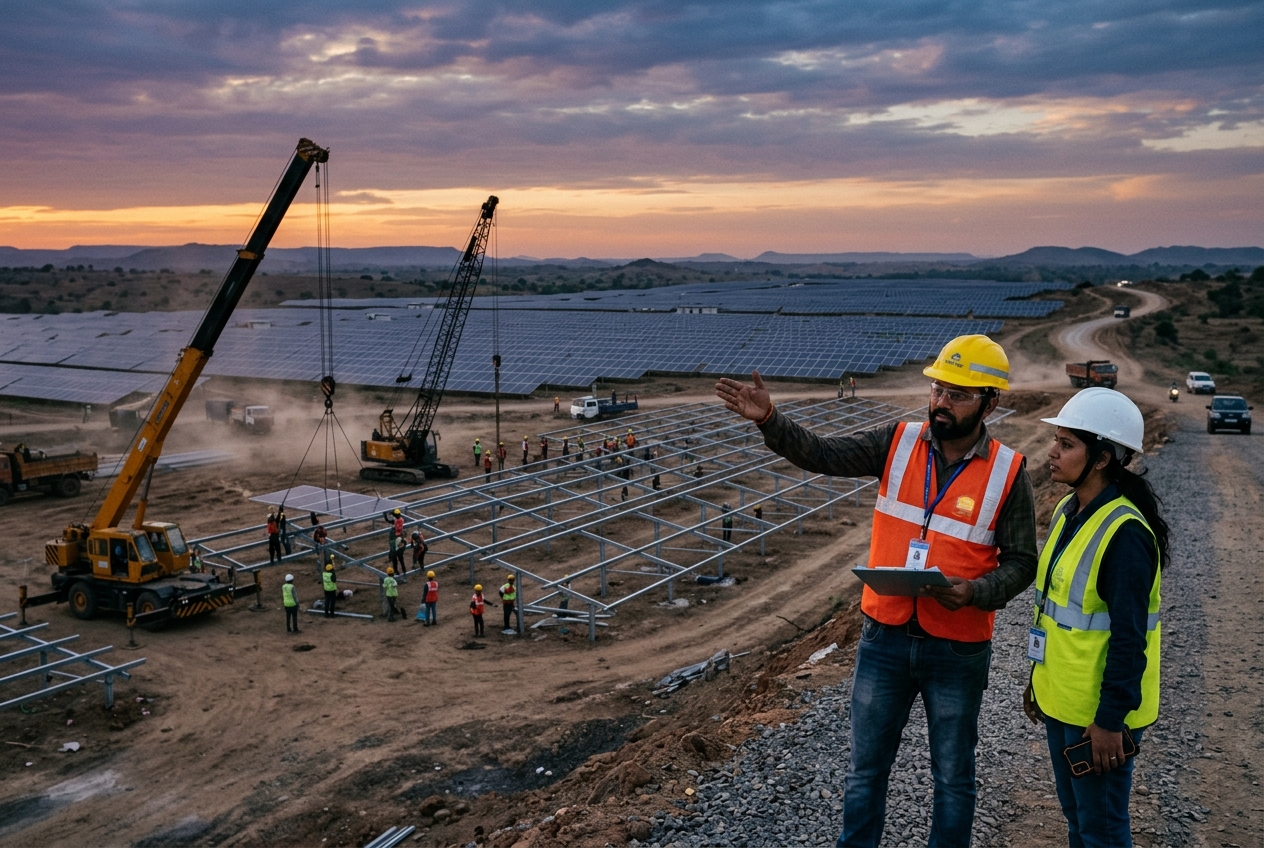
India’s utility-scale and C&I solar market in 2026 is seeing a more mature design conversation around inverter sizing, inverter loading ratio, medium-voltage block architecture and long-term plant bankability. Module prices, ALMM-driven procurement choices, CFA-linked design constraints in some segments, and the rising use of hybrid and storage-ready plants have made inverter strategy a first-order financial decision rather than a late-stage electrical selection.
For developers, lenders and energy consumers, the wrong inverter approach can quietly destroy project IRR through avoidable clipping, poor part-load efficiency, higher auxiliary consumption, reactive-power derating, transformer mismatch, slow service response or weak SCADA visibility. For EPC contractors, inverter selection now has to integrate procurement timing, Indian grid-code compliance, harmonic performance, HT yard philosophy, spares planning and commissioning risk.
This article focuses on a topic distinct from standard AC-coupled BESS and general EPC cost discussions: how to optimise inverter sizing and MV block design for Indian solar projects in 2026, with practical numbers, ALMM considerations and lender-grade decision rules.
Why inverter strategy matters more in 2026
In the Indian market, DC module pricing has moderated compared with the ALMM shock periods, but inverter pricing and availability still show brand-wise dispersion based on domestic assembly, imported power-electronics content, after-sales footprint and warranty bankability. At the same time:
- Many projects are being bid with tighter tariffs and less room for generation underperformance
- State discom interconnection approvals increasingly scrutinise reactive power, ramp-rate and power-quality compliance
- Larger-format modules have pushed string current, combiner philosophy and inverter MPPT planning into a new design regime
- Storage-ready plants require AC-side and control-system choices that should not be locked into dead-end architectures
- Lenders now ask more detailed questions on OEM track record, MTBF assumptions, service SLAs and spares strategy
In practical terms, an inverter decision affects:
- Annual yield and clipping loss
- Grid-code compliance at the POI
- Plant availability and fault recovery time
- Auxiliary energy use
- Land use and cable routing
- Transformer loading margins
- Capex per MWac
- Opex through service agreements and spare holding
- Augmentation flexibility
That means inverter sizing should be treated as a revenue-engineering problem, not just a BoQ line item.
Choosing the right DC:AC ratio for Indian solar plants
The most common shorthand in industry remains the DC:AC ratio, also called ILR. But in 2026, the right answer depends on state irradiation profile, tariff structure, module temperature behaviour, evacuation limit, degradation assumptions and whether the plant is storage-ready.
As a broad market range in India:
- Utility-scale fixed-tilt plants often land between 1.30 and 1.45 DC:AC
- Tracker-based plants commonly sit between 1.20 and 1.35, depending on backtracking and seasonal peak shape
- C&I captive and behind-the-meter plants may use 1.10 to 1.30 depending on sanctioned load, export limits and rooftop or land constraints
- Storage-ready solar plants may intentionally accept slightly higher midday clipping if that energy can later be shifted through BESS in future phases
A useful rule is that ILR should not be fixed before at least these five checks are done:
- Hourly energy simulation using site-specific weather and module/inverter thermal models
- POI export limit and any discom restrictions on injection pattern
- Inverter reactive-power duty at high ambient temperatures
- Transformer loading with harmonic and thermal margins
- Revenue sensitivity to clipping versus extra DC capex
For many Indian sites with strong irradiation and high module operating temperatures, raising ILR from 1.30 to 1.40 does not translate into a proportional rise in clipping because temperature suppresses module output during peak sun hours. In several central and western Indian utility-scale cases, annual clipping in the 1.35 to 1.40 range may still remain around 1.0% to 2.5% of DC energy, while annual net generation gain versus a lower ILR can justify the added DC investment.
However, generic rules are dangerous. In cooler northern states, high-albedo sites or tracker configurations with broader midday plateaus, aggressive ILR can quickly create clipping beyond lender comfort if tariff upside is low. For fixed-price PPAs near INR 2.4 to INR 3.1 per kWh equivalent revenue assumptions, each 0.5% generation error matters. For C&I open-access projects monetising power at blended landed tariffs of roughly INR 4.0 to INR 6.5 per kWh, the economics can support different clipping trade-offs.
Central vs string inverters: what is changing in India
The old framing of central inverter for utility and string inverter for distributed plants is no longer sufficient. High-power string inverters in the 300 kW-plus class have become a serious utility-scale option in India, especially where terrain variation, block-level availability and O&M response are critical.
Central inverter advantages still include:
- Lower equipment count per MWac
- Potentially lower capex in some scale bands
- Simpler AC collection inside the inverter block
- Familiarity among some EPC and utility stakeholders
But central inverter drawbacks remain material:
- Larger single-point outages
- More DC-side aggregation complexity
- Less granular MPPT performance on undulating or mismatch-prone sites
- Heavier cranage and replacement logistics
- Longer restoration timelines if critical subassemblies fail
String inverter advantages in 2026 include:
- Better MPPT granularity with large-format modules and mixed string conditions
- Easier phased installation and commissioning
- Lower generation loss per inverter outage
- Simpler fault isolation and replacement
- Strong fit for storage-ready and hybrid control architectures
The main concerns with string platforms are:
- Higher inverter count and therefore more field devices
- AC-side cable and combiner discipline becomes more important
- Communications and SCADA integration quality varies by OEM
- Outdoor thermal performance and enclosure reliability must be validated carefully
For Indian utility-scale projects in the 25 MWac to 200 MWac range, high-power string architectures are increasingly being selected when land undulation, availability guarantees and maintainability outweigh any nominal capex delta. For flatter sites with highly standardised block layouts, central inverters may still remain competitive.
This is where Procurement & vendor management matters. A good EPC decision should compare not just ex-works price but delivered lifecycle value, including service network density in India, board-level replacement strategy, recommended critical spares, warranty carve-outs and mean time to repair.
MV block architecture: the hidden value driver
Many project teams under-appreciate the financial impact of inverter-to-transformer block design. The number of inverters per transformer, transformer rating margin, LV cable lengths, and MV feeder arrangement all affect technical losses, uptime and construction speed.
In 2026, common utility-scale design choices include:
- 2.5 MW to 6.25 MW AC blocks depending on inverter topology and site layout
- 33 kV collection systems as the dominant architecture for many medium and large plants
- 66 kV or higher evacuation depending on project size and substation interface
What should be optimised?
- Keep DC and AC cable lengths balanced against civil and road layout rather than minimising only one side
- Avoid transformer sizing so tight that reactive duty or ambient conditions force hidden derating
- Check partial-load efficiency, not only peak efficiency
- Review fault-level implications at the MV bus and POI
- Ensure protection coordination from inverter to HT yard is OEM-independent and field-testable
A common issue in Indian plants is selecting an apparent low-cost transformer block that later runs hotter because inverters are expected to provide reactive support at poor grid conditions. If the PPA, interconnection approval or utility code requires operation at, say, 0.95 power factor or a defined reactive capability band, active power export may be constrained unless the inverter and transformer are jointly sized for that duty.
That means nameplate MW is not enough. Teams should verify effective export capability under:
- High ambient temperatures such as 45°C and above
- Dust-loaded conditions affecting cooling
- Grid voltage fluctuation near the POI
- Reactive support operation during weak-grid periods
ALMM, domestic supply chains and bankability checks
Inverter procurement is not governed by ALMM in the same way modules are, but ALMM-linked module choices directly shape inverter design because module current, voltage window, degradation profile and availability influence stringing and MPPT strategy. Many projects in 2026 are pairing ALMM-listed modules with inverter platforms originally optimised around different current classes, leading to avoidable mismatch or design conservatism.
A disciplined tender should therefore ask these questions early:
- What is the maximum operating current per MPPT and per input under worst-case irradiance and temperature conditions?
- Is there any clipping on the DC input side before the AC conversion stage due to current limit?
- Can the inverter accommodate the selected module’s Isc with design margin as per applicable standards and site conditions?
- What are the OEM’s Indian references with similar large-format modules?
- Does the warranty remain fully valid with the proposed string length, environmental conditions and DC oversizing?
Lenders in 2026 also increasingly want visibility on:
- Indian service centre presence
- Spare inverter or spare power-stack strategy
- Cybersecurity provisions for plant controls and remote access
- Historical field failure data in Indian climatic conditions
- Warranty claimant process and turnaround times
This is where QA/QC & HSE enforcement and Testing, commissioning & handover become financially relevant rather than procedural. A good FAT, SAT, pre-energisation check and reactive-power validation can prevent months of underperformance disputes.
Technology trends to watch in 2026
A few inverter and control trends are shaping project decisions in India now:
- Higher current-capable string inverters to match large-format n-type modules
- Improved night-time reactive support and grid-forming readiness in hybrid-oriented platforms
- Better string-level diagnostics for fault detection and availability analytics
- Integrated PID recovery, arc-fault logic and advanced I-V curve diagnostics in some platforms
- Tighter EMS compatibility for future BESS integration
For developers planning phased hybrids, selecting inverters and PPC/SCADA architecture that can later communicate cleanly with storage controllers is often worth more than a small upfront capex saving. Growthifye’s work across Solar & hybrid plant EPC and BESS system integration is relevant here because plant architecture chosen on day one can either simplify or complicate future hybrid augmentation.
Another emerging consideration is warranty-backed operation at elevated DC oversizing ratios. Some OEMs market high oversizing tolerance, but the bankable question is whether annual operating conditions, harmonic performance, thermal cycling and service support actually justify that claim in India’s hot, dusty environments.
A practical decision framework for developers and lenders
For most Indian projects in 2026, the right process is not to chase the lowest inverter rupee-per-watt quote. Instead, teams should run a bankable matrix with technical, commercial and operational scoring.
A practical checklist includes:
- Site weather profile and expected module temperature distribution
- Target ILR based on hourly simulation, not rule-of-thumb
- Central versus high-power string architecture comparison
- Reactive power and grid-code duty at the POI
- Transformer loading and thermal margin review
- DC input current compatibility with chosen module family
- Indian service footprint and spare strategy of the OEM
- Cybersecurity and SCADA integration quality
- Warranty exclusions, liquidated damages interfaces and availability guarantees
- Long-term compatibility with storage or hybrid retrofit
For lenders, it is useful to ask for downside cases under:
- 1% higher-than-modelled clipping
- inverter derating at peak ambient conditions
- one major inverter block outage with delayed service response
- lower-than-assumed reactive export capability
- module substitution within ALMM-compliant procurement constraints
These are not academic stress tests. In a market where debt service coverage can tighten quickly, a modest yield miss or availability shortfall can materially affect repayment comfort.
What good EPC execution looks like
The strongest EPC outcome is achieved when inverter strategy is frozen only after integrated review of DC design, AC collection, HT evacuation, controls and commercial obligations. Too often, developers finalise modules, inverters and transformers in separate silos, then discover late-stage incompatibilities in current limits, cable routing or reactive compliance.
A robust EPC package should include:
- Detailed energy simulations for at least two ILR and inverter architecture options
- OEM-backed thermal and reactive capability curves
- Cable and transformer loss analysis at annual profile level
- Protection coordination studies through to the POI
- Clear FAT, SAT and commissioning test protocols
- Spare parts and service-level obligations written into supply and O&M contracts
In 2026, winning projects are not only those with low capex. They are the ones where design, procurement and commissioning choices preserve exportable energy through the full asset life.
If you are evaluating inverter sizing, MV block architecture, ALMM-linked module compatibility or storage-ready solar design, contact Growthifye’s advisory desk. Our team supports techno-commercial diligence, owner’s engineering and execution strategy to help developers, C&I buyers and lenders make bankable solar EPC decisions.
Explore Growthifye's related capabilities
This analysis connects directly to our advisory practice: Solar & hybrid plant EPC · BESS system integration · Balance of system & civil works · Procurement & vendor management.
About the author

Chief Executive Officer, Growthifye — With over 23 years in management consulting, Sudarshan has taken businesses from concept to scale — building and scaling new-age digital and energy businesses.
- 23+ years in management consulting
- EY alumnus
- Led large-scale BESS programmes, capital raises and advisory mandates
Want this analysis applied to your project?
Talk to our team