
Grid-Forming Inverters for RE Evacuation in India 2026: ISTS Design, Costs, Grid Codes
By Sudarshan Karweer · sudarshan@growthifye.com · +91 84510 99371 (Call / WhatsApp) · 2026-10-26
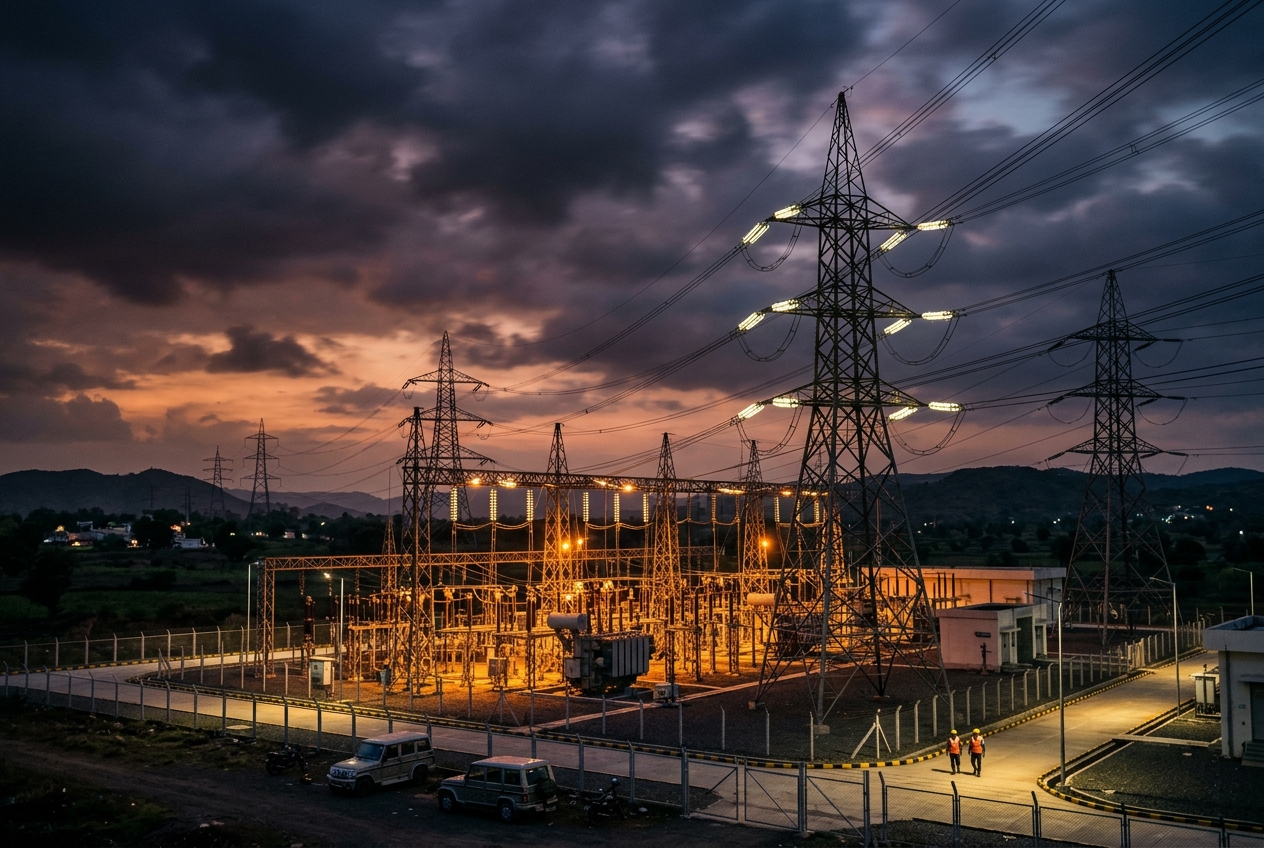
India’s renewable build-out is now colliding with a transmission reality that is more technical than geographic. In 2026, many large solar, wind and hybrid projects are not just asking whether they can secure evacuation capacity under ISTS or a state network. They are asking whether the receiving grid is electrically strong enough to absorb large blocks of inverter-based generation without curtailment, unstable voltage behaviour, control interaction or repeated grid-code non-compliance.
One topic is moving quickly from pilot discussion to mainstream design review: grid-forming inverters, or GFM inverters. For developers, EPCs, lenders and utilities, this is no longer an academic conversation. In weak-grid pockets, renewable parks with high inverter penetration are being evaluated not only on MW injection and N-1 readiness, but also on how they behave during disturbances, low short-circuit strength and fast voltage-frequency excursions.
This article looks at where grid-forming inverters fit into India’s 2026 RE evacuation landscape, how they differ from conventional grid-following designs, the cost implications, the planning triggers for ISTS-connected projects, and what stakeholders should verify before locking project design.
Why grid-forming matters in India’s 2026 evacuation context
India’s transmission expansion is significant, but the pace of renewable addition is forcing many projects into electrically weaker nodes, longer EHV corridors and complex pooling arrangements. The classic evacuation checklist of bay availability, line loading, transformer capacity and connectivity approval is no longer enough.
In several RE-rich regions, the power system is seeing:
- high inverter-based resource concentration at pooling substations
- low system strength during off-peak or high-RE hours
- voltage sensitivity at 220 kV and 400 kV nodes
- oscillatory control interactions across multiple OEM inverters and plant controllers
- tighter scrutiny of dynamic performance during disturbance studies
Conventional inverter-based plants are mostly grid-following. They synchronise to an existing voltage waveform and inject power accordingly. That works well when the surrounding grid is strong and stable. But as short-circuit ratio weakens, a grid-following plant can struggle with phase-locking, voltage support quality and stable current injection during disturbances.
A grid-forming inverter behaves differently. It can establish or support voltage and frequency reference more actively, improving stability in weak-grid conditions. In practice, this can help reduce the risk of non-performance during commissioning and operations in systems with very high renewable penetration.
For India, this matters especially in:
- large solar parks connected through long 400 kV or 765 kV evacuation paths
- wind-heavy western and southern corridors with varying system strength
- hybrid projects with battery energy storage integrated at pooling level
- remote RE zones where the transmission backbone is expanding but local strength still lags generation growth
Grid-following vs grid-forming: what changes for evacuation planning
The difference between grid-following and grid-forming is not marketing language. It changes how planners and owners should think about connectivity risk.
A grid-following plant is generally adequate where:
- short-circuit strength is healthy
- nearby synchronous generation remains available
- there is limited concentration of inverter-based generation at a node
- dynamic studies show good damping and acceptable voltage recovery
A grid-forming-capable plant becomes relevant where:
- the grid is weak or becoming weak during certain operating scenarios
- multiple RE plants are clustered at the same evacuation node
- planners expect reduced synchronous support over time
- battery storage is part of the project or substation-level stability strategy
- dynamic studies show concerns with PLL instability, poor voltage recovery or control interaction
The practical point for developers is this: grid-forming is not automatically required for every project, but ignoring it in a weak-grid location can become expensive later. If a project reaches procurement, interconnection studies or commissioning before these issues are addressed, redesign costs can be material.
In many cases, the question is not whether the entire plant must be grid-forming. It may be enough to deploy a portion of inverter capacity or a co-located BESS in grid-forming mode to improve system behaviour. But that conclusion should come from serious Power system studies, not from a generic OEM brochure.
Where Indian grid codes and planning practice are heading
As of 2026, India’s formal regulations do not universally mandate grid-forming inverters across renewable projects. However, the direction of travel is clear. Grid operators, CTU, STUs and technical committees are paying far more attention to dynamic performance of inverter-based resources, especially at scale.
Relevant context includes:
- CEA Technical Standards for connectivity and plant performance
- IEGC-linked requirements on frequency, voltage and reactive support behaviour
- CERC and CTU processes around connectivity, GNA-linked planning and interconnection studies
- renewable integration studies by central agencies and POSOCO/GRID-INDIA operational experience
In practice, project developers are increasingly being asked for deeper EMT and RMS study evidence, not just load flow and fault calculations. Questions that were once raised only for very large or unusual schemes are now more common:
- How will the plant perform at low short-circuit strength?
- Is the inverter control proven for weak-grid operation?
- What is the expected response during three-phase and single-phase disturbances?
- How will the plant coordinate with STATCOMs, SVCs or substation reactive equipment?
- Can the plant maintain stable operation when nearby inverter-based plants are also controlling aggressively?
For lenders, this is turning into a bankability issue. If a project’s evacuation node is technically weak, the financing risk is not limited to line completion delays. It extends to generation loss, prolonged testing, additional capex and possible curtailment or de-rating.
Cost impact: what developers and lenders should expect
Grid-forming capability does not come free. But it is important to compare its cost against the full cost of poor weak-grid readiness.
In 2026, the incremental capex impact depends on OEM, plant size, controls architecture and whether storage is involved. Indicative market observations for utility-scale Indian projects are:
- inverter package premium for advanced grid-support and grid-forming-capable controls: often around 2% to 6% over a standard utility-scale inverter solution, depending on feature set and tested operating envelope
- additional plant controller, model validation and study costs: roughly INR 0.5 crore to INR 2 crore for a large project, depending on complexity and study scope
- if BESS is included and used for grid-forming support, the economics depend on storage duration and market use case; the incremental value may be justified not only by stability support but also by energy shifting and ancillary-service readiness
At project level, the total adder may translate to roughly INR 0.03 crore to INR 0.12 crore per MW for some configurations, though this range can move significantly based on storage integration, OEM selection and testing requirements.
That needs to be compared with the downside of not planning properly:
- repeated commissioning failures and retesting
- forced installation of additional dynamic reactive support later
- curtailment due to unstable operating limits
- lower CUF realisation for wind and hybrid projects
- delayed COD and liquidated damages exposure
- lender concern over unproven controls in weak-grid conditions
For tariff-sensitive bids, every paisa matters. But the financial question should be framed correctly. If a plant bids at a tariff band around INR 2.45 to INR 3.20 per kWh, depending on technology and tender context, even modest curtailment or prolonged underperformance can erode equity returns more than a well-justified controls premium.
Where grid-forming is most likely to be used first
Not every renewable plant in India will shift to grid-forming architecture immediately. Adoption will likely happen first in specific pockets where the value is clear.
The leading use cases are:
- RE projects connecting into weak 220 kV or 400 kV systems with long electrical distance from strong generation centres
- hybrid solar-wind-BESS projects where storage is already present and can provide fast voltage-frequency support
- large pooling stations with multiple inverter-based generators under one evacuation backbone
- projects where developers want to improve resilience against future system-strength deterioration, not just current conditions
- demonstration-oriented projects backed by large developers or offtakers with strong technical teams
Battery-linked hybrid projects are particularly important. A BESS inverter operating in grid-forming mode can provide synthetic inertia-like response, fast voltage support and black-start-adjacent capabilities in some architectures. While black-start application in India will remain selective and system-operator driven, the broader point is that storage makes advanced grid-support design more practical.
This also has implications for substation and evacuation package design. A project cannot treat inverter behaviour, collector system design, transformer impedance, reactive compensation and protection philosophy as separate silos. They must be engineered together, especially for projects connecting at 220 kV, 400 kV or above.
That is where integrated support across HV/EHV substation design and Protection, control & SCADA becomes commercially valuable, not just technically elegant.
What to check before bid, financing and EPC award
For developers and investors, the right time to assess grid-forming need is before irreversible commitments. Waiting until detailed engineering or commissioning is risky.
A practical due-diligence checklist should include:
- node-specific system strength assessment under multiple seasonal and dispatch scenarios
- RMS and, where required, EMT studies for weak-grid performance
- review of nearby existing and planned inverter-based resource concentration
- verification of OEM track record for grid-forming or weak-grid operation at comparable scale
- confirmation of model availability and acceptability for utility/grid-operator studies
- interaction assessment with STATCOM, SVC, capacitor banks and OLTC behaviour
- plant controller strategy for active/reactive power and voltage regulation
- protection implications, including disturbance response and tripping logic
- commissioning test plan and performance acceptance criteria
This is also where many projects underestimate timeline risk. If the interconnection point is technically sensitive, study iterations with CTU, STU, utility reviewers and OEMs can take months. That can affect financing drawdown, equipment ordering and COD confidence.
A robust early-stage transmission and evacuation advisory process should therefore answer three questions:
- Is the node merely congested, or is it also electrically weak?
- Can conventional grid-following design meet compliance across realistic scenarios?
- If not, what is the lowest-cost combination of controls, reactive support and storage-enabled grid-forming that secures bankability?
The strategic takeaway for India’s next wave of RE
India’s next phase of renewable growth will not be determined only by who can secure land, modules, turbines or PPAs. It will be shaped by who understands power-system behaviour at the evacuation interface.
Grid-forming inverters are not a universal answer. In some projects, they may be unnecessary. In others, they may become the difference between a plant that merely connects and a plant that performs reliably through disturbance events, weak-grid periods and future network changes.
For policymakers and utilities, the implication is straightforward: planning frameworks must increasingly look beyond static transmission capacity and include system-strength and dynamic performance readiness. For lenders, technical diligence should expand beyond route length and bay completion. For developers, bid strategy should account for node quality, not only available connectivity quantum.
As India pushes further into high-renewable operation, the winners in transmission planning will be those who identify weak-grid risk early, quantify it properly and design evacuation systems that remain stable under real operating conditions.
If your project is evaluating ISTS connectivity, pooling substation design, weak-grid behaviour or dynamic compliance for solar, wind, hybrid or storage-linked assets, contact Growthifye’s advisory desk. Our team supports transmission planning, interconnection strategy and implementation reviews across complex RE evacuation projects in India.
Explore Growthifye's related capabilities
This analysis connects directly to our advisory practice: Power system studies · HV/EHV substation design · Transmission line engineering · Protection, control & SCADA.
About the author

Chief Executive Officer, Growthifye — With over 23 years in management consulting, Sudarshan has taken businesses from concept to scale — building and scaling new-age digital and energy businesses.
- 23+ years in management consulting
- EY alumnus
- Led large-scale BESS programmes, capital raises and advisory mandates
Want this analysis applied to your project?
Talk to our team

