Pumped Hydro vs BESS in India 2026: Economics, Dispatch and Bankable Use Cases
By Sudarshan Karweer · sudarshan@growthifye.com · +91 84510 99371 (Call / WhatsApp) · 2026-08-25
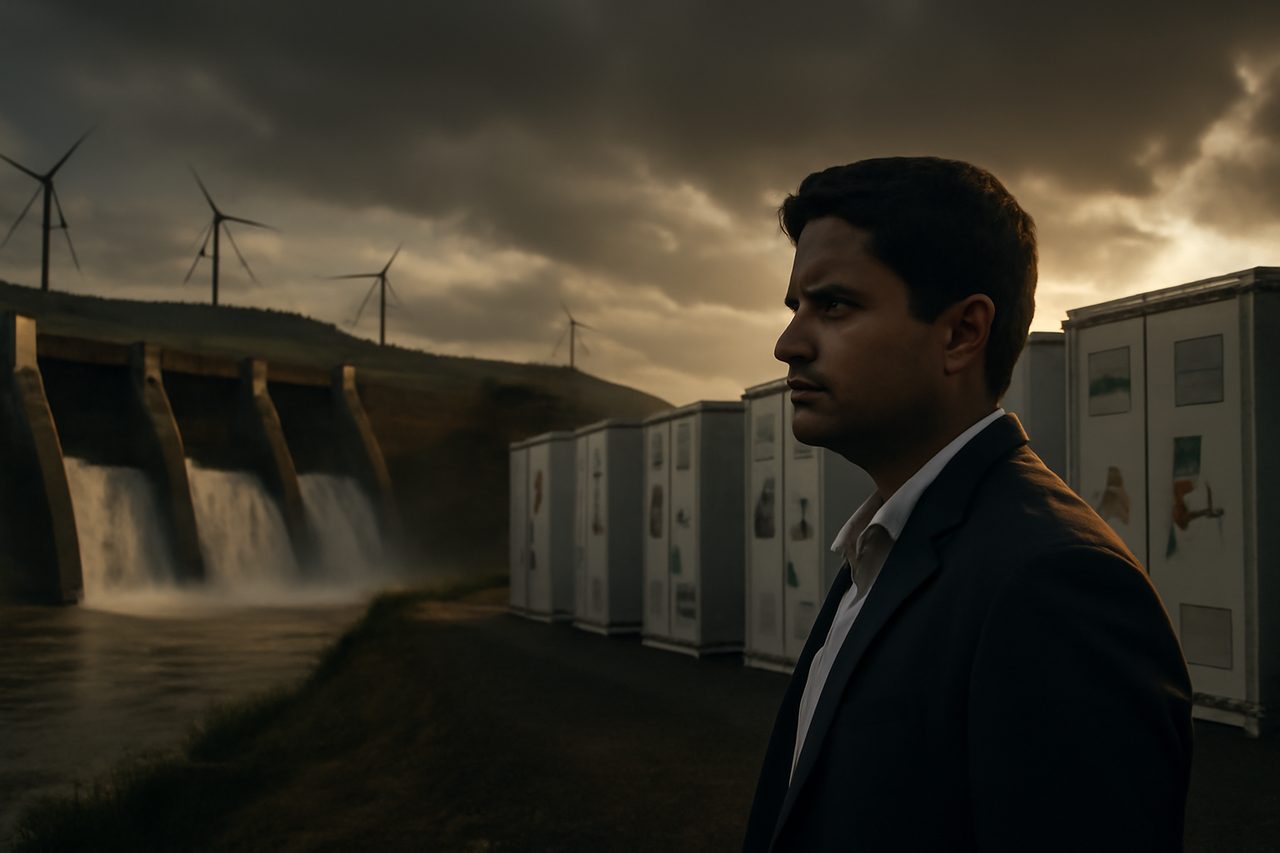
India’s storage market in 2026 is no longer a simple “battery versus no battery” discussion. For developers, C&I consumers, discoms, lenders and policymakers, the real question is increasingly this: where does battery energy storage systems (BESS) make more sense, and where is pumped hydro storage (PHS) the better fit?
That distinction matters because storage is now being procured for very different jobs. Some projects need fast-response frequency control and evening peak shifting. Others need 6–10 hour firming for RTC and FDRE supply. Some require local grid support near congested substations. Others are effectively long-duration capacity assets with multi-decade operating lives. Treating all storage technologies as interchangeable leads to poor bid design, weak revenue assumptions and financing stress.
In India, 2026 has sharpened this debate. Solar tariffs remain competitive, hybrid tenders continue to evolve, ancillary service markets are becoming more relevant, and state utilities are under pressure to improve peak management without overcommitting to expensive short-duration solutions for long-duration problems. At the same time, multiple states are pushing pumped hydro parks and allotments, while BESS is gaining ground through central support mechanisms, viability gap funding structures and hybrid procurement.
This article sets out a practitioner view of pumped hydro versus BESS in India in 2026: how they differ technically, where the economics diverge, how lenders underwrite them, and which use cases are actually bankable.
Why pumped hydro and BESS should not be compared on capex alone
A common mistake in Indian project discussions is comparing storage technologies only on Rs crore per MW or Rs crore per MWh. That is an incomplete framework.
The better comparison is across five dimensions:
- discharge duration needed at commercial operation
- annual cycling profile
- response speed and ramping requirement
- locational grid value
- financing tenor and residual asset life
BESS is modular, fast to deploy and highly responsive. It is typically best suited where system value comes from sub-second response, intra-day cycling, renewable shifting over 2–4 hours, congestion support, and avoiding expensive local network upgrades. In India, many current tenders and private offtake structures fit this profile.
Pumped hydro, by contrast, is a civil-infrastructure asset. It generally has longer development timelines, higher upfront complexity, stronger land and water dependencies, and transmission planning implications. But once built, it can offer long discharge durations, lower degradation risk relative to batteries, and useful operating life extending several decades. That makes it relevant for deep evening peak support, multi-hour renewable firming and long-term capacity adequacy.
So the right question is not “which is cheaper?” It is “which storage configuration delivers the required service at the lowest risk-adjusted levelized cost over the real duty cycle?”
Technology fit by Indian use case in 2026
In the Indian market, the use case often determines the technology more than the headline tariff.
For BESS, the strongest use cases in 2026 are:
- 1–4 hour renewable shifting paired with solar or hybrid plants
- evening peak support for discom procurement
- C&I demand-charge optimisation and backup replacement in select segments
- ancillary services and fast ramping support
- grid constraint relief near urban or industrial load pockets
- substation deferral where a battery can postpone capex on wires and transformers
For pumped hydro, the stronger use cases are:
- 6–10 hour or longer shifting requirements
- state-level peak balancing with large daily energy volumes
- RTC and FDRE supply where long-duration firmness matters more than fast response
- seasonal or multi-day operating flexibility in systems with rising renewable penetration
- long-life capacity support for utilities that can manage development lead times
This is why pumped hydro is increasingly discussed by state governments and central agencies for large-scale grid balancing, while BESS is often preferred in competitively tendered modular deployments that need speed and predictable execution.
In practical advisory work, we often see BESS selected where the buyer values certainty of COD, locational flexibility and rapid response. Pumped hydro becomes relevant where the buyer can absorb permitting complexity and is optimising for duration and asset life over a 30–50 year horizon.
2026 economics: what matters more than headline tariff
By 2026, Indian stakeholders have become more disciplined about storage economics. A single tariff quote tells very little unless one knows the duration, cycles, augmentation assumptions, auxiliary consumption, round-trip efficiency, evacuation costs and degradation profile.
For BESS, project economics in India still depend heavily on:
- battery chemistry and cell sourcing
- DC-to-AC sizing ratio
- augmentation schedule over contract life
- usable depth of discharge
- annual cycle count
- HVAC and auxiliary load in Indian temperature conditions
- round-trip efficiency, often in the 84% to 90% effective operating range depending on system boundary
- warranty structure and performance guarantees
- land and evacuation configuration
For utility-scale BESS in 2026, developers and lenders are generally evaluating 2-hour and 4-hour configurations separately because their economics and revenue opportunities differ materially. A 2-hour battery may work for ancillary support, ramp smoothing and limited evening shifting. A 4-hour battery is more aligned with discom peak support and renewable energy time-shift applications, but it demands stronger revenue certainty because capex per delivered MW of firm evening output rises substantially.
Pumped hydro economics, meanwhile, hinge on different drivers:
- civil construction risk
- geology and reservoir design
- water availability and usage permissions
- longer pre-construction timeline
- transmission access and distance to pooling point
- electromechanical equipment package
- round-trip efficiency, often around 70% to 80% depending on design and operating regime
- plant load factor assumptions under actual dispatch schedules
- debt tenor and construction-period interest accumulation
In many Indian cases, pumped hydro may look expensive or slow initially, but its long life can improve lifecycle economics for long-duration applications. BESS may show superior near-term project IRR because it is faster to build and easier to integrate, but repeated augmentation and residual value assumptions require careful scrutiny.
This distinction is particularly important for lenders. For batteries, underwriting is tied to contract design, OEM quality, replacement reserves and operating strategy. For pumped hydro, underwriting is tied to construction execution, approvals, geological diligence and long-term dispatch confidence.
Dispatch characteristics: the operational difference buyers often underestimate
Storage procurement in India still tends to focus heavily on tariff discovery and insufficiently on dispatch realism. That creates mismatch risk.
BESS can move from idle to full output in seconds. It is ideal for:
- frequency response
- fast reserve
- renewable intermittency smoothing
- avoiding short-term overdrawal or imbalance exposure
- evening peaks that are sharp but not extremely long
Pumped hydro is less about ultra-fast market response and more about sustained energy delivery. It suits:
- long evening ramps extending beyond 4 hours
- large-volume energy shifting from solar-heavy daytime periods
- bulk balancing across utility portfolios
- repeated daily dispatch with lower concern about electrochemical degradation
For example, consider a discom facing a 7 pm to 11 pm peak and increasing midday solar surplus. A 2-hour BESS can help but may not fully cover the peak unless combined with demand response, peaking thermal flexibility or additional procurement. A 4-hour BESS may cover much of the requirement, but at significant capital cost. A pumped hydro plant with 6–8 hour discharge can be operationally stronger for this shape of demand, provided the utility can contract and evacuate the power efficiently.
Similarly, for an RTC or FDRE developer, a battery may be highly effective for correcting intra-day profile mismatch and avoiding short-duration deficits. But if the contract demands deeper firmness into late evening and overnight periods, pumped hydro or a portfolio approach may be more robust than simply upsizing batteries.
That is why bankable modelling in 2026 increasingly requires chronological dispatch simulations rather than simplistic average-day assumptions. Storage technology choice changes materially once one runs hourly and sub-hourly profiles across a full year with realistic charging windows, transmission constraints, efficiency losses and outage assumptions.
Bankability and risk allocation: what lenders and investors are looking for
In India, storage bankability in 2026 is less about technological novelty and more about risk allocation.
For BESS, lenders want clarity on:
- degradation curve over contract period
- augmentation capex timing and funding source
- OEM bankability and long-term service support
- warranty-backed availability and performance metrics
- fire safety design and compliance framework
- interconnection and charge treatment under the applicable regulatory setup
- revenue stack simplicity versus merchant exposure
A battery project with a single contracted use case, transparent dispatch logic and conservative augmentation assumptions is typically easier to finance than a project depending on multiple uncertain merchant revenue streams.
For pumped hydro, lenders focus on:
- concession structure and land rights
- environmental and forest approvals where applicable
- detailed geological and hydrological studies
- EPC packaging and interface risk
- construction schedule realism
- cost overrun protection
- offtake structure after COD
- long-term operating regime and payment security
Because pumped hydro projects involve more civil complexity, they often need stronger sponsor capability, more detailed diligence and more patience during development. But once key risks are resolved, their long-life profile can appeal to infrastructure-oriented capital.
From a policy standpoint, this means India should avoid designing one generic storage tender format for all technologies. A BESS tender optimised around 2-hour modular deployment, fast COD and availability guarantees may not be suitable for pumped hydro. Likewise, long-duration system needs should not be forced into short-duration battery structures just because they are easier to tender quickly.
Policy and procurement implications for India
India’s storage planning challenge in 2026 is not just about adding megawatts. It is about matching technology to system need.
For policymakers and procurers, three principles matter.
First, duration should be procured explicitly. If the system requires 6–8 hour discharge, then the tender should state that clearly rather than assuming all storage will perform equally under a generic capacity framework.
Second, location matters. A battery sited near a constrained urban substation may have much higher grid value than a remote storage asset with lower apparent capex. Conversely, a pumped hydro asset with strong transmission connectivity may provide state-wide balancing value that a fragmented battery fleet cannot replicate as efficiently.
Third, payment design must reflect service delivered. Fast-response grid support, pure capacity availability, renewable shifting and firm energy delivery are different products. Mixing them in one underdefined procurement format usually leads either to inflated tariffs or underperformance later.
For state utilities, a practical 2026 approach is to segment procurement:
- BESS for near-term congestion relief, ancillary support and 2–4 hour peak shifting
- pumped hydro for long-duration balancing and capacity support where site conditions and transmission allow
- hybrid portfolios for RTC and FDRE procurement where the developer can optimise across wind, solar and storage combinations
For C&I consumers, pumped hydro is usually not a direct behind-the-meter option in the way BESS can be. But large open-access buyers should still care, because utility-scale storage choice affects long-term evening supply costs, balancing charges and the shape of firm renewable products available in the market.
How to decide: a practical screening framework for developers and offtakers
Before selecting BESS or pumped hydro for an Indian project, stakeholders should run a structured screening exercise.
Start with these questions:
- What exact service is being bought: capacity, firm energy, ramping, ancillary support, congestion relief, or a combination?
- What is the required discharge duration in the worst week, not just the average day?
- How many cycles per year are expected?
- How much value comes from response speed versus discharge length?
- Is COD urgency critical?
- What are the site constraints on land, water, permits and transmission?
- Can the offtaker support a long development cycle?
- Is the revenue stream contracted or partly merchant?
- What does the lender require in terms of technology diligence and sponsor support?
In many cases, the answer will not be “BESS only” or “pumped hydro only.” The optimal portfolio may be layered. A battery can handle fast-response and high-value short-duration tasks, while pumped hydro covers bulk long-duration shifting. For large utilities and integrated developers, that blended strategy will likely become more common as renewable penetration deepens.
The key point is this: India’s 2026 storage market is mature enough that technology choice must be use-case specific, model-based and finance-aware. BESS is not a universal solution for every storage problem. Pumped hydro is not automatically superior because of duration and asset life. Each wins in different contexts, and the wrong comparison framework can destroy project economics.
Growthifye supports developers, C&I consumers, utilities, lenders and policymakers with storage technology selection, pumped hydro and BESS feasibility, dispatch modelling, grid integration, PMC support and bankability assessment. If you are evaluating a storage-linked project or procurement strategy, contact Growthifye’s advisory desk for a project-specific assessment.
About the author

Founder & CEO, Growthifye — engineering and financing India's clean-energy transition.
Want this analysis applied to your project?
Talk to our team